
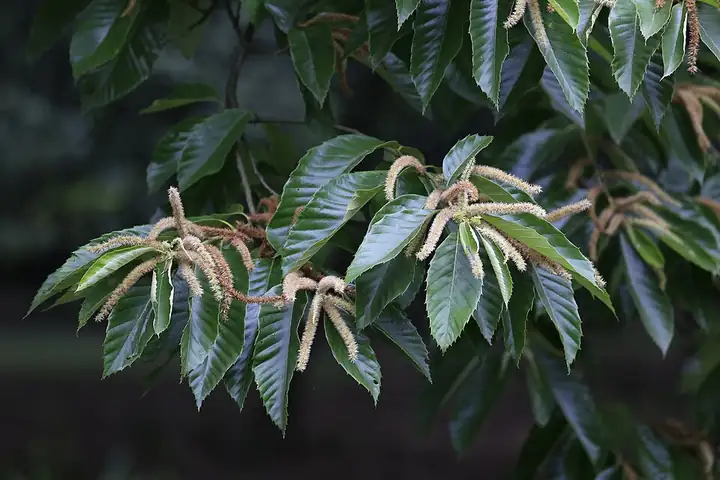
Chestnut
Castanea mollissima (Chinese chestnut) and hybrids · Beech family (Fagaceae)
| Hardiness zones | 4 to 8 |
|---|---|
| Sun | full sun |
| Water | moderate |
| Life cycle | perennial |
| Frost | Hardy: takes frost |
| Soil pH | 5.5–6.5 |
| Spacing | 480 to 600 inches |
About Chestnut
Chinese chestnut is a spreading nut tree about 40 to 60 feet tall that bears sweet, starchy nuts in spiny burs. It tolerates chestnut blight, the fungus disease to which the native American chestnut and chinkapins are very susceptible, so Chinese chestnuts and blight-resistant hybrids are the ones to plant for nuts.
NC State lists zones 4-8; dormant trees handle about -20 F (University of Missouri). Avoid frost pockets, where late freezes hurt swelling buds.
When to plant
Timing is counted from your average last spring frost (and first fall frost). Sow & Tell works out the actual dates for your ZIP code.
Spring planting is best: bare-root trees in March, container trees in late March or early October in Missouri (University of Missouri). In a backyard, plant at least three trees (different named varieties if grafted) 40 to 50 feet apart, in full sun. Grafted trees start bearing 2 to 3 years after planting.
Soil
Well-drained loam to sandy loam; heavy or soggy soil leads to Phytophthora root rot (University of Missouri). Chestnuts tolerate acid soil but not strongly alkaline soil (UC).
Work in any lime, phosphorus or potassium a soil test calls for across the planting area (not into the hole); aim for pH 5.5 to 6.5.
Feeding
- First year, early June, if new shoots have grown a few inches: nitrogen fertilizer such as 34-0-0. Spread about half a cup over the weed-free area around the tree.
- Each spring from the second year, before bud swell (about April 1 in Missouri): nitrogen fertilizer such as 34-0-0. Give about 0.1 lb of actual nitrogen per year of tree age in all, two-thirds now and spread within the drip line (a 3-year-old tree needs about 0.9 lb of 34-0-0 in all).
- End of flowering (about June 20 in Missouri): nitrogen fertilizer such as 34-0-0. Apply the remaining third of the year's nitrogen within the drip line.
Don't plant in heavy or poorly drained soil, which brings Phytophthora root rot; paint or wrap young trunks against sunscald.
Harvest
Burs split and drop nuts from September through October, over 2 to 4 weeks; pick nuts up at least every other day. Wear heavy leather gloves and roll burs under your shoe to pop out nuts (University of Missouri).
One crop each fall: burs drop nuts over 2 to 4 weeks in September and October, so pick up at least every other day.
Varieties (19)
| Variety | Type | Days | Notes |
|---|---|---|---|
| Abundance | Chinese | Chinese chestnut cultivar listed by NC State. | |
| AU Homestead | Chinese | About 27-35 nuts per pound; steady, moderate crops. Bred at Auburn University. | |
| Crane | Chinese | Excellent flavor. About 32 nuts per pound; stores well. | |
| Gideon | Chinese | About 28-38 nuts per pound; spreading tree, more cold hardy, with steady high yields; nuts peel easily. | |
| Kuling | Chinese | Chinese chestnut cultivar listed by NC State. | |
| Meiling | Chinese | Chinese chestnut cultivar listed by NC State. | |
| Nanking | Chinese | Chinese chestnut brought in by USDA; listed by NC State. | |
| Qing | Chinese | About 21-35 nuts per pound; compact, spreading crown and heavy crops (may overbear). | |
| Layeroka | Chinese x European hybrid | Productive, blight-resistant timber type. | |
| Skioka | Chinese x European hybrid | About 35-40 nuts per pound. | |
| Willamette | Chinese x European hybrid | Sweet and easy to peel. About 18-22 nuts per pound. | |
| Okei | European | Very large nuts (about 16 per pound) and lots of pollen, but light crops; shells tend to split. | |
| Silverleaf | European | Large, very sweet nuts that peel easily. Shells tend to crack. | |
| Colossal | European x Japanese hybrid | The main California variety: very large, uniform nuts (about 18 per pound) with a thick inner skin. | |
| Eurobella | European x Japanese hybrid | Smaller nuts. | |
| Nevada | European x Japanese hybrid | Productive, with smaller nuts. | |
| Bouche de Betizac | European x Japanese hybrid (France) | French release. | |
| Precoce Migoule | European x Japanese hybrid (France) | French release. | |
| Sleeping Giant | Hybrid (Chinese x Japanese-American) | About 28-35 nuts per pound; upright tree. |
Pests to watch for
Chestnut weevils, Potato leafhopper, Deer, Rabbits, Voles
Diseases and problems
Chestnut blight, Root and crown rot, Armillaria root rot, Sunscald
In the kitchen
Eaten raw, boiled or roasted, and used in stuffing, baked goods, soups, stir-fries and ice cream; dried nuts grind into a flour (UC).
Keeping it: Fresh chestnuts are almost half water and mold quickly, so chill them right away: keep them at 32 F or a little above in sealed 1- to 2-gallon plastic bags in the refrigerator, where they keep up to about 3 months (University of Missouri; UC).
Safety: Chestnuts are tree nuts, though the FDA's 2025 allergen guidance doesn't count chestnut among the major tree-nut allergens; people with a tree-nut allergy should still check with their doctor. The flowers have a smell some people find unpleasant, and falling burs are spiny and messy (NC State).
Pets: The ASPCA lists American chestnut (Castanea dentata) as non-toxic to dogs, cats and horses; no separate entry for Chinese chestnut was found. Don't confuse it with horse chestnut or buckeye (Aesculus), which the ASPCA lists as toxic.
Sources
- plants.ces.ncsu.edu
- centerforagroforestry.org
- ccfruitandnuts.ucanr.edu
- portal.ct.gov
- fda.gov
- aspca.org
- aspca.org
Photo: Photo: Zhangzhugang / Wikimedia Commons, CC BY-SA 4.0 (CC BY-SA 4.0). Photo resized for the web.

Planting dates and advice are general guidance; check with your local Cooperative Extension office for your area.