
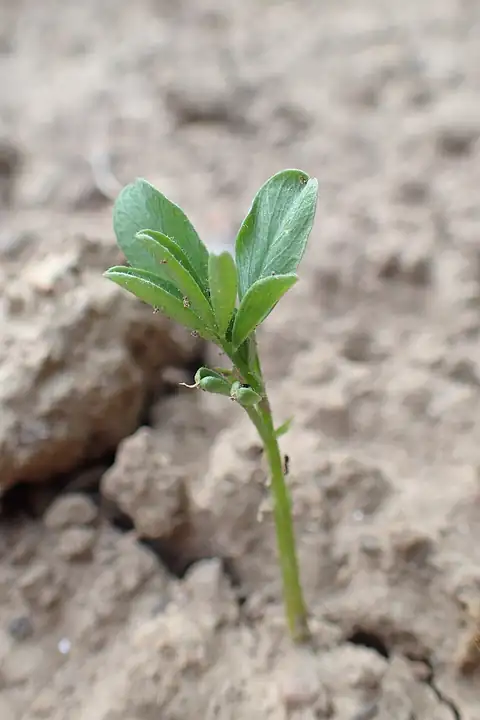
Chickpea
Cicer arietinum · Pea family (Fabaceae)
| Hardiness zones | 3 to 11 |
|---|---|
| Sun | full sun |
| Water | low |
| Life cycle | annual |
| Frost | Half-hardy: takes a light frost |
| Spacing | 5 to 7 inches |
| Days to harvest | 100 to 130 days |
| Soil temperature to plant | at least 50°F |
About Chickpea
Chickpeas (garbanzo beans) are a cool-season legume grown for their round seeds, eaten dried in hummus, stews and salads. Kabuli types have large cream seeds and white flowers; desi types are smaller, darker and often ground into flour. The bushy plants, 1 to 2 feet tall, have a deep taproot that makes them drought tolerant, and most U.S. chickpeas come from California and the Pacific Northwest.
Grown as a spring-sown annual: it is frost tolerant and likes days of 70-80F, but yields poorly where rain is heavy (over about 30 inches a year) or in wet, humid summers.
When to plant
Timing is counted from your average last spring frost (and first fall frost). Sow & Tell works out the actual dates for your ZIP code.
- Sow seeds outdoors: from 2 weeks before to 2 weeks after the last frost
Days count from seeding to dry seed; desi types ripen about two weeks before kabuli types. Sow in early spring (March to early April in eastern Oregon, May in Idaho) once soil is above 50F for kabuli or 45F for desi, 1 1/2 to 2 1/2 inches deep, about 3 to 5 seeds per square foot. Use a chickpea-specific inoculant: the one for peas and lentils won't work.
Soil
Well-drained sandy or silt loam; it doesn't tolerate wet or salty soil, and Oregon State advises avoiding soil below pH 6.5 because of disease.
Add phosphorus, potassium and sulfur only as a soil test calls for, and keep fertilizer out of contact with the seed.
Feeding
Extra nitrogen seldom helps and can block nodules; avoid soggy, low spots and don't plant chickpeas in the same place more than once every 3 to 5 years.
Harvest
Harvest for dry seed when most plants and pods have turned straw yellow and the pods are nearly dry. Pods shatter easily, so pull or cut plants when slightly damp with dew, finish drying them, then thresh and store the seed dry.
Pull or cut the plants once, when most pods have turned straw yellow and the seed is nearly dry; pods shatter, so don't wait too long.
Varieties (17)
| Variety | Type | Days | Notes |
|---|---|---|---|
| Myles | Desi | 83 to 115 days | Small tan to spotted seed; fern-type leaves; resists Ascochyta blight; the highest two-year average yield in the Oregon trials. |
| Sarah | Desi | 115 days | Small tan to spotted seed; moderately resistant to Ascochyta blight. |
| Alma | Kabuli | Tested in a 2019 Nevada trial. | |
| CDC Frontier | Kabuli | Tested in a 2019 Nevada trial. | |
| CDC Leader | Kabuli | Tested in a 2019 Nevada trial. | |
| CDC Orion | Kabuli | Tested in a 2019 Nevada trial. | |
| CDC Palmer | Kabuli | Highest seed yield in a 2019 Nevada trial. | |
| Dwelley | Kabuli | 96 to 122 days | Large cream seed; resists Ascochyta blight; simple (unifoliate) leaves. |
| Evans | Kabuli | 96 to 121 days | Large cream seed; resists Ascochyta blight; simple leaves. |
| Nash | Kabuli | Largest seed in a 2019 Nevada trial. | |
| Sanford | Kabuli | 96 to 121 days | Large cream seed; resists Ascochyta blight; simple leaves. |
| Sawyer | Kabuli | Tested in a 2019 Nevada trial. | |
| Sierra | Kabuli | 96 to 106 days | Large cream seed; resists Ascochyta blight; simple leaves. |
| Sinaloa | Kabuli | 90 to 100 days | Large cream seed; fern-type leaves; susceptible to Ascochyta blight. |
| Spanish White | Kabuli | 125 days | Large cream seed; fern-type leaves; susceptible to Ascochyta blight. |
| Surutato-77 | Kabuli | 120 days | Large cream seed; susceptible to Ascochyta blight. |
| UC-27 | Kabuli | 124 days | Large cream seed; fern-type leaves; susceptible to Ascochyta blight; the top yielder in Oregon State's Moscow, Idaho trials. |
Pests to watch for
Cutworms, Cabbage looper, Aphids
Diseases and problems
Ascochyta blight, White mold, Fusarium wilt, Bacterial blights of beans, Root and crown rot, Gray mold (Botrytis), Mosaic viruses, Lettuce mosaic
In the kitchen
Cook dried chickpeas for hummus, soups, minestrone, curries, Spanish stews and salads, or grind small desi types into flour.
Keeping it: Dry the threshed seed well and store it in airtight containers in a cool, dry place; Oregon State stores chickpeas at 10-12% moisture to keep out mold and insects.
Safety: The Extension sources we used list no toxic parts; cook dry chickpeas before eating, and add beans to your meals a little at a time to ease gas (UMaine).
Pets: Not listed by the ASPCA
Sources
Photo: Photo: Krzysztof Ziarnek, Kenraiz, CC BY-SA 4.0, via Wikimedia Commons (CC BY-SA 4.0). Photo resized for the web.

Planting dates and advice are general guidance; check with your local Cooperative Extension office for your area.