
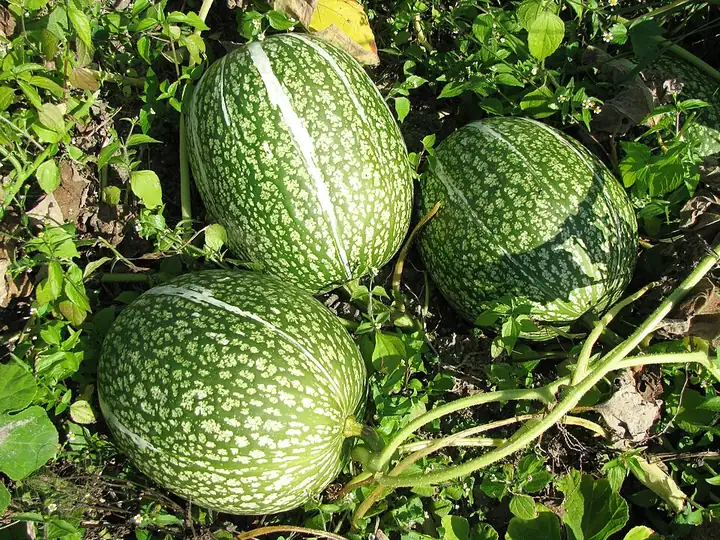
Chilacayote
Cucurbita ficifolia · Gourd family (Cucurbitaceae)
| Hardiness zones | 9 to 11 |
|---|---|
| Sun | full sun to part shade |
| Water | moderate |
| Life cycle | annual |
| Frost | Tender: killed by frost |
| Soil pH | 6.5–7.5 |
| Spacing | 12 to 36 inches |
| Soil temperature to plant | at least 59°F |
About Chilacayote
Chilacayote, also called fig-leaf gourd or shark fin melon, is a big, fast squash vine from the highlands of Mexico and the Andes with fig-shaped leaves. Its round fruits look like small watermelons, with white flesh and black seeds; young fruits are cooked like summer squash, and in Mexico the mature flesh and seeds are candied into dulce. It handles cool weather better than other squash, and whole mature fruits store for many months.
NC State lists zones 9-11 and says it isn't cold tolerant; elsewhere grow it as a warm-season annual. Most kinds need the short days of fall to flower and are late, so in short-season areas the fruit may not mature before frost (PROSEA).
When to plant
Timing is counted from your average last spring frost (and first fall frost). Sow & Tell works out the actual dates for your ZIP code.
Sow about 1 to 2 inches deep, three seeds to a hill, and thin to the strongest seedling; seed needs soil above about 59F to sprout (PROSEA). Vines can run 30 feet, so give them a fence or lots of ground; seeds take about 16 weeks from flowering to ripen.
Soil
Fertile, well-drained soil (PROSEA); NC State says it tolerates poor soil and likes steady moisture.
Work plenty of well-rotted manure or compost into fertile, well-drained soil at pH 6.5 to 7.5, plus a balanced fertilizer such as 10-10-10 if a soil test calls for it (PROSEA).
Feeding
Water at the soil with drip or furrows rather than sprinklers: wet leaves invite leaf diseases (PROSEA).
Harvest
Pick young fruits any time for cooking like summer squash. For keeping, let fruits mature on the vine until the rind is hard, and cut them before frost with a few inches of stem (PROSEA).
Mature fruits for storing are cut once, before frost in temperate areas. Young fruits can be picked earlier to cook like summer squash.
Pests to watch for
Whiteflies, Aphids
Diseases and problems
Powdery mildew, Mosaic viruses, Alternaria leaf spot, White mold, Bacterial leaf spot
In the kitchen
Young fruits are cooked like zucchini; mature flesh is candied (dulce) or made into drinks; the seeds are roasted as a snack; young leaves, vine tips and male flowers are cooked or added to soups (PROSEA; NC State; USDA plant inventory records).
Keeping it: Whole, mature fruits with hard rinds keep for months: up to about 6 months at 50-59F (PROSEA), and NC State says they can last 2 years or more, getting sweeter.
Safety: NC State lists the fruit, leaves and stems as edible and notes no toxic parts. Mature fruits have a very hard rind.
Pets: Not listed by the ASPCA. NC State tags it as non-toxic to cats, dogs and horses.
Sources
Photo: Photo: Zenon Sych, CC BY-SA 4.0, via Wikimedia Commons (CC BY-SA 4.0). Photo resized for the web.

Planting dates and advice are general guidance; check with your local Cooperative Extension office for your area.