
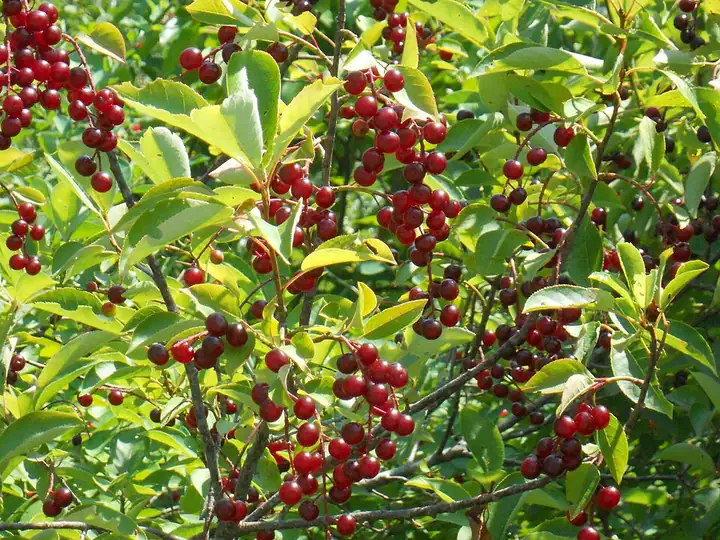
Chokecherry
Prunus virginiana · Rose family (Rosaceae)
| Hardiness zones | 2 to 6 |
|---|---|
| Sun | full sun |
| Water | moderate |
| Life cycle | perennial |
| Frost | Hardy: takes frost |
| Soil pH | 6.0–8.0 |
| Spacing | 60 to 96 inches |
About Chokecherry
Chokecherry is a native North American shrub or small tree with long, fragrant spikes of white flowers in spring and clusters of dark red to nearly black cherries in late summer. The fruit is too astringent for most people raw but makes a much-loved jelly, syrup and juice, and the plant spreads by root runners into thickets that feed birds and wildlife. Its leaves, twigs, bark and pits are poisonous to people and livestock. Alaska, where it is not native and spreads into stream corridors and forests, banned its import, transport and sale in 2025.
NC State lists zones 2-6, though Utah State notes the wild species grows in zones 2 to 10 and in all but six states. In Alaska it is under a state quarantine: don't buy, sell or plant it there.
When to plant
Timing is counted from your average last spring frost (and first fall frost). Sow & Tell works out the actual dates for your ZIP code.
Plant in spring or fall, 5 to 8 feet apart, and water well and mulch after planting (Utah State). Keep weeds and grass away from young plants (USDA NRCS). Expect suckers from the roots, so plant where a thicket is welcome; heavy crops usually start in the third or fourth year (Utah State).
Soil
Grows in many soils but fruits best in moist, well-drained soil rich in organic matter; it does not like soggy or salty soil (Utah State; Montana State; USDA FEIS).
Test the soil first; chokecherry does best in well-drained soil rich in organic matter with a pH of about 6 to 8 (Utah State; Montana State).
Feeding
- Each spring: Balanced fertilizer such as 16-16-16. Utah State suggests about 4 oz per plant, adjusted to growth, crop and leaf color and to your soil test; water it in.
Too much nitrogen invites bacterial spot, and too much water can cause root rot (Utah State; Montana State).
Harvest
Fruit ripens about 10 weeks after bloom, usually July to September, when it turns dark purple, black or deep red (Utah State). Later-picked fruit is sweeter (University of Alaska Fairbanks); pick whole clusters and strip the berries off (Montana State).
One crop each late summer, starting in the third or fourth year. Fruit forms on young wood, so remove some older stems each late winter to keep crops coming.
Varieties (5)
USDA NRCS and NC State name only 5 chokecherry cultivars. 'Canada Red' and 'Schubert' are the ones most often sold; three Canadian releases are named without details.
| Variety | Type | Days | Notes |
|---|---|---|---|
| Garrington | Canadian release | Canadian chokecherry release listed by USDA NRCS. | |
| Goertz | Canadian release | Canadian chokecherry release listed by USDA NRCS. | |
| Robert | Canadian release | Canadian chokecherry release listed by USDA NRCS. | |
| Canada Red | Commonly sold. Fruit turns from red to black when ripe. | ||
| Schubert | One of the oldest chokecherry cultivars, selected from the black-fruited western form found near Valley City, North Dakota. |
Pests to watch for
Eastern tent caterpillar, Aphids, Deer, Birds
Diseases and problems
Black knot, X-disease, Bacterial spot, Valsa canker, Shot hole
In the kitchen
Mostly cooked into jelly, syrup, juice, preserves and wine, since the raw fruit is astringent (USDA NRCS; USDA FEIS; Utah State). Only the ripe fruit's juice or pulp is used; the pits are strained out.
Keeping it: Pull off stems and leaves, rinse, and keep berries covered in the fridge for up to a week; spread dry berries on a tray to freeze, then bag them for up to two years (University of Alaska Fairbanks).
Safety: The leaves, twigs, stems, bark and pits are poisonous: they contain prunasin, which releases cyanide when chewed or digested (USDA NRCS; USDA FEIS; Utah State). Deaths have been reported, mostly in children who chewed leaves and stems or swallowed pits; the fruit flesh itself is not toxic, so never crush pits or blend whole berries (USDA NRCS; University of Alaska Fairbanks). Livestock, especially cattle and sheep, can be poisoned by eating the leaves, and wilted or frost-damaged leaves are the most dangerous (USDA NRCS; USDA FEIS; Utah State).
Pets: Toxic to dogs, cats and horses (ASPCA): stems, leaves and seeds contain cyanide, worst when leaves are wilting; signs include brick-red gums, dilated pupils, trouble breathing, panting and shock.
Sources
- plants.sc.egov.usda.gov
- plants.ces.ncsu.edu
- fs.usda.gov
- extension.usu.edu
- extension-store.montana.edu
- extension.usu.edu
- uaf.edu
- uaf.edu
- dnr.alaska.gov
- aspca.org
Photo: Photo: Botteville / Wikimedia Commons, Public domain. Photo resized for the web.

Planting dates and advice are general guidance; check with your local Cooperative Extension office for your area.