
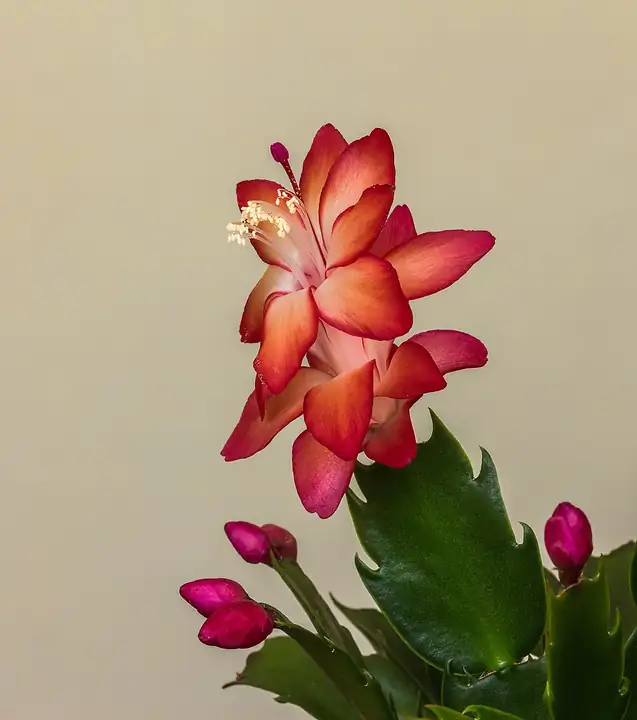
Christmas cactus
Schlumbergera x buckleyi (Christmas cactus) and S. truncata (Thanksgiving cactus), sold together as holiday cactus · Cactus family (Cactaceae)
| Hardiness zones | 9 to 11 |
|---|---|
| Sun | part shade |
| Water | moderate |
| Life cycle | perennial |
| Frost | Tender: killed by frost |
About Christmas cactus
Holiday cacti are spineless, jungle cacti from the mountain forests of southeast Brazil, where they perch on branches and cliffs in the shade (NC State, Wisconsin Horticulture). Their flat, jointed stems arch over the pot and tip with satiny flowers in red, pink, white, purple or orange when the nights get long and cool in fall, so a well-kept plant blooms every winter for decades; NC State notes one can live more than a hundred years. The Thanksgiving type has claw-tipped segments and blooms in late November, the true Christmas type has rounded segments and blooms in late December.
Hardy outdoors only in zones 9-11 (NC State); it is grown indoors everywhere and can summer outdoors in filtered shade once nights stay above about 55 F, coming in when fall nights cool toward that (UMN, Wisconsin Horticulture).
When to plant
Timing is counted from your average last spring frost (and first fall frost). Sow & Tell works out the actual dates for your ZIP code.
Usually bought in bud in fall or started from a cutting of 2-5 stem segments rooted in perlite or a well-drained mix (Penn State, Wisconsin Horticulture).
Growing it indoors
- Light: Bright but filtered light; prolonged direct sun turns the segments pale red and burns them, though a few hours of morning sun is fine (NC State, Wisconsin Horticulture).
- Water: Soak the pot from the top until water runs through, then let the mix go nearly dry before the next drink, every 1-2 weeks in a warm room (NC State, Penn State); empty the saucer. Water less after the flowers drop and in late summer, then resume normal watering when buds swell (UMN, Wisconsin Horticulture); soggy mix rots the roots and turns stems mushy.
- Humidity: It likes humid air more than desert cacti do; a pebble tray or an occasional misting helps in dry winter rooms (UMN, Penn State).
- Temperature: Wisconsin Horticulture gives 55-60 F as its minimum and 75-80 F days as ideal; cool 55-65 F nights set the buds, nights above 65 F keep it from blooming, and drafts or sudden swings make buds drop (UMN).
- Feeding: UMN feeds a balanced houseplant fertilizer at half strength monthly from June through August, then a low-nitrogen formula such as 0-15-10 during fall bud set; none in winter, and overfeeding while buds form can stop the bloom (Penn State).
- Repotting: Only every 3-4 years, in late winter or early spring after the flowers fade, into a pot just slightly larger; it blooms best somewhat pot-bound and should never be repotted in bloom (UMN, Penn State).
Soil
A well-drained, slightly acidic mix high in organic matter, such as 1 part potting soil, 2 parts peat and 1 part sharp sand or perlite (UMN, Wisconsin Horticulture).
Pot in a well-drained, slightly acidic mix such as 1 part potting soil, 2 parts peat moss and 1 part sharp sand or perlite (UMN).
Feeding
- June through August, during summer growth: balanced houseplant fertilizer at half strength. Once a month, on moist mix (UMN); MU Extension says monthly for any growing houseplant.
- Fall, while flower buds are forming: low-nitrogen fertilizer high in phosphorus and potassium, such as 0-15-10. One light feeding as buds set (UMN); Penn State warns that heavy feeding during bud development can prevent bloom.
- Winter, in and after bloom: none. Stop feeding and water less until new growth starts in spring (UMN, Penn State).
Overfertilizing while buds develop can stop flowering, and a pot that stays wet rots the roots (Penn State, UMN).
Harvest
Blooms in late November (Thanksgiving type) to late December (Christmas type) after about 6 weeks of long nights and 55-65 F nights starting in mid-September; each flush lasts 2-3 weeks at about 70 F, longer if cooler (NC State, UMN, Wisconsin Horticulture). Let spent flowers drop and water less until spring.
Varieties (2)
The Extension pages we opened name the two parent species and the hybrid but no individual cultivars, though Wisconsin Horticulture says well over a hundred exist.
| Variety | Type | Days | Notes |
|---|---|---|---|
| Thanksgiving cactus (Schlumbergera truncata) | Claw-edged, late November | Stem segments with pointed, claw-like teeth; the widest color range (red, pink, peach, purple, orange, white) and most of what stores sell as Christmas cactus. | |
| Christmas cactus (Schlumbergera x buckleyi) | Scalloped, late December | An old hybrid of S. truncata and S. russelliana with rounded, scalloped segments and drooping magenta or white flowers; the heirloom passed down in families. |
Pests to watch for
Mealybugs, Scale insects, Twospotted spider mite, Aphids, Fungus gnats
Diseases and problems
Root and crown rot, Stem rot
In the kitchen
Safety: Not listed as poisonous to people or pets (NC State, ASPCA), and the stems have no spines.
Pets: Non-toxic to dogs, cats and horses (ASPCA, listed as Schlumbergera bridgesii).
Sources
- plants.ces.ncsu.edu
- extension.umn.edu
- extension.psu.edu
- hort.extension.wisc.edu
- extension.missouri.edu
- aspca.org
Photo: Photo: Agnes Monkelbaan, CC BY-SA 4.0, via Wikimedia Commons (CC BY-SA 4.0). Photo resized for the web.

Planting dates and advice are general guidance; check with your local Cooperative Extension office for your area.