
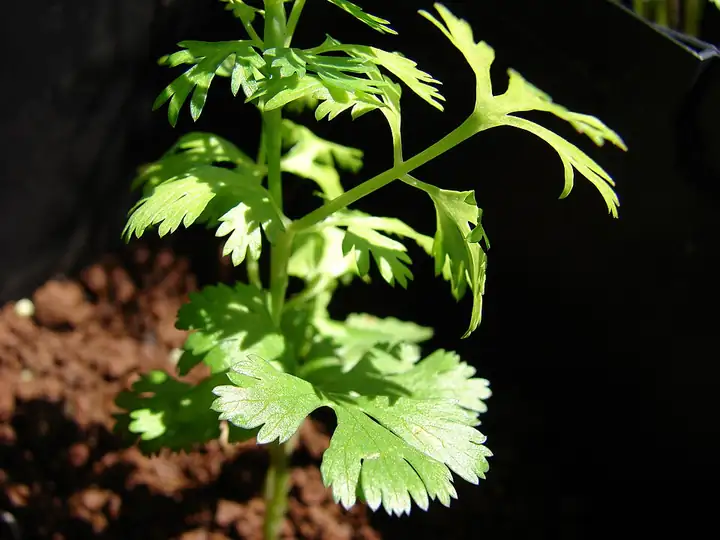
Cilantro (coriander)
Coriandrum sativum · Carrot family (Apiaceae)
| Hardiness zones | 2 to 11 |
|---|---|
| Sun | full sun to part shade |
| Water | moderate |
| Life cycle | annual |
| Frost | Half-hardy: takes a light frost |
| Soil pH | 6.0–7.5 |
| Spacing | 3 to 6 inches |
| Days to harvest | 45 to 80 days |
About Cilantro (coriander)
Cilantro is a cool-season annual grown for its bright, citrusy leaves; its dried seeds are the spice coriander. It bolts quickly once the weather turns hot, so it is best sown in spring and fall, a little at a time.
Grown as a cool-season annual in every zone; it tolerates cool weather but will not survive a hard freeze.
When to plant
Timing is counted from your average last spring frost (and first fall frost). Sow & Tell works out the actual dates for your ZIP code.
- Sow seeds outdoors: up to 2 weeks after the last frost
Days to harvest count from sowing, for leaves; a seed crop needs at least 100 days. Sow directly (the taproot makes it hard to transplant) in early spring, again every 2-3 weeks, and again in mid-August for fall; skip summer sowings, which bolt.
Soil
Well-drained, moderately fertile soil kept evenly moist; mulch helps keep the soil cool and delays bolting.
Work 2-4 inches of well-rotted compost into the top 4-6 inches of soil per 25 sq ft, leaving a loose seedbed; aim for a pH around 6.5.
Feeding
- early summer (feed 1-2 times during the season): nitrogen fertilizer such as 21-0-0. Scatter about 1/4 cup per 25 sq ft of bed and water it in.
Too much nitrogen makes cilantro less flavorful.
Harvest
Pick leaves once plants are about 6 inches tall and before they bolt, or cut the whole bunch an inch above the ground. For coriander seed, cut the plants when the seeds turn light brown, usually 2-3 weeks after flowering.
Pick leaves once plants are about 6 inches tall, or cut the whole bunch an inch above the ground and let it regrow for a second cutting before it bolts. Sow every 2 to 3 weeks for a longer leaf harvest; let late plants go to seed for coriander.
Varieties (10)
Extension sources name about 10 cilantro cultivars; most are slow-bolting leaf types, and none hold up well in hot, long summer days (Wisconsin Extension). Utah State says all varieties do fine when grown for coriander seed.
| Variety | Type | Days | Notes |
|---|---|---|---|
| Pot Cilantro 99057 | Container type | Illinois Extension says it was the first cilantro bred for pots; sow directly into containers. | |
| Confetti | Fine-leaf type | Best flavor and texture when plants are small. Ferny, finely divided leaves for baby leaf, microgreens and garnish; needs little chopping. | |
| Calypso | Slow-bolt leaf type | Full, bulky plant with large leaf rosettes; Penn State says it bolts about three weeks later than Santo. | |
| Cruiser | Slow-bolt leaf type | Upright plant that works well for bunching; slow to bolt. | |
| Leisure | Slow-bolt leaf type | 28 to 40 days | Uniform, high-yielding plants that tolerate heat and are slow to bolt. |
| Marino | Slow-bolt leaf type | Flavorful. Vigorous, quick-growing and high-yielding; slow to bolt, similar to Santo. | |
| Santo | Slow-bolt leaf type | Good, even flavor. Widely available slow-bolting type with dark leaves, grown for foliage. | |
| Slow Bolt | Slow-bolt leaf type | 45 to 50 days | Easy to grow and slower to flower than many varieties. |
| California Long Standing | |||
| Delfino |
Pests to watch for
Aphids, Cutworms, Carrot rust fly
Diseases and problems
Bacterial leaf spot, Aster yellows, Damping off, Bolting (going to seed)
In the kitchen
Leaves are used in salsa and in Mexican and Asian dishes; the dried seed (coriander) is a spice.
Keeping it: Stand stems in a glass of water, cover loosely with a bag, and refrigerate; it keeps up to about a week. Rinse just before use.
Pets: Not toxic to dogs, cats or horses (ASPCA)
Sources
- plants.ces.ncsu.edu
- hort.extension.wisc.edu
- extension.illinois.edu
- extension.psu.edu
- extension.usu.edu
- extension.umn.edu
- aspca.org
Photo: Photo: Forest & Kim Starr, CC BY 3.0 US, via Wikimedia Commons (CC BY 3.0 US). Photo resized for the web.

Planting dates and advice are general guidance; check with your local Cooperative Extension office for your area.