
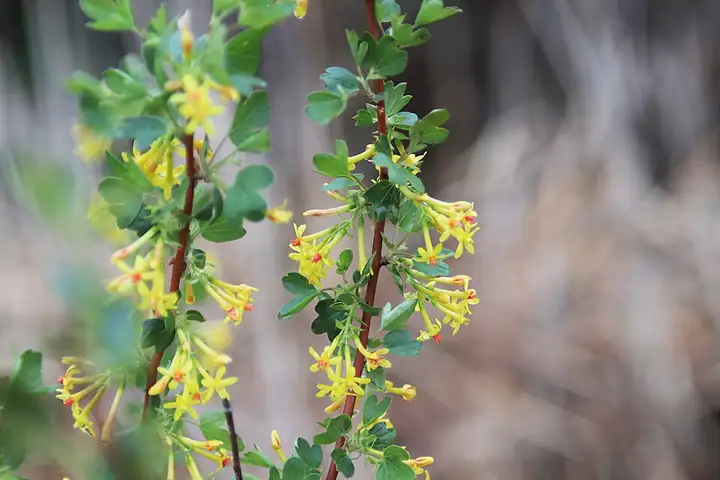
Clove currant (golden currant)
Ribes aureum, including var. villosum (syn. Ribes odoratum), the clove or buffalo currant · Currant family (Grossulariaceae)
| Hardiness zones | 3 to 8 |
|---|---|
| Sun | full sun to part shade |
| Water | moderate |
| Life cycle | perennial |
| Frost | Hardy: takes frost |
About Clove currant (golden currant)
Clove currant is a native North American shrub whose yellow, trumpet-shaped spring flowers smell like cloves. Its berries ripen from yellow to red and finally black or dark purple, and make good jam, jelly and pie. Like all currants it can host white pine blister rust, so check your state's rules before planting.
Hardy to zone 3: the University of Minnesota rates the clove currant 'Crandall' excellent to very good in zones 3-5. Most references put its southern limit at about zone 8. It is native to the western and central US (US Forest Service).
When to plant
Timing is counted from your average last spring frost (and first fall frost). Sow & Tell works out the actual dates for your ZIP code.
Before you buy, check with your state department of agriculture: North Carolina bans growing any currant or gooseberry (Ribes) because they host white pine blister rust (NC Department of Agriculture). Plants begin fruiting after about 3 years (NRCS). The shrub grows 3 to 10 feet tall and can spread by underground stems (Forest Service).
Soil
Grows in a wide range of soils, from fine to coarse loams (Forest Service; NRCS).
Have the soil tested and mix in compost as the test suggests (University of Minnesota, for currants).
Feeding
- Late fall each year: well-composted manure. Spread a few shovelfuls around each plant (University of Minnesota, for currants).
Harvest
Berries ripen in mid to late summer, going from green to yellow to red and finally black or dark purple (NRCS; Forest Service). Pick when fully colored.
Clove currant flowers in spring (about April-June) and fruits once a year, mainly June to August; plants usually start fruiting after about 3 years.
Varieties (1)
'Crandall' is the only named clove currant cultivar described by the sources we could open (Penn State, University of Minnesota, USDA NRCS). NRCS notes other selections exist but does not name them.
| Variety | Type | Days | Notes |
|---|---|---|---|
| Crandall | Clove (buffalo) currant | Milder and different in taste from black currants. Vigorous bush with clove-scented flowers in spring and bright fall color. Very resistant to white pine blister rust but can get powdery mildew. Canes may bend or break under a heavy crop. |
Pests to watch for
Spotted wing drosophila
Diseases and problems
White pine blister rust
In the kitchen
Made into jam, jelly, pie and even ice cream (NRCS).
Keeping it: Refrigerate fully colored berries and use them within a few days, or freeze them.
Safety: No toxic parts were noted in the sources we checked. Its main risk is to trees: currants are alternate hosts of white pine blister rust, which infects five-needled pines (Forest Service).
Pets: Not listed by the ASPCA
Sources
- plants.sc.egov.usda.gov
- fs.usda.gov
- ncagr.gov
- extension.oregonstate.edu
- extension.umn.edu
- plantsservices.sc.egov.usda.gov
- plantsservices.sc.egov.usda.gov
- aspca.org
Photo: Photo: 406Harps / Wikimedia Commons, CC BY-SA 4.0 (CC BY-SA 4.0). Photo resized for the web.

Planting dates and advice are general guidance; check with your local Cooperative Extension office for your area.