
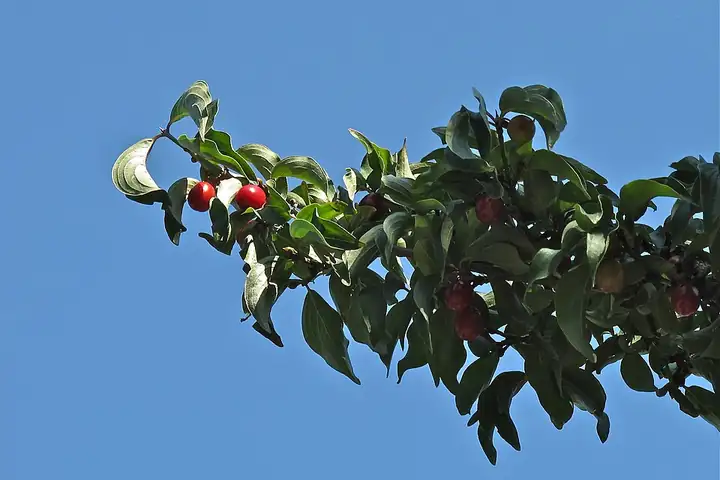
Cornelian cherry
Cornus mas · Dogwood family (Cornaceae)
| Hardiness zones | 4 to 8 |
|---|---|
| Sun | full sun to part shade |
| Water | moderate |
| Life cycle | perennial |
| Frost | Hardy: takes frost |
| Soil pH | 5.5–7.5 |
About Cornelian cherry
Cornelian cherry is a European and Asian dogwood, not a true cherry, grown as a large shrub or small tree. Tiny yellow flowers open in late winter before the leaves, followed by tart, olive-shaped red fruit in summer. It is long-lived and has few pest problems.
Zones 4-8 (University of Wisconsin; NC State). Plants survive -25 to -30 F, but fruit buds are hurt below about -20 F, and the very early bloom tolerates about 18 F (University of Wisconsin). Not native: USDA PLANTS lists it as introduced, with no noxious or invasive status.
When to plant
Timing is counted from your average last spring frost (and first fall frost). Sow & Tell works out the actual dates for your ZIP code.
Dormant bare-root plants suffer less transplant shock than leafed-out ones (University of Wisconsin). Unpruned plants grow 15-25 feet tall and 15-20 feet wide (NC State), and the first harvest comes about 4 years after planting (University of Wisconsin).
Soil
Adaptable to heavy clay, sandy or loamy soil as long as it drains well (University of Wisconsin); fairly drought-tolerant once established (University of Arkansas).
Choose a well-drained spot in half-day to full sun; clay, sandy or loamy soil at pH 5.5-7.5 all work.
Feeding
Don't expect fruit right away (the first harvest comes about 4 years after planting), and plant two cultivars, since it is only partly self-fertile.
Harvest
Fruit ripens in mid-summer (NC State) over a long stretch, so pick several times. Firm red fruit is tart; as it softens and darkens it turns sweeter and more aromatic, with a plum-like flavor (University of Wisconsin).
Cornelian cherry gives one crop a year, but the fruit ripens over a long stretch, so plan several pickings. Firm fruit is tart; it turns sweeter and plum-like as it softens.
Varieties (18)
| Variety | Type | Days | Notes |
|---|---|---|---|
| Redstone | Conservation and landscape release | Plenty of scarlet fruit. Dense small tree or rounded shrub up to about 25 ft, with glossy leaves. Chosen for vigor and long life; no disease or insect problems showed up in 44 years of testing. Rated hardy to zone 5a. | |
| Alba | Fruit-color form | White fruit. | |
| Flava | Fruit-color form | Yellow fruit. | |
| Fructu Violaceo | Fruit-color form | Purple fruit. | |
| Macrocarpa | Fruit-color form | Larger fruit than the species. | |
| Xanthocarpa | Fruit-color form | Yellow fruit. | |
| Bodacious | Fruiting cultivar | Sold as resistant to anthracnose, but University of Wisconsin trial plants showed anthracnose and had not fruited after several years. | |
| Elegant | Fruiting cultivar | Bright red, pear-shaped fruit about 1 1/2 inches long; somewhat tart and firmer than Pioneer. Established well in University of Wisconsin trials; had some leaf spot with little effect on the crop. | |
| Jolico | Fruiting cultivar | Sold as resistant to anthracnose, but University of Wisconsin trial plants showed anthracnose and had not fruited after several years. | |
| Pioneer | Fruiting cultivar | Dark red, pear-shaped fruit about 1 1/2 inches long; juicy, sweet and very soft when fully ripe. Established well from dormant bare-root plants and was bearing fruit in University of Wisconsin trials. | |
| Yellow | Fruiting cultivar | Yellow-fruited. The trial plant at the University of Wisconsin died of dogwood anthracnose within about a year. | |
| Aureo-Elegantissima | Ornamental cultivar | Leaves bordered in yellow, green and pink. Grown mainly for its foliage. | |
| Elegantissima | Ornamental cultivar | Red fruit. Leaves edged in yellow, green and pink; yellow flowers. Grown mainly for its foliage. | |
| Golden Glory | Ornamental cultivar | Dense, upright shrub or small tree with dark green leaves. Grown as an ornamental. | |
| Nana | Ornamental cultivar | Dwarf form, about 3 ft tall. | |
| Saffron Sentinel | Ornamental cultivar | Upright, narrow growth habit. Grown as an ornamental. | |
| Spring Glow | Ornamental cultivar | An ornamental form that NC State says is better suited to southern climates. | |
| Variegata | Ornamental cultivar | Variegated leaves. Grown mainly for its foliage. |
Pests to watch for
Scale insects, Plum curculio, Deer, Birds, Tree squirrels
Diseases and problems
Anthracnose (leaf spot), Powdery mildew, Gray mold, Crown canker, Septoria leaf spot
In the kitchen
Used for syrup, jelly, jam, pies, wine and baked goods, and prepared like olives where it is native (University of Wisconsin); the fruit makes a tart jelly (NC State).
Safety: NC State lists no toxicity for cornelian cherry. The large pit clings tightly to the flesh (University of Wisconsin), so pit fruit carefully.
Pets: Not listed as toxic by the ASPCA
Sources
- uncommonfruit.cias.wisc.edu
- plants.ces.ncsu.edu
- uaex.uada.edu
- ohiodnr.gov
- plantsservices.sc.egov.usda.gov
- eddmaps.org
- aspca.org
- aspca.org
Photo: Photo: Michael Wittwer / Wikimedia Commons, CC BY-SA 4.0 (CC BY-SA 4.0). Photo resized for the web.

Planting dates and advice are general guidance; check with your local Cooperative Extension office for your area.