
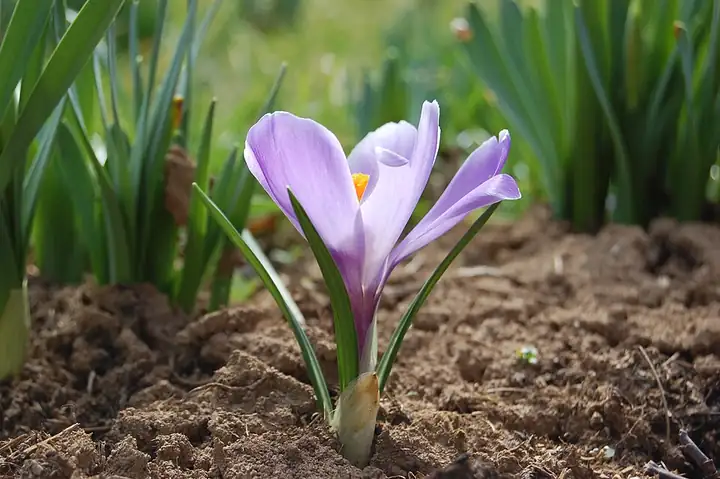
Crocus
Crocus species (C. vernus, C. chrysanthus, C. tommasinianus and others; saffron is C. sativus) · Iris family (Iridaceae)
| Hardiness zones | 3 to 8 |
|---|---|
| Sun | full sun to part shade |
| Water | low |
| Life cycle | perennial |
| Frost | Hardy: takes frost |
| Spacing | 2 to 4 inches |
About Crocus
Crocuses are small corms that open cup-shaped flowers in late winter or earliest spring, often right after the snow melts. They are among the first flowers of the year, and bees flock to them on cold days (UC Master Gardeners, Chicago Botanic Garden). Fall-blooming kinds include saffron crocus, whose red-orange threads are the spice.
NC State lists zones 3-8 (saffron crocus 5-8). In mild-winter California, chill corms about 10 weeks in the fridge and treat them as annuals (UC Master Gardeners); in South Carolina, snow crocus, Cloth of Gold and 'tommies' come back better than Dutch crocus (Clemson).
When to plant
Timing is counted from your average last spring frost (and first fall frost). Sow & Tell works out the actual dates for your ZIP code.
Plant spring crocus corms in fall about 3 inches deep (2 1/2-4 inches) and 2-4 inches apart (NC State, Clemson, Chicago Botanic Garden). Plant fall crocus and saffron crocus as soon as you buy them in late summer, saffron 4 inches deep and 4 inches apart (Clemson, NC State); lay chicken wire over new plantings to stop squirrels (UMN).
Soil
Well-drained, gritty sandy loam with some organic matter; avoid heavy clay (NC State).
Gritty, well-drained sandy loam with some organic matter; avoid heavy clay (NC State).
Feeding
- Early spring, as shoots come up (plantings you keep): balanced fertilizer such as 10-10-10. The general spring-bulb advice applies: Clemson gives 1-2 lb per 100 sq ft in fall and as shoots emerge. Follow a soil test.
Leave the leaves for about six weeks after bloom (NC State); if crocus grows in a lawn, hold off mowing that spot until then.
Harvest
Spring crocus blooms from February to March, and the flowers close at night and on cloudy days. Leave the leaves for about six weeks after bloom so the corms can recharge (NC State). Saffron crocus blooms for 1-2 weeks in fall: pick out the red-orange stigmas and use them fresh or dried (NC State).
Varieties (8)
Extension and botanical-garden sources we could open name 8 crocuses, several without descriptions; fall-blooming species other than saffron crocus are covered only in general terms (Clemson).
| Variety | Type | Days | Notes |
|---|---|---|---|
| Yellow Mammoth | Crocus flavus | ||
| Jeanne d'Arc | Dutch crocus (Crocus vernus) | ||
| Remembrance | Dutch crocus (Crocus vernus) | ||
| Blue Pearl | Snow crocus (Crocus chrysanthus) | ||
| Cloth of Gold | Species (Crocus angustifolius) | Golden crocus that comes back well in South Carolina. | |
| Snow crocus | Species (Crocus chrysanthus) | Early, small crocus that comes back well in South Carolina. | |
| Saffron crocus | Species (Crocus sativus) | Purple fall flowers with red-orange stigmas (the spice); 6-10 inches; sterile. | |
| Tommies | Species (Crocus tommasinianus) | Lavender to red-purple flowers with white throats, 4-6 inches tall; naturalizes in lawns and is reported to resist squirrels. |
Pests to watch for
Tree squirrels, Voles, Rabbits
Diseases and problems
Root and crown rot
In the kitchen
Saffron, the costly spice, is the dried red-orange stigmas of saffron crocus (Crocus sativus), a fall bloomer (NC State).
Safety: Don't confuse crocus with autumn crocus or meadow saffron (Colchicum), a fall bloomer that looks similar and is poisonous (Clemson, ASPCA). Use saffron only from plants you know for sure are Crocus sativus.
Pets: Spring crocus can cause stomach upset (vomiting, diarrhea, drooling) in dogs and cats if any part is eaten (ASPCA). The look-alike autumn crocus (Colchicum) is far more dangerous: severe vomiting, bloody diarrhea and liver, kidney and possibly bone marrow damage (ASPCA).
Sources
- plants.ces.ncsu.edu
- plants.ces.ncsu.edu
- plants.ces.ncsu.edu
- hgic.clemson.edu
- hgic.clemson.edu
- chicagobotanic.org
- ucanr.edu
- extension.umn.edu
- njaes.rutgers.edu
- extension.sdstate.edu
- aspca.org
Photo: Photo: Smihael, CC BY-SA 3.0, via Wikimedia Commons (CC BY-SA 3.0). Photo resized for the web.

Planting dates and advice are general guidance; check with your local Cooperative Extension office for your area.