
Cucamelon
Melothria scabra · Gourd family (Cucurbitaceae)
| Hardiness zones | 3 to 11 |
|---|---|
| Sun | full sun |
| Water | moderate |
| Life cycle | tender perennial (grown as an annual) |
| Frost | Tender: killed by frost |
| Soil pH | 6.0–6.8 |
| Spacing | 9 to 12 inches |
| Days to harvest | 70 to 90 days |
| Soil temperature to plant | at least 59°F |
About Cucamelon
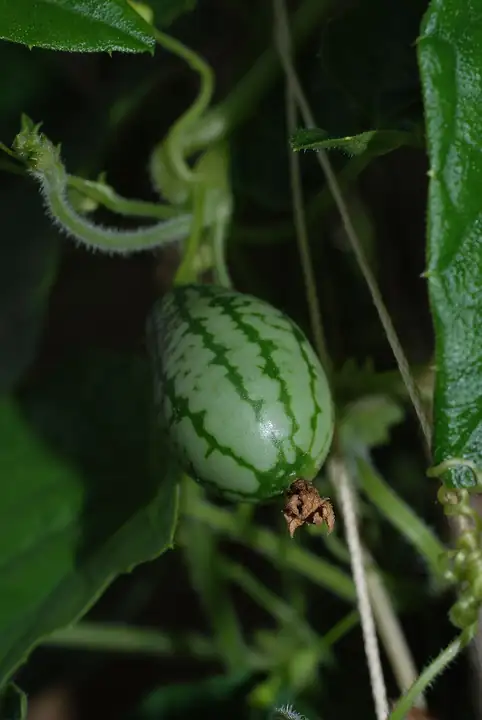
Cucamelon, also sold as Mexican sour gherkin or mouse melon, is a slender vine native from Mexico to Venezuela. Its grape-sized fruits look like tiny watermelons and taste like a crisp cucumber with a lemony, sour edge. The vines climb to about 10 feet and have few pest problems, so it's a fun crop for kids and containers.
Grown as a warm-season annual in every zone; frost kills the vines. Gardeners can dig the fleshy roots in fall and keep them dry indoors above about 50F to replant in spring (Wisconsin Extension; Penn State).
When to plant
Timing is counted from your average last spring frost (and first fall frost). Sow & Tell works out the actual dates for your ZIP code.
- Start seeds indoors: 4 to 6 weeks before the last frost
Start seeds indoors 4 to 6 weeks before the last frost, or sow outdoors after the last frost when you would plant cucumbers; most seeds sprout within 10 days (Wisconsin Extension; Penn State). Days count from sowing (about 70 to 90); put up a trellis at planting.
Soil
Humus-rich, well-drained soil; Ontario's crop guide gives a pH of 6.0 to 6.8 and says to wait until the soil is warm.
Work compost into well-drained soil and aim for pH 6.0 to 6.8; follow a soil test for pre-plant fertilizer, as Ontario's guide does for this crop.
Feeding
- Just before the vines start to run: nitrogen fertilizer such as 21-0-0 or 46-0-0. Side-dress the rest of the season's nitrogen beside the row and water it in; sandy soils may need a second side-dressing once vines run (OMAFRA).
Don't let fruit lie on the ground, where slugs damage it; grow the vines up a trellis (Wisconsin Extension).
Harvest
Pick fruits about the size of a large grape, under about an inch long, while firm; bigger fruits turn seedy (UGA; Wisconsin Extension). Vines bear from midsummer until frost.
Vines bear from midsummer until frost with many pickings; pick fruits at grape size so the plant keeps setting more and fruits don't turn seedy.
Pests to watch for
Aphids, Slugs
Diseases and problems
Powdery mildew
In the kitchen
Eat the fruits whole, skin and all, as a snack or in salads and salsas, toss them into stir-fries, or pickle the older, seedier ones (Wisconsin Extension; Penn State).
Keeping it: Treat them like cucumbers: cool them soon after picking and keep them cool and humid, about 45-55F (OMAFRA).
Safety: Extension sources note no toxic parts; the whole fruit is eaten.
Pets: Not listed by the ASPCA
Sources
- hort.extension.wisc.edu
- extension.psu.edu
- site.extension.uga.edu
- omafra.gov.on.ca
- greenhouse.eeob.iastate.edu
- aspca.org
Photo: Photo: Tigerente, CC BY-SA 3.0, via Wikimedia Commons (CC BY-SA 3.0). Photo resized for the web.

Planting dates and advice are general guidance; check with your local Cooperative Extension office for your area.