
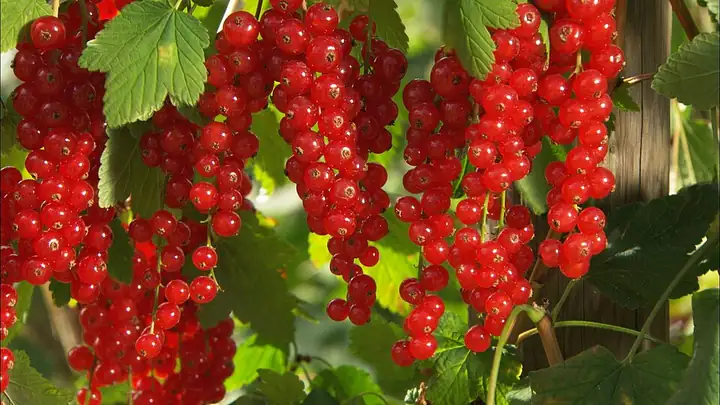
Currant
Ribes sativum (red, pink and white currants) and Ribes nigrum (black currant) · Currant family (Grossulariaceae)
| Hardiness zones | 3 to 7 |
|---|---|
| Sun | full sun to part shade |
| Water | moderate |
| Life cycle | perennial |
| Frost | Hardy: takes frost |
| Soil pH | 5.8–6.8 |
| Spacing | 36 to 60 inches |
About Currant
Currants are tidy, very cold-hardy shrubs that bear clusters of tart berries within a few years and tolerate some shade. Before planting, check your state's rules: currants can host white pine blister rust, and some states restrict them.
Most varieties are rated very good to excellent in zones 3-5 (University of Minnesota). Where summers often top 90 F, give them part shade (Washington State). Currants need a cold winter and struggle in the heat south of about zone 7.
When to plant
Timing is counted from your average last spring frost (and first fall frost). Sow & Tell works out the actual dates for your ZIP code.
- Set out plants: up to 4 weeks before the last frost
Plant once temperatures below 20 F are past and the soil can be worked (University of Minnesota). Expect fruit 1 to 3 years after planting (University of Minnesota), with full crops in the 3rd or 4th year (Washington State). Space black currants 4-5 feet apart.
Soil
Rich, well-drained soil high in organic matter with good air movement; they tolerate slightly alkaline soil.
Test the soil and aim for a pH of about 6 (lime if too acid); work compost, manure or leaves into rich, well-drained soil, ideally the fall before planting.
Feeding
- Late fall each year: well-composted manure. A few shovels full spread around each plant.
If you mulch with low-nitrogen material such as wood chips, the plants may need extra nitrogen.
Harvest
Pick when the color, flavor and firmness change and berries come away easily (University of Minnesota). Currants ripen over about 2 weeks and hold on the bush for another week; for jelly, pick a little early for more pectin (Washington State).
Currants give one crop a year in June-July; the berries don't drop right away, so one or two pickings usually do it. Fruit comes mostly on 2- and 3-year-old canes, so each winter remove the oldest canes and keep about eight canes of mixed ages.
Varieties (19)
| Variety | Type | Days | Notes |
|---|---|---|---|
| Ben Lomond | Black currant | ||
| Ben Sarek | Black currant | Large berries that are easy to pick. Highly resistant to white pine blister rust but prone to powdery mildew. Compact plant with heavy yields; tolerates frost at bloom. | |
| Consort | Black currant | Small to medium berries; medium crop. Resistant or immune to white pine blister rust, but prone to leaf spot and mildew. | |
| Coronet | Black currant | Marginal fruit quality. Rust-resistant, but yields are low. | |
| Crusader | Black currant | Large berries of fair quality. Immune to white pine blister rust; prone to powdery mildew. Only moderately productive. | |
| Titania | Black currant | Large, high-quality berries. Immune or highly resistant to white pine blister rust and resistant to mildew. Very vigorous, to about 6 ft; heavy crops within three years. | |
| Crandall | Clove (buffalo) currant | Black fruit with a milder, different flavor from other black currants. Very resistant, maybe immune, to white pine blister rust; prone to powdery mildew. Clove-scented yellow flowers in spring and bright fall color. A native species. | |
| Jostaberry | Jostaberry (currant x gooseberry hybrid) | Black berries larger than currants. Thornless, vigorous hybrid; resistant to white pine blister rust. | |
| Cascade | Red currant | Large, dark red fruit. Only medium vigor and yield. Prone to botrytis. | |
| Honeyqueen | Red currant | Tender, juicy berries with good flavor. Resists powdery mildew. Long harvest period. | |
| Jonkheer van Tets | Red currant | Dark red fruit with excellent flavor. Heavy yields. Resists mildew and aphids but prone to botrytis fruit rot. | |
| Red Lake | Red currant | Large, bright red berries of good quality. Vigorous, hardy and productive. Prone to powdery mildew. | |
| Rovada | Red currant | Large, aromatic red berries on long clusters that are easy to pick. Blooms late, so it often escapes frost. Resists powdery mildew and other leaf diseases. Very dependable. | |
| Viking | Red currant | Rust-resistant. | |
| Wilder | Red currant | Good-quality berries. High-yielding, with better leaf spot resistance than similar types. | |
| Blanka | White or pink currant | Large, pale yellow berries with a mild, sweet flavor. Heavy, dependable yields; vigorous and easy to grow. Resists powdery mildew. Late bloom; red-and-green leaves. | |
| Pink Champagne | White or pink currant | Pink berries with very good flavor for fresh eating. Resists powdery mildew, but yields are low. | |
| Primus | White or pink currant | Translucent white berries with sweet, intense flavor. Vigorous. Prone to powdery mildew. Yields a bit less than Blanka. | |
| White Imperial | White or pink currant | Sweet, juicy, rich, low-acid pinkish-white berries. Resists powdery mildew. Moderate yields; spreading habit. |
Pests to watch for
Imported currantworm, Aphids, Twospotted spider mite
Diseases and problems
Rust, Powdery mildew, Anthracnose
In the kitchen
Eaten fresh or made into jelly, jam, juice and wine; berries freeze well (Washington State).
Keeping it: Cool berries quickly after picking; in a covered container in the fridge they keep up to several weeks.
Safety: Currants and gooseberries are alternate hosts of white pine blister rust, a disease that can kill white pines, so some states restrict them: North Carolina bans all Ribes statewide (NC Department of Agriculture), Maine bans European black currant statewide and all Ribes in many counties (Maine Forest Service), and Ohio bans European black currant except approved rust-resistant varieties (Ohio State). Many states lifted their rules decades ago (Oregon State), so check with your state department of agriculture before you buy. Black currant is the most susceptible; rust-resistant varieties include 'Consort', 'Crusader', 'Titania' and 'Ben Sarek' (Ohio State; University of Minnesota).
Pets: Not listed as toxic by the ASPCA
Sources
- extension.umn.edu
- s3.wp.wsu.edu
- extension.oregonstate.edu
- content.ces.ncsu.edu
- ncagr.gov
- maine.gov
- ohioline.osu.edu
- aspca.org
- aspca.org
Photo: Photo: Burkhard Mücke, CC BY-SA 3.0, via Wikimedia Commons (CC BY-SA 3.0). Photo resized for the web.

Planting dates and advice are general guidance; check with your local Cooperative Extension office for your area.