
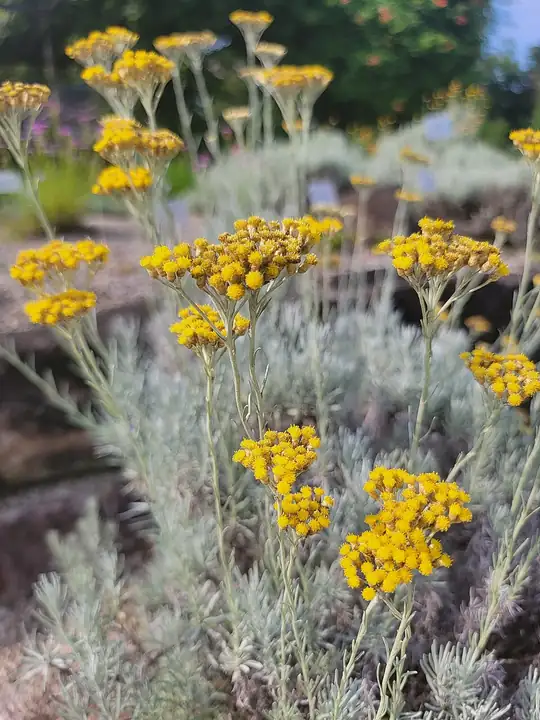
Curry plant
Helichrysum italicum · Aster family (Asteraceae)
| Hardiness zones | 7 to 10 |
|---|---|
| Sun | full sun |
| Water | low |
| Life cycle | perennial |
| Frost | Half-hardy: takes a light frost |
About Curry plant
Curry plant is a small, silver-leaved Mediterranean shrub, about 2 feet tall, whose leaves smell strongly of curry and whose small yellow flowers dry well (UIC Heritage Garden, NMSU). It is not the curry leaf tree (Murraya koenigii) used in Indian cooking, and it has nothing to do with curry powder (Indiana University). Most gardeners grow it for scent, silver foliage, dried flowers and potpourri.
Hardy in about zones 7-10 (UIC Heritage Garden); young plants are frost tender, so set them out in late spring. Not on any U.S. invasive list we found.
When to plant
Timing is counted from your average last spring frost (and first fall frost). Sow & Tell works out the actual dates for your ZIP code.
Start seed indoors in late winter (February or March), pot up seedlings after 2-3 weeks, and plant outdoors in late spring or early summer; it also roots from 2-inch cuttings of an established plant (UIC Heritage Garden).
Soil
Well-drained sandy or loamy soil, neutral to alkaline, in a spot sheltered from wind and winter wet; water sparingly and skip the mulch (UIC Heritage Garden).
Plant in well-drained sandy or loamy soil, neutral to alkaline, in a sunny spot sheltered from wind and winter wet.
Feeding
Water sparingly and don't mulch around it; wet soil is the main threat.
Harvest
Pick leaves as needed; cut flower stems for drying. Prune back to old wood in spring, and cut back in late fall before it goes dormant (UIC Heritage Garden).
Varieties (1)
No named cultivars are documented by the university sources we checked; Rutgers names one smaller subspecies.
| Variety | Type | Days | Notes |
|---|---|---|---|
| Dwarf curry plant | Subspecies microphyllum | A smaller form of curry plant; Rutgers researchers studied its scented leaf oil alongside the regular curry plant. |
In the kitchen
Sources disagree: NMSU and UIC describe leaves used to flavor rice, eggs, soups and vegetables, while Indiana University's greenhouse says it isn't recommended for cooking. If you try it, use a little; it does not taste like curry powder.
Safety: Grow it mainly as an ornamental: Indiana University doesn't recommend it for cooking, and the health claims made for its oil aren't backed by good studies. Don't confuse it with curry leaf (Murraya koenigii), a different plant.
Pets: Not listed by the ASPCA.
Sources
Photo: Photo: Fritzmann2002, CC BY-SA 4.0, via Wikimedia Commons (CC BY-SA 4.0). Photo resized for the web.

Planting dates and advice are general guidance; check with your local Cooperative Extension office for your area.