
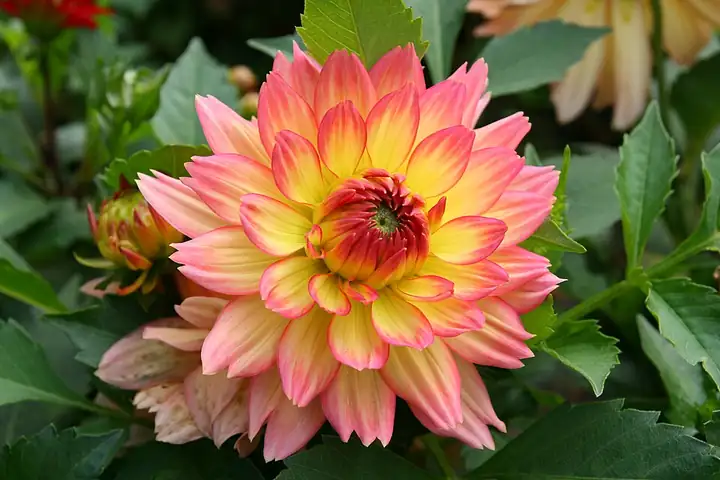
Dahlia
Dahlia hybrids (Dahlia species) · Aster family (Asteraceae)
| Hardiness zones | 7 to 10 |
|---|---|
| Sun | full sun |
| Water | high |
| Life cycle | tender perennial (grown as an annual) |
| Frost | Tender: killed by frost |
| Spacing | 12 to 48 inches |
| Soil temperature to plant | at least 55°F |
About Dahlia
Dahlias grow from tuberous roots and bloom from midsummer until frost, in every color but true blue and in shapes from small pompons to 12-inch dinner plates. Bees, butterflies and hummingbirds visit them (NC State). Where winters are cold, dig the tubers after frost and store them indoors until spring.
NC State rates tubers for zones 7-10: mulch them in place over winter in zones 8-10, but dig them in zone 7 and anywhere colder, since temperatures below about 25 F injure them.
When to plant
Timing is counted from your average last spring frost (and first fall frost). Sow & Tell works out the actual dates for your ZIP code.
- Start seeds indoors: 6 to 8 weeks before the last frost
- Set out plants: around the last frost
Plant tubers outdoors after frost danger is past and the soil is at least 55 F, 3-6 inches deep with the eye up; for earlier flowers, start them in pots indoors 6-8 weeks before (Clemson, NC State, Chicago Botanic Garden). In cold areas, after frost kills the tops cut stems to 6 inches, lift the clumps a few days later with a fork, let them dry 1-3 days, and store in peat, vermiculite, sand or wood shavings at about 35-50 F, checking monthly for rot (Penn State, UMN, NC State, Chicago Botanic Garden).
Soil
Rich, moist but well-drained soil high in organic matter; Chicago Botanic Garden adds compost and aims for a pH near 6.5. Mulch and water often (NC State).
Mix compost into rich, well-drained soil and aim for a pH near 6.5 (Chicago Botanic Garden).
Feeding
- Monthly through the summer, once plants are growing: water-soluble fertilizer, or a low-nitrogen fertilizer such as 5-10-10. Clemson suggests a monthly water-soluble feed, or 2-3 lb of 5-10-10 per 100 sq ft in July; Chicago Botanic Garden feeds regularly with 5-10-10 or 5-20-20. Follow a soil test.
- Mid-August: no more fertilizer. Chicago Botanic Garden stops feeding in mid-August so the tubers can mature before fall digging.
Keep water off the leaves to limit fungal disease (Chicago Botanic Garden), and set stakes before plants reach about 12 inches tall (Chicago Botanic Garden).
Harvest
Dahlias bloom from midsummer until frost. Pinch the main tip about 3 weeks after planting for a bushier plant, stake tall kinds, and deadhead to keep flowers coming (Clemson, NC State). For extra-large blooms, pinch off the side buds (Chicago Botanic Garden).
Varieties (10)
Extension and botanical-garden sources we could open document 10 dahlias; many popular named dahlias are described only in catalogs, which we don't use.
| Variety | Type | Days | Notes |
|---|---|---|---|
| Wannabee | Anemone-flowered dahlia | Mauve-purple outer petals around a golden-orange pincushion center; fits beds, borders and containers; introduced 2004. | |
| Cherish | Dahlia | Soft yellow petals blushed rose at the edges; compact, about 3 feet tall. | |
| Elsie Huston | Dahlia | A heat-tolerant dahlia recommended for Florida. | |
| Mystic Enchantment | Dahlia | Red flowers. | |
| Peaches and Dreams | Dahlia | ||
| Imperial Wine | Dahlia (fringed) | Deep wine-red, lightly fringed 4-inch flowers that don't fade; plants about 5 feet; long stems for cutting. | |
| Mignon Mix | Dahlia mix | A dahlia mix Penn State names for home gardens. | |
| Alauna Clair-Obscur | Fimbriated (fringed) cactus dahlia | Deep raspberry petals with feathery white tips; needs staking. | |
| Candlelight | Informal decorative dahlia | Orange flowers blending to golden yellow centers on long stems; stake against summer storms. | |
| Junkyard Dog | Novelty dahlia | Deep pink and magenta flowers streaked white, about 7 inches across, on 5-foot plants; introduced 2004. |
Pests to watch for
Aphids, Twospotted spider mite, Thrips, European corn borer, Four-lined plant bug, Foliar nematodes
Diseases and problems
Powdery mildew, Gray mold (Botrytis), Mosaic viruses, Crown gall, Tuber rot, Phytophthora root rot, Cucumber mosaic
In the kitchen
The Aztecs grew dahlias as a food crop, but the tubers are rarely eaten today (NC State).
Safety: Leaves can upset the stomach if eaten in large amounts, and the sap can irritate skin (NC State).
Pets: Toxic to dogs, cats and horses (ASPCA): usually mild stomach upset and mild skin irritation. NC State also rates it low severity.
Sources
- plants.ces.ncsu.edu
- hgic.clemson.edu
- chicagobotanic.org
- extension.psu.edu
- extension.umn.edu
- gardeningsolutions.ifas.ufl.edu
- aspca.org
- aspca.org
Photo: Photo: Lestat (Jan Mehlich), CC BY-SA 3.0, via Wikimedia Commons (CC BY-SA 3.0). Photo resized for the web.

Planting dates and advice are general guidance; check with your local Cooperative Extension office for your area.