
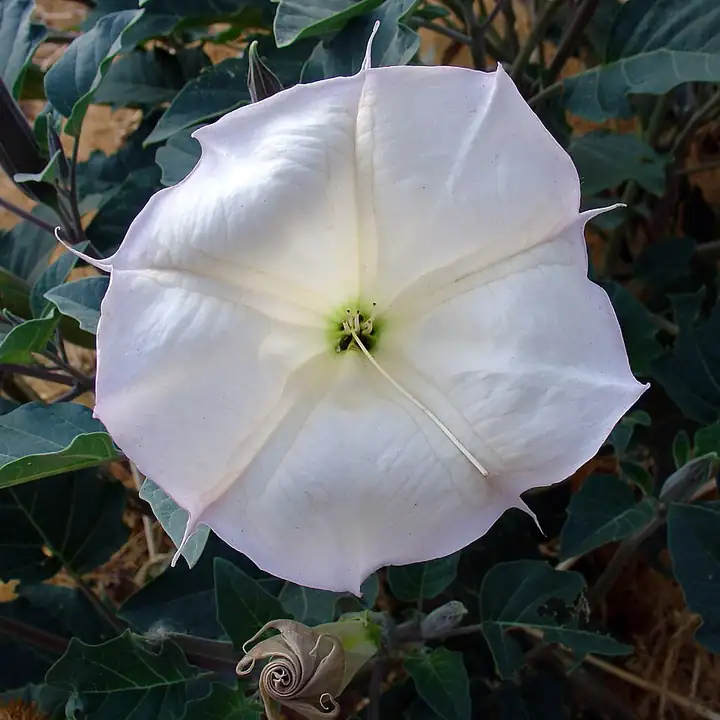
Datura (jimsonweed, moonflower datura)
Datura wrightii (sacred datura), Datura inoxia (pricklyburr) and Datura stramonium (jimsonweed); garden forms of the related Datura metel are sold under the same names · Nightshade family (Solanaceae)
| Hardiness zones | 9 to 11 |
|---|---|
| Sun | full sun |
| Water | low |
| Life cycle | tender perennial (grown as an annual) |
| Frost | Tender: killed by frost |
About Datura (jimsonweed, moonflower datura)
Daturas are bushy plants with huge, upward-facing white or purple-tinged trumpet flowers that open at dusk, smell sweet and wilt by the next noon; big sphinx moths pollinate them (NC State, Wildflower Center). Sacred datura (D. wrightii) is native to the Southwest, from California to Texas, while USDA lists pricklyburr and jimsonweed as introduced, and jimsonweed is a widespread poisonous weed of gardens and fields. ALL parts of every datura are highly poisonous to people and animals. Don't confuse it with angel's trumpet (Brugmansia), a woody shrub whose flowers hang down, or with the moonflower vine (Ipomoea alba): the names 'moonflower' and 'angel's trumpet' get used for all three, so check the Latin name on the tag.
Sacred datura is a perennial from a tuberous root in zones 9-11 and is grown as an annual farther north (NC State); jimsonweed is a summer annual. Jimsonweed is a listed weed: Connecticut prohibits buying, selling, moving or growing it by statute.
When to plant
Timing is counted from your average last spring frost (and first fall frost). Sow & Tell works out the actual dates for your ZIP code.
- Start seeds indoors: 6 to 8 weeks before the last frost
- Set out plants: up to 2 weeks after the last frost
Start seed indoors about 6-8 weeks before the last frost and set plants out after it (NC State, for garden datura, D. metel); in Texas the Wildflower Center starts sacred datura seed in January for 4-inch pots by April. Sacred datura freezes back, so spring planting is best. Wear gloves to handle seed and plants. No sourced count from sowing to first bloom.
Soil
Well-drained sandy or loamy soil, or even clay; it's drought tolerant once settled (NC State, Wildflower Center).
Any well-drained soil works, from sand to clay; it is drought tolerant and doesn't need rich soil (NC State, Wildflower Center).
Feeding
Don't let seed pods ripen where children, pets or livestock can reach them; cut off spent flowers instead (NC State, WVU).
Harvest
In most gardens it blooms from midsummer to frost, and from May to November in the Southwest; each flower opens in the evening and wilts the next day (NC State). Cut off spent flowers before the spiny seed pods form: that stops self-sown seedlings and keeps the most poisonous part, the seed, away from kids and pets (NC State, WVU).
Varieties (8)
NC State documents these garden forms of D. metel; the three species in this record are listed too so their differences (and jimsonweed's legal status) are clear. All are highly poisonous.
| Variety | Type | Days | Notes |
|---|---|---|---|
| Alba | Garden datura (D. metel) | Large white trumpets that face upward and open from dusk to dawn. | |
| Aurea | Garden datura (D. metel) | Golden yellow flowers. | |
| Belle Blanche | Garden datura (D. metel) | White flowers. | |
| Blackcurrant Swirl | Garden datura (D. metel) | Flowers dark purple-black outside and white inside. | |
| Cornucopaea | Garden datura (D. metel) | Double or triple-layered blooms, often dark purple or violet outside with a white inside. | |
| Sacred datura (D. wrightii) | Native species | White, sometimes purple-tinged flowers up to about 8 in long on a sprawling plant 2-5 ft tall; perennial from a tuberous root in zones 9-11; host for the Carolina sphinx moth. | |
| Pricklyburr (D. inoxia) | Species | Large white trumpet flowers; often confused with sacred datura. USDA lists it as introduced in the lower 48. | |
| Jimsonweed (D. stramonium) | Weedy species | Summer annual weed 1-4 ft tall with 2-4 in white to purple-tinged flowers and spiny, egg-shaped pods; seeds live in soil for years. |
Pests to watch for
Tomato hornworm
In the kitchen
Safety: Every part is highly poisonous, especially the seeds (NC State: high severity). Tropane alkaloids (atropine, scopolamine, hyoscyamine) cause dilated pupils, hot, dry, flushed skin, fever, confusion, hallucinations, a racing heart, seizures and coma, and poisoning can be fatal; cooking doesn't make leaves safe (CDC, MedlinePlus, WVU). The sap can cause a rash, so wear gloves. If any part may have been eaten, call Poison Help at 1-800-222-1222 right away.
Pets: Not listed by the ASPCA. NC State lists datura as a danger to dogs, cats, horses and cattle, and the Wildflower Center says all parts are poisonous to people and animals.
Sources
- plants.ces.ncsu.edu
- plants.ces.ncsu.edu
- plants.ces.ncsu.edu
- plants.ces.ncsu.edu
- wildflower.org
- plantsservices.sc.egov.usda.gov
- plantsservices.sc.egov.usda.gov
- plantsservices.sc.egov.usda.gov
- ipm.ucanr.edu
- extension.wvu.edu
- medlineplus.gov
- cdc.gov
- cipwg.media.uconn.edu
- aspca.org
- aspca.org
Photo: Photo: Dlarsen / Wikimedia Commons, Public domain. Photo resized for the web.

Planting dates and advice are general guidance; check with your local Cooperative Extension office for your area.