
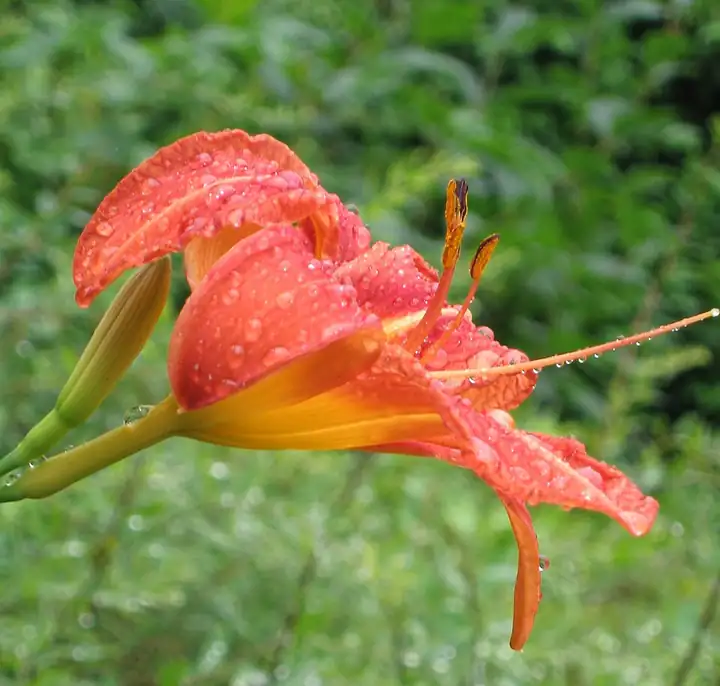
Daylily
Hemerocallis hybrids (also H. fulva, H. lilioasphodelus and others) · Asphodel family (Asphodelaceae)
| Hardiness zones | 3 to 9 |
|---|---|
| Sun | full sun to part shade |
| Water | moderate |
| Life cycle | perennial |
| Frost | Hardy: takes frost |
| Soil pH | 6.0–6.5 |
| Spacing | 18 to 36 inches |
About Daylily
Daylilies are tough, easy perennials; each flower lasts one day, but a clump makes hundreds of buds and blooms for a month or more, and rebloomers like 'Stella de Oro' keep going. They are not true lilies, but they are still toxic to cats. Heads-up: the orange 'ditch lily' (Hemerocallis fulva) spreads by thick roots into roadsides, meadows and stream banks and is listed as invasive in several states, so plant named hybrids instead.
Hardy in zones 3-9. The orange ditch lily, H. fulva, is listed as invasive by Delaware, Georgia, Kentucky, Ohio and Wisconsin agencies, among others (Invasive Plant Atlas); it spreads by rhizomes, not seed.
When to plant
Timing is counted from your average last spring frost (and first fall frost). Sow & Tell works out the actual dates for your ZIP code.
Plant divisions in spring or early fall (Virginia Tech says April through September), with the crown no more than 1 inch below the soil. Space 2-3 feet apart, or 15-18 inches for miniatures. Divide every 3-5 years, keeping 2-3 fans per piece (UMN). Clumps reach full size in 3-4 years (Clemson).
Soil
Well-drained soil with plenty of organic matter; it tolerates drought and salt once established (NC State, Clemson).
Follow a soil test every 3-5 years; aim for pH 6-6.5 and work in organic matter (UMN; Clemson).
Feeding
- early spring: compost or manure, or a complete fertilizer such as 5-10-5. A light spring feeding is plenty for average soil (UMN; Missouri); Virginia Tech feeds only if a soil test shows a need.
- midsummer, after the first big flush of bloom (July for everblooming types): complete fertilizer such as 10-10-10. Feed again after the first bloom peak and 6-8 weeks later for rebloomers (Arkansas; Penn State).
Too much nitrogen gives leaves instead of flowers (Virginia Tech).
Harvest
Most bloom in early to midsummer; mixing early, mid and late cultivars stretches the season from May to September. Snap off spent flowers and young seed pods, and cut finished flower stalks down low, so plants put energy into more blooms (Arkansas, SDSU, UMN).
Varieties (24)
| Variety | Type | Days | Notes |
|---|---|---|---|
| Black Eyed Stella | Reblooming | Golden yellow with a dark red eye; 13 in tall. | |
| Charles Johnston | Reblooming | Reblooms through the season. | |
| Green Flutter | Reblooming | Canary yellow with green throats; 20-24 in tall. | |
| Happy Returns | Reblooming | Yellow flowers that repeat through summer. | |
| Super Stella | Reblooming | A reblooming 'Stella' type. | |
| Mini Stella | Reblooming miniature | Small yellow flowers that repeat. | |
| Stella de Oro | Reblooming miniature | Gold flowers on 11 in plants; blooms early-midseason and keeps reblooming. | |
| Joan Senior | Semi-evergreen | Near-white flowers on 25 in stems. | |
| Bertie Ferris | Orange-apricot flowers; 20 in tall. | ||
| Buttered Popcorn | Yellow flowers; 28 in tall. | ||
| Carolyn Criswell | Buff yellow flowers; 22 in tall. | ||
| Chicago Apache | Scarlet red flowers; 27 in tall. | ||
| Chicago Blackout | Deep red flowers. | ||
| Daring Deception | Pale lavender-pink with a black-purple eye and edge; 24 in tall. | ||
| Follow Your Heart | Pale strawberry to shrimp-pink blend; 33 in tall. | ||
| Gordon Biggs | Raspberry red with a red eye; 24 in tall. | ||
| Hush Little Baby | Rose pink flowers; 22 in tall. | ||
| Hyperion | Yellow flowers. | ||
| Little Grapette | Small lavender-purple flowers. | ||
| Mardi Gras Parade | Lavender with a wine eye; 24 in tall. | ||
| Prairie Blue Eyes | Lavender with a blue eye zone; 28 in tall. | ||
| Siloam Double Classic | Pink double flowers. | ||
| Texas Sunlight | Gold flowers; 28 in tall. | ||
| Woodside Ruby | Ruby red flowers; 34 in tall. |
Pests to watch for
Thrips, Aphids, Twospotted spider mite, Slugs, Brown garden snail
Diseases and problems
Daylily rust, Leaf streak, Crown rot
In the kitchen
Buds and flowers are edible, raw, fried or dried, and are used in many Chinese dishes (NC State; Virginia Tech).
Keeping it: Pick edible flowers the day you use them; if you must hold them, keep them in a plastic bag in the fridge for a day or so.
Safety: Daylily flowers may act as a laxative or diuretic, so eat them in moderation (NC State).
Pets: Toxic to cats and can be deadly (ASPCA): eating any part can cause vomiting, loss of appetite, lethargy, kidney failure and death. Get a cat to a vet right away. The ASPCA lists daylilies as non-toxic to dogs.
Sources
- plants.ces.ncsu.edu
- plants.ces.ncsu.edu
- hgic.clemson.edu
- hgic.clemson.edu
- extension.umn.edu
- ipm.missouri.edu
- uaex.uada.edu
- extension.sdstate.edu
- ext.vt.edu
- invasiveplantatlas.org
- mgnv.org
- aspca.org
- aspca.org
- aspca.org
- aspca.org
- extension.psu.edu
Photo: Photo: Peter Andersen, CC BY-SA 2.5, via Wikimedia Commons (CC BY-SA 2.5). Photo resized for the web.

Planting dates and advice are general guidance; check with your local Cooperative Extension office for your area.