
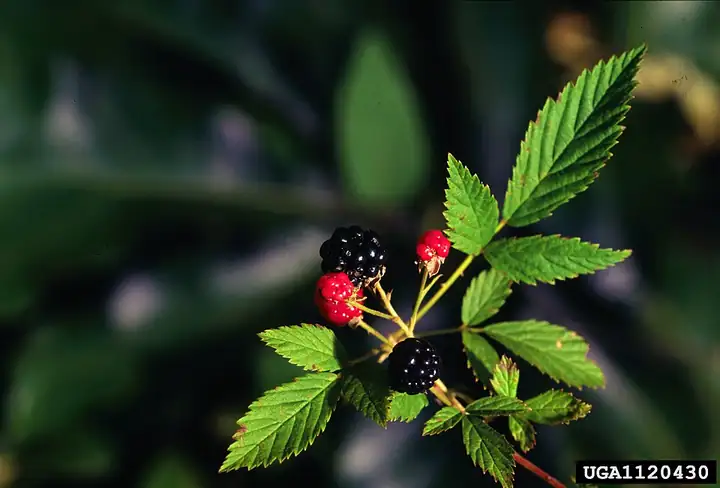
Dewberry
Rubus flagellaris (northern dewberry) and Rubus trivialis (southern dewberry) · Rose family (Rosaceae)
| Hardiness zones | 3 to 9 |
|---|---|
| Sun | full sun to part shade |
| Water | moderate |
| Life cycle | perennial |
| Frost | Hardy: takes frost |
| Soil pH | 5.5–6.5 |
| Spacing | 36 to 96 inches |
About Dewberry
Dewberries are native trailing blackberries whose canes creep along the ground, usually under 2 feet tall, and root where their tips touch soil. They flower a month or two before upright blackberries and give large, sweet, juicy black berries early in the season. Many people pick them wild; in a garden, train them on a trellis to keep them in bounds.
NC State lists northern dewberry for zones 3-8 and southern dewberry for zones 4-9; dewberries are somewhat hardier than boysenberries (Oklahoma State).
When to plant
Timing is counted from your average last spring frost (and first fall frost). Sow & Tell works out the actual dates for your ZIP code.
Plant in spring, or in fall where winters are mild (NC State). Oklahoma State spaces trailing blackberries 3 to 4 feet apart, while NC State gives trailing types 6 to 8 feet. Train canes on a two-wire trellis at 3 and 5 feet (NC State).
Soil
Adapts to clay, loam or sand (NC State); for the best berries, grow trailing blackberries in well-drained sandy loam (NC State).
Follow a soil test; aim for a pH of 5.5-6.5 in well-drained soil (NC State).
Feeding
- Established plants: March, before bloom: balanced fertilizer such as 10-10-10. Spread along the row, following a soil test (NC State).
- Right after harvest: balanced fertilizer such as 10-10-10. Spread about 5 pounds per 100 feet of row (NC State).
Don't let canes sprawl untended: tips root where they touch the ground and the planting can turn into a thicket (NC State).
Harvest
Southern dewberries ripen in April and May and northern ones from May to July (NC State), a little ahead of upright blackberries (Oklahoma State). Pick when berries turn from shiny to dull black for the sweetest fruit (NC State).
Southern dewberry fruits once a year, with ripe berries in April-May after a March-June bloom.
Varieties (4)
Only 4 named dewberries are documented, all older cultivars described in USDA germplasm records. Most dewberries are wild native plants that people gather rather than plant. No source rates single cultivars for hardiness zones. Boysenberry and other trailing blackberry hybrids are listed under blackberry.
| Variety | Type | Days | Notes |
|---|---|---|---|
| Austin Mayes | Dewberry (trailing) | A wild hybrid dewberry with trailing canes. | |
| Carolina | Dewberry (trailing) | Firm, short, bright black berries with large seeds; similar to Lucretia and good fresh or cooked. More vigorous and productive than Lucretia and more resistant to Septoria leaf spot; moderately thorny. | |
| Lucretia | Dewberry (trailing) | Large, jet-black, long berries that are juicy and firm, with a lively tart-sweet taste when fully ripe. Vigorous, very productive trailing canes with many small prickles; needs winter protection in cold areas. Prone to anthracnose and double blossom (rosette). | |
| Austin Thornless | Dewberry (trailing), thornless | Medium, firm, bright black berries with a mild taste. Upper canes are thornless, though the lower canes have some spines. A shy bearer, and rabbits damaged it badly in winter. |
Pests to watch for
Raspberry cane borer
Diseases and problems
Fusarium wilt, Root and crown rot
In the kitchen
Eaten raw or cooked, and often made into jam and preserves (NC State).
Keeping it: Soft berries keep only two or three days in the fridge, so don't wash them until you're ready to eat; freeze extras fast.
Safety: No toxic parts were noted in the sources we checked. Stems have slender thorns and bristly red hairs (Texas A&M), so wear gloves.
Pets: Not listed by the ASPCA
Sources
- plants.ces.ncsu.edu
- plants.ces.ncsu.edu
- content.ces.ncsu.edu
- extension.okstate.edu
- foragefax.tamu.edu
- plantsservices.sc.egov.usda.gov
- plantsservices.sc.egov.usda.gov
- aspca.org
Photo: Photo: James H. Miller and Ted Bodner, Southern Weed Science Society, Bugwood.org / Wikimedia Commons, CC BY 3.0 US (CC BY 3.0 US). Photo resized for the web.

Planting dates and advice are general guidance; check with your local Cooperative Extension office for your area.