
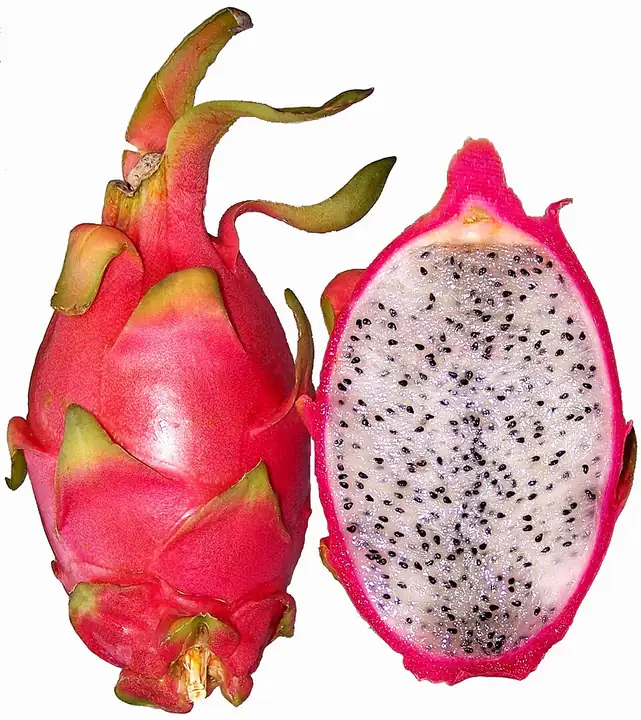
Dragon fruit (pitaya)
Selenicereus undatus (formerly Hylocereus undatus) and related Selenicereus species · Cactus family (Cactaceae)
| Hardiness zones | 10 to 11 |
|---|---|
| Sun | full sun |
| Water | moderate |
| Life cycle | perennial |
| Frost | Tender: killed by frost |
About Dragon fruit (pitaya)
Dragon fruit is a vigorous climbing cactus with long green stems, huge fragrant white flowers that open for a single night, and bright pink or yellow fruit with white or red flesh. It grows fast and can fruit within a year from a rooted cutting, so it suits a large pot with a sturdy post. Heads-up: the UF/IFAS Assessment rates Selenicereus undatus invasive in central and south Florida, so gardeners there should keep it in a pot or skip it.
NC State lists zones 10-11 and frost kills it; long freezes below about 31 F damage plants, though light frost injury heals fast (UF/IFAS). The UF/IFAS Assessment of Non-Native Plants calls Selenicereus undatus invasive and not recommended in central and south Florida (fine in north Florida); it is not a Florida noxious weed.
When to plant
Timing is counted from your average last spring frost (and first fall frost). Sow & Tell works out the actual dates for your ZIP code.
No source ties the move outdoors to a frost date; set a potted plant out once frost danger is over. Rooted stem cuttings can fruit 6-9 months after planting in Florida (UF/IFAS), while Hawaii growers see the first crop in the second year (University of Hawaii); seedlings take up to 7 years. In the ground, keep plants 15-25 ft from trees, buildings and power lines (UF/IFAS).
Soil
Any well-drained soil or cactus potting mix; it needs regular water but rots in constantly wet soil (UF/IFAS; NC State).
Use well-drained soil or cactus potting mix; UF/IFAS suggests working in well-rotted manure or compost, about 4 lb per plant in the first year in the ground.
Feeding
- First year, every 2 months during the warm season: balanced fertilizer with magnesium, such as 6-6-6 or 8-3-9 with 2-3% magnesium. UF/IFAS uses light applications of about 1/4 lb per in-ground plant every 2 months; scale down for a pot and follow the label.
- Second and third years, every 2 months in the warm season: the same fertilizer plus compost or manure. UF/IFAS raises in-ground amounts to 0.3-0.4 lb per plant every 2 months and raises compost or manure to about 6 lb per plant.
- Late March through September: minor-element (micronutrient) spray; chelated iron on high-pH soil. UF/IFAS suggests 4-6 minor-element sprays through the season, following the label.
Don't keep the soil constantly wet: too much water too often causes root and stem rot (UF/IFAS), and uneven watering splits the fruit (University of Hawaii).
Harvest
Pick fruit when it is fully colored, using hand clippers (UF/IFAS). Fruit is ready about 30-50 days after the flower is pollinated, and fruit left to 50 days was heavier and sweeter in Hawaii trials (University of Hawaii); UC trials averaged about 40 days from bloom to harvest.
Dragon fruit flowers and ripens fruit through the warm season, about June to October in Hawaii and June to November in Florida, so check plants often. Fruit can be picked 30 days after it sets, but waiting up to about 50 days makes it sweeter; a dry winter and early spring helps it bloom, then keep it watered from flowering through harvest.
Varieties (20)
| Variety | Type | Days | Notes |
|---|---|---|---|
| Armando | Red skin, red flesh | Sugar about 16.11 Brix in UC trials. Fruit averaged about 390 g (about 14 oz) in UC trials, ripening about 41 days after bloom; rated 4 for cold and 4 for heat tolerance on a 1-5 scale. | |
| Cebra | Red skin, red flesh | Sugar about 15.75 Brix in UC trials. Fruit averaged about 468 g (about 16.5 oz) in UC trials, ripening about 46 days after bloom; rated 3.5 for cold and 3.5 for heat tolerance on a 1-5 scale. | |
| Lisa | Red skin, red flesh | Sugar about 17.02 Brix in UC trials. Heavy yielder; among the most heat- and cold-tolerant. Fruit averaged about 465 g (about 16 oz) in UC trials, ripening about 44 days after bloom; rated 3.75 for cold and 4 for heat tolerance on a 1-5 scale. | |
| Orejona | Red skin, red flesh | Sugar about 15.78 Brix in UC trials. Fruit averaged about 438 g (about 15.5 oz) in UC trials, ripening about 45 days after bloom; rated 3.25 for cold and 3.75 for heat tolerance on a 1-5 scale. | |
| Rosa | Red skin, red flesh | Sugar about 16.05 Brix in UC trials. Fruit averaged about 384 g (about 13.5 oz) in UC trials, ripening about 45 days after bloom; rated 3.5 for cold and 3.5 for heat tolerance on a 1-5 scale. | |
| San Ignacio | Red skin, red flesh | Sugar about 15.6 Brix in UC trials. The largest fruit in the trial and a heavy yielder. Fruit averaged about 552 g (about 19 oz) in UC trials, ripening about 48 days after bloom; rated 3.75 for cold and 4 for heat tolerance on a 1-5 scale. | |
| Valdivia Roja | Red skin, red flesh | Sugar about 17.9 Brix in UC trials. Small fruit but the most cold-tolerant selection in the trial. Fruit averaged about 250 g (about 9 oz) in UC trials, ripening about 40 days after bloom; rated 5 for cold and 4.5 for heat tolerance on a 1-5 scale. | |
| Sin Espinas | Red-fleshed | Sugar about 16.5 Brix in UC trials. Red flesh; lower yield and less heat and cold tolerance. Fruit averaged about 393 g (about 14 oz) in UC trials, ripening about 43 days after bloom; rated 2.25 for cold and 2.75 for heat tolerance on a 1-5 scale. | |
| Bien Hoa White | White-fleshed | Sugar about 11.85 Brix in UC trials. White flesh; lowest sugar in the trial. Fruit averaged about 388 g (about 13.5 oz) in UC trials, ripening about 37 days after bloom; rated 2.5 for cold and 2.5 for heat tolerance on a 1-5 scale. | |
| Mexicana | White-fleshed | Sugar about 14.04 Brix in UC trials. White flesh. Fruit averaged about 495 g (about 17.5 oz) in UC trials, ripening about 40 days after bloom; rated 3.25 for cold and 3 for heat tolerance on a 1-5 scale. | |
| Seoul Kitchen | White-fleshed | Sugar about 12.18 Brix in UC trials. Large white-fleshed fruit and a heavy yielder. Fruit averaged about 518 g (about 18 oz) in UC trials, ripening about 41 days after bloom; rated 4 for cold and 4 for heat tolerance on a 1-5 scale. | |
| Vietnamese Giant | White-fleshed | Sugar about 15.6 Brix in UC trials. White flesh. Fruit averaged about 338 g (about 12 oz) in UC trials, ripening about 41 days after bloom; rated 3.25 for cold and 3.25 for heat tolerance on a 1-5 scale. | |
| Vietnam #1 | White-fleshed (Selenicereus undatus) | Large pink fruit averaging about 14 oz, with white flesh. | |
| Colombiana | Yellow pitaya (yellow skin, white flesh) | Very sweet: about 21 Brix in UC trials. Fruit under about 200 g (7 oz) and slow, taking 150-180 days from bloom to harvest; rated 1 of 5 for heat and cold tolerance. | |
| Yellow Dragon | Yellow pitaya (yellow skin, white flesh) | Very sweet: about 21 Brix, the highest in UC trials. Fruit under about 200 g (7 oz) and slow, taking 150-180 days from bloom to harvest; rated 1 of 5 for heat and cold tolerance. | |
| American Beauty | Sugar about 18.51 Brix in UC trials. Sweet fruit, but less heat and cold tolerance. Fruit averaged about 380 g (about 13.5 oz) in UC trials, ripening about 43 days after bloom; rated 2.75 for cold and 2.5 for heat tolerance on a 1-5 scale. | ||
| Bien Hoa Red | Sugar about 18.9 Brix in UC trials. Very sweet but low-yielding, with poor heat and cold tolerance. Fruit averaged about 360 g (about 12.5 oz) in UC trials, ripening about 41 days after bloom; rated 1.75 for cold and 1.75 for heat tolerance on a 1-5 scale. | ||
| Delight | Sugar about 18.08 Brix in UC trials. Red skin; heavy yielder. Fruit averaged about 371 g (about 13 oz) in UC trials, ripening about 41 days after bloom; rated 3 for cold and 3.5 for heat tolerance on a 1-5 scale. | ||
| Haley's Comet | Sugar about 16.7 Brix in UC trials. Red skin; among the most heat- and cold-tolerant. Fruit averaged about 482 g (about 17 oz) in UC trials, ripening about 38 days after bloom; rated 4.5 for cold and 4.25 for heat tolerance on a 1-5 scale. | ||
| Physical Graffiti | Sugar about 17.93 Brix in UC trials. Top yielder in UC San Diego-area trials, and among the most heat- and cold-tolerant. Fruit averaged about 374 g (about 13 oz) in UC trials, ripening about 40 days after bloom; rated 4.5 for cold and 4.5 for heat tolerance on a 1-5 scale. |
Pests to watch for
Twospotted spider mite, Thrips, Scale insects, Mealybugs, Leaffooted bugs, Slugs, Birds
Diseases and problems
Stem and fruit canker, Anthracnose (fruit and stem rot), Bacterial stem rot, Root rot
In the kitchen
Most fruit is eaten fresh; the pulp also goes into ice cream, yogurt, jelly, juice, candy and pastries, and unopened flower buds can be cooked as a vegetable (UF/IFAS).
Keeping it: Ripe fruit keeps 4 to 5 days on the counter, or several weeks in a plastic bag in the fridge.
Safety: The sources we checked list no toxic parts, and we found no research-based guidance on pregnancy, drug interactions or allergies. Stems carry sharp spines, so wear gloves and long sleeves when pruning or picking (NC State; UF/IFAS).
Pets: Not toxic to dogs or cats (ASPCA)
Sources
- ask.ifas.ufl.edu
- www3.ctahr.hawaii.edu
- plants.ces.ncsu.edu
- ucanr.edu
- ucanr.edu
- assessment.ifas.ufl.edu
- fnai.org
- aspca.org
Photo: Photo: T.Voekler, CC BY-SA 3.0, via Wikimedia Commons (CC BY-SA 3.0). Photo resized for the web.

Planting dates and advice are general guidance; check with your local Cooperative Extension office for your area.