
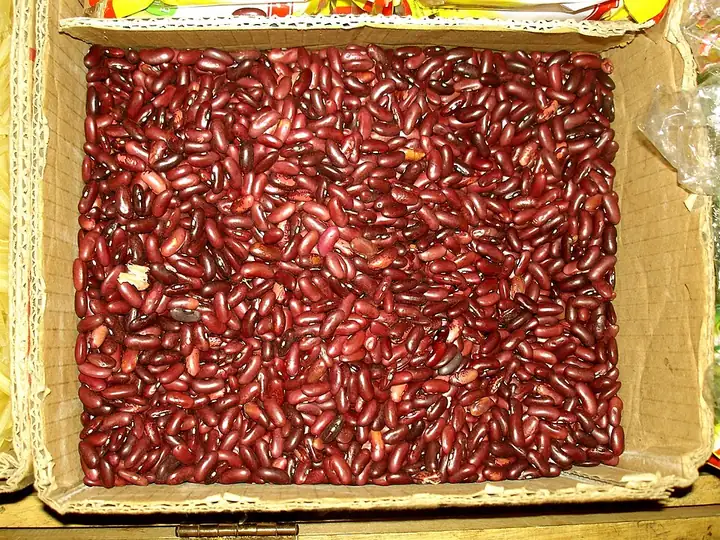
Dry beans (pinto, black, kidney, navy)
Phaseolus vulgaris · Pea family (Fabaceae)
| Hardiness zones | 3 to 11 |
|---|---|
| Sun | full sun |
| Water | moderate |
| Life cycle | annual |
| Frost | Tender: killed by frost |
| Soil pH | 6.5–7.0 |
| Spacing | 2 to 6 inches |
| Days to harvest | 90 to 120 days |
| Soil temperature to plant | at least 60°F |
About Dry beans (pinto, black, kidney, navy)
Dry beans are the same species as green beans, but grown until the pods turn brown and the seeds are hard, then shelled for winter soups, chili and baked beans. Hundreds of bush and pole varieties come in every color and pattern, from black turtle and pinto to heirlooms like Jacob's Cattle and Vermont Cranberry. They fix their own nitrogen, need little fertilizer, and store for years. Raw or undercooked dry beans are toxic: see safety.
Grown as a warm-season annual in every zone after frost danger has passed; pick varieties that mature in under about 95-100 days where summers are short.
When to plant
Timing is counted from your average last spring frost (and first fall frost). Sow & Tell works out the actual dates for your ZIP code.
- Sow seeds outdoors: up to 3 weeks after the last frost
Days count from seeding to dry pods. Sow 1 1/2 to 2 inches deep once soil is about 60F (never below 50F): bush types 2-3 inches apart in rows 18-30 inches apart, pole types 4-6 inches apart on a trellis. Inoculate seed with bean Rhizobium; soaking is optional (no more than 12 hours).
Soil
Fertile, well-drained soil in a spot where water doesn't collect; raised beds help heavy soils drain and dry the crop at harvest.
Test the soil (tell the lab you're growing beans), add phosphorus and potassium as recommended, and lime to about pH 6.5-7.0.
Feeding
Too much nitrogen stops the roots from forming nitrogen-fixing nodules and invites white mold; check a few roots late in the season for pink-centered nodules.
Harvest
Leave pods on the plant until they are brown, dry and leathery and open easily in your hand; stop watering once pods turn yellow so they dry down. Pull whole plants or pick pods before they shatter, finish drying them under cover, then thresh by stomping the plants in a tarp or bag and winnow out the chaff.
For dry beans the pods are left to dry on the plant and picked once, or whole plants are pulled; pole types ripen over a longer stretch, so you may pick their dry pods in a few rounds.
Varieties (23)
| Variety | Type | Days | Notes |
|---|---|---|---|
| Black Coco | Black | 112 days | Black seed. |
| Black Valentine | Black | 111 days | Black seed. |
| Midnight Black Turtle | Black | 118 days | Black seed. |
| Swedish Brown | Brown | 117 days | Brown seed. |
| Borlotti | Cranberry | 121 days | Cranberry-class seed. |
| Tongue of Fire | Cranberry | 109 days | Cranberry-class seed. |
| Vermont Cranberry | Cranberry | 109 days | Cranberry-class seed. |
| Red Hawk | Dark red kidney | 108 days | Dark red kidney seed. |
| Red Kidney | Dark red kidney | 101 days | Dark red kidney seed; one of the earliest in the WSU trials. |
| Flageolet (French Flageolet) | Flageolet | 119 days | Flageolet-class seed. |
| Great Northern | Great Northern (white) | 109 days | Medium white seed. |
| Jacob's Cattle (Trout) | Jacob's Cattle (white with red) | 107 days | Jacob's Cattle-class seed (white with colored speckles). |
| Lariat | Pinto | 114 days | Pinto seed; one of the highest-yielding pintos in the WSU trials. |
| Othello | Pinto | 104 days | Pinto-class seed. |
| Quincy | Pinto | 106 days | Pinto seed; high yielding in the WSU trials. |
| Red Mexican | Small red | 108 days | Small red seed. |
| Navy Bean | Small white (navy) | 114 days | Small white seed. |
| Soldier | Soldier | 108 days | Soldier-class seed. |
| Cannellini | White kidney | 104 days | White kidney-shaped seed. |
| Calypso (Black Calypso) | White with partial color | 111 days | White seed with partial black color. |
| Hidatsa Shield Figure | White with partial color | 109 days | White seed with a colored patch. |
| Ireland Creek Annie | Yellow | 101 days | Yellow seed; an early, productive Northwest heirloom in the WSU trials. |
| Maine Yellow Eye | Yellow eye | 109 days | Yellow eye-class seed (white with a colored eye). |
Pests to watch for
Seedcorn maggot, Cucumber beetles, Bean leaf beetle, Aphids, Leafhoppers, Whiteflies, Stink bugs, Cutworms
Diseases and problems
Anthracnose, Bean common mosaic, Bacterial blights of beans, White mold, Rust, Fusarium root rot, Beet curly top virus
In the kitchen
Soak and simmer for soups, stews, chili, refried beans, baked beans and rice dishes; most dry beans can stand in for one another, though cooking times vary.
Keeping it: Dry beans to under about 15% moisture, then keep them in labeled, airtight jars or buckets in a dark, dry place; they keep for years, but after 3 or more years some may stay hard when cooked.
Safety: Raw or undercooked dry beans, especially red kidney beans, contain a lectin (phytohaemagglutinin) that causes severe vomiting; as few as four or five undercooked kidney beans can make someone sick. Soak, drain, then boil in fresh water for at least 30 minutes, and don't cook dry kidney beans from raw in a slow cooker (K-State). Add beans to your diet a little at a time to ease gas.
Pets: Not listed by the ASPCA
Sources
Photo: Photo: David E Mead, CC0, via Wikimedia Commons (CC0). Photo resized for the web.

Planting dates and advice are general guidance; check with your local Cooperative Extension office for your area.