
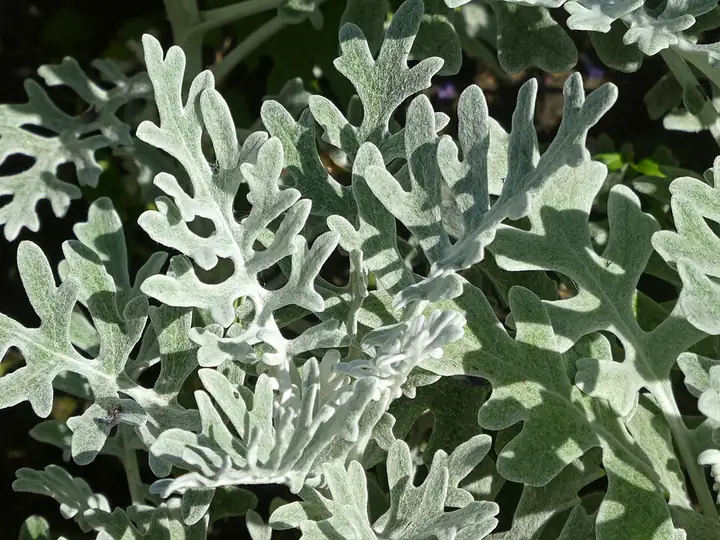
Dusty miller
Jacobaea maritima (formerly Senecio cineraria) · Daisy family (Asteraceae)
| Hardiness zones | 7 to 10 |
|---|---|
| Sun | full sun to part shade |
| Water | low |
| Life cycle | tender perennial (grown as an annual) |
| Frost | Half-hardy: takes a light frost |
| Spacing | 6 to 12 inches |
About Dusty miller
Dusty miller is a Mediterranean subshrub grown for its soft, silvery-white, felted leaves, which make bright flowers and dark foliage pop in beds, edgings and pots. It is usually treated as an annual and kept as a low mound 8-15 inches tall. Every part is poisonous if eaten, so plant it where kids and pets won't chew on it.
NC State rates it hardy in zones 7-10 (Wisconsin says 7a or 8a); it shrugs off the first light frosts, but the leaves die back once it stays below freezing, so most gardeners grow it as a summer annual.
When to plant
Timing is counted from your average last spring frost (and first fall frost). Sow & Tell works out the actual dates for your ZIP code.
- Start seeds indoors: 10 to 15 weeks before the last frost
No bloom count here: it's grown for leaves. Start seed indoors 10-15 weeks before the last frost (NC State); press the tiny seed onto the mix without covering it and keep it at 68-77 F (Wisconsin). Most people buy plants; in Florida, UF plants it in May-June in zones 7-8, March-May in zone 9, and from fall into early spring in zones 10-11. To keep a favorite, root tip cuttings in summer and grow them indoors under glass over winter (Wisconsin, NC State).
Soil
Moist, well-drained, moderately fertile soil; it copes with poor soil, heat and drought, but soggy ground rots the roots and stems (Wisconsin, NC State, Oklahoma State).
Plant in well-drained, moderately fertile soil in sun; it tolerates poor soil, so heavy amending isn't needed (Wisconsin).
Feeding
Don't overwater or plant in soggy spots: wet roots lead to root and stem rot (UF, Oklahoma State, NC State).
Harvest
Grown for its leaves, not flowers. Yellow daisy flowers may show up in summer, especially on older plants; many gardeners pinch them off so the plant puts its energy into foliage, and trim leggy plants back now and then (NC State, UF, Wisconsin). Stems make a silvery filler for bouquets.
Varieties (8)
Extension sources document 8 cultivars; most are seed-grown and differ mainly in height and how finely the leaves are cut.
| Variety | Type | Days | Notes |
|---|---|---|---|
| Silver Queen | Compact | About 8 in tall with silver-white, lacy leaves. | |
| Candicans | Seed-grown | Vigorous, 16-24 in tall with large, lobed leaves; good for cut foliage. | |
| Silverdust | Seed-grown | 10-12 in tall with very finely cut, lacy leaves. | |
| Cirrus | Seed-grown, compact | About 8 in tall with rounded, uncut leaves. | |
| New Look | Seed-grown, compact | About 10 in tall with large, wide leaves. | |
| Quicksilver | Seed-grown, compact | 8-12 in tall with cut leaves. | |
| Silver Lace | Fine, lace-like silver foliage. | ||
| Silverado | Fern-like silver foliage. |
Pests to watch for
Slugs
Diseases and problems
Root rot, Stem rot, Rust
In the kitchen
Safety: NC State rates dusty miller as highly poisonous: all parts contain pyrrolizidine alkaloids that can cause serious liver damage if eaten. The sap can mildly irritate skin, so wear gloves when handling it.
Pets: No entry of its own at the ASPCA, but the ASPCA lists Senecio species (groundsel, ragwort), the group dusty miller was long classed in, as toxic to dogs, cats and horses: pyrrolizidine alkaloids can cause liver failure. NC State flags dusty miller as a problem for cats, dogs and horses.
Sources
- plants.ces.ncsu.edu
- hort.extension.wisc.edu
- extension.okstate.edu
- ask.ifas.ufl.edu
- umass.edu
- aspca.org
- aspca.org
Photo: Photo: Екатерина Борисова / Wikimedia Commons, CC BY-SA 4.0 (CC BY-SA 4.0). Photo resized for the web.

Planting dates and advice are general guidance; check with your local Cooperative Extension office for your area.