
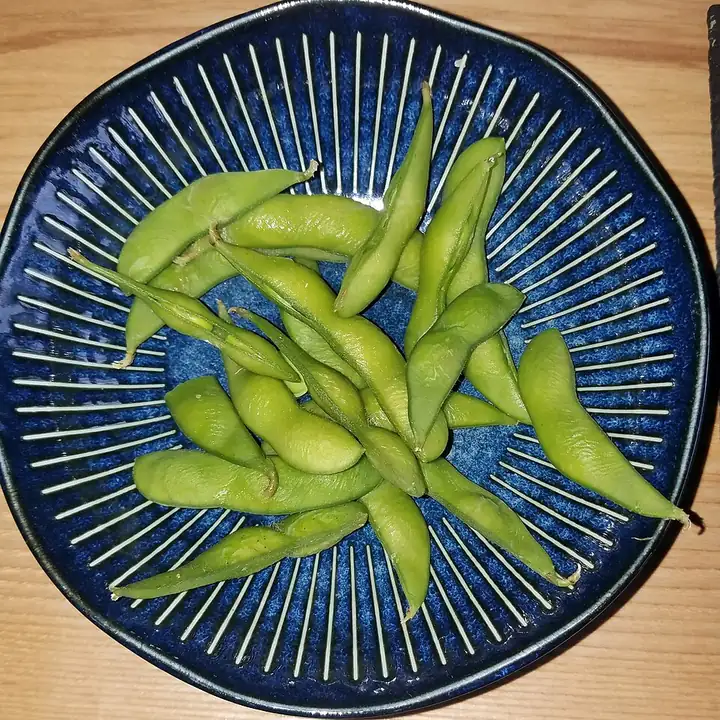
Edamame
Glycine max · Pea family (Fabaceae)
| Hardiness zones | 3 to 11 |
|---|---|
| Sun | full sun |
| Water | moderate |
| Life cycle | annual |
| Frost | Tender: killed by frost |
| Spacing | 2 to 4 inches |
| Days to harvest | 70 to 90 days |
About Edamame
Edamame are vegetable soybeans picked while the pods are still green and the beans are sweet. They are easy to grow in warm weather, and the whole planting tends to ripen at once.
Grown as a warm-season annual in every zone; it is killed by frost, so plant it after the danger of frost has passed.
When to plant
Timing is counted from your average last spring frost (and first fall frost). Sow & Tell works out the actual dates for your ZIP code.
- Sow seeds outdoors: up to 2 weeks after the last frost
Days count from seeding. Sow after the danger of frost has passed; soil at 75 to 85F gives the best sprouting. Coating seed with a soybean inoculant helps the plants fix nitrogen. Space rows 12 to 18 inches apart.
Soil
Most well-drained garden soils; too much nitrogen makes floppy plants. Keep soil moist until seedlings come up.
Test soil (ideally the fall before), keep pH about 6.0 to 6.5 (add any lime in fall), and give phosphorus and potassium only as the test calls for.
Feeding
Skip the inoculant and the plants will need added nitrogen; inoculating is the cheaper way to meet their needs.
Harvest
Pick when pods are full-sized, plump and bright green, with the beans nearly touching, before pods or leaves start to yellow. The best window lasts only a few days.
Most pods ripen at the same time and stay at their best for only a few days, so pick them all (or pull whole plants) while pods are plump and bright green, before leaves yellow.
Varieties (17)
| Variety | Type | Days | Notes |
|---|---|---|---|
| UA Kirksey | Determinate | Bred by the University of Arkansas (U.S. patent 8,766,051, 2014) and grown commercially in Arkansas. | |
| Beer Friend | Early | 102 days | An early edamame with medium pods. |
| Envy | Early | 75 to 102 days | The shortest plants in WSU's 2002 trial, with small pods. |
| Haruno-mai | Early | 102 days | An early edamame with large pods. |
| Sapporo Midori | Early | 103 to 107 days | Among the best-tasting in WSU's 2002 trial. An early edamame with large pods. |
| Butterbeans | Green-seeded | 90 to 108 days | Kentucky lists it for fresh use. In WSU's 2002 trial it had the most unmarketable pods. |
| Asmara | Tasters described it as sweet and nutty. A released edamame used as a check in a 2020 taste study. | ||
| Kitanosuzu | 107 to 110 days | Medium pods and good emergence in WSU's trial. | |
| Lucky Lion | 112 to 114 days | On Utah State's list of edamame varieties. | |
| Mana | 116 to 117 days | Large pods; the heaviest pods in WSU's 2002 trial. | |
| Midori Giant | UT Gardens says it has performed well in Tennessee. | ||
| Misono Green | 105 to 110 days | Large pods. | |
| Sayakomachi | 112 days | Highest taste score in WSU's 2002 trial. Large pods and the highest yield among varieties tested over several years at WSU. | |
| Sayamusume | 103 to 110 days | Medium pods and good emergence in WSU's trial. | |
| Shironomai | 107 to 113 days | Tested at three WSU sites. | |
| White Lion | 109 to 110 days | Tested at two WSU sites. | |
| Yukimusume | 110 days | Large beans. |
Pests to watch for
Aphids, Stink bugs, Bean leaf beetle, Seedcorn maggot, Blister beetles, Groundhog (woodchuck)
Diseases and problems
Iron chlorosis, Powdery mildew, Rust, Tomato and tobacco ringspot
In the kitchen
Boil or steam the pods about 5 minutes, salt them, and squeeze the beans out to eat; shelled beans go into salads and dips.
Keeping it: Refrigerate pods right after picking; kept cold and humid they stay fresh up to two weeks, but they're sweetest soon after harvest.
Safety: Edamame are cooked, not eaten raw (SDSU). Some people are allergic to soy, and soy in amounts above normal food levels may be unsafe during pregnancy (NCCIH).
Pets: Not listed as toxic by the ASPCA
Sources
- extension.usu.edu
- extension.sdstate.edu
- extension.missouri.edu
- plants.ces.ncsu.edu
- nccih.nih.gov
- aspca.org
- aspca.org
- wpcdn.web.wsu.edu
- extension.missouri.edu
Photo: Photo: Daderot, CC0, via Wikimedia Commons (CC0). Photo resized for the web.

Planting dates and advice are general guidance; check with your local Cooperative Extension office for your area.