
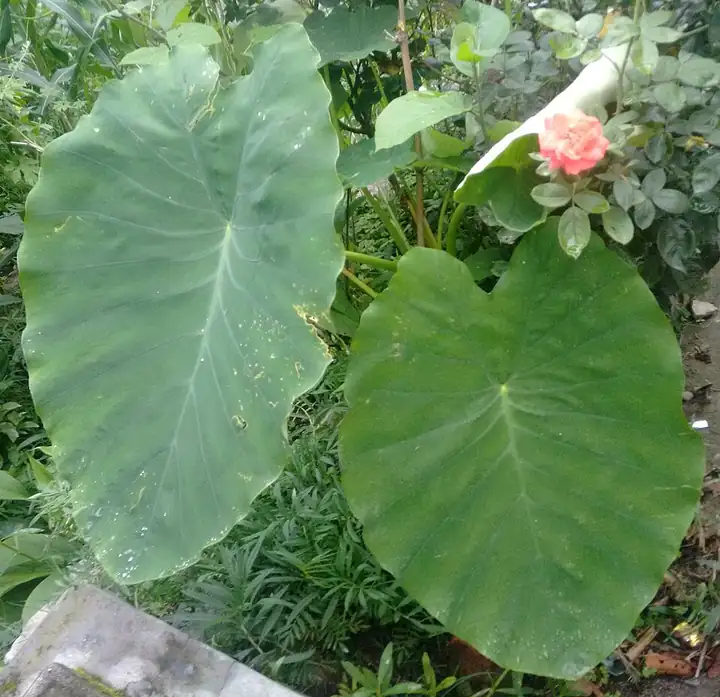
Elephant ear
Colocasia esculenta (taro) and Alocasia species and hybrids; a few kinds sold as elephant ears are Xanthosoma · Arum family (Araceae)
| Hardiness zones | 8 to 12 |
|---|---|
| Sun | full sun to part shade |
| Water | high |
| Life cycle | tender perennial (grown as an annual) |
| Frost | Tender: killed by frost |
About Elephant ear
Elephant ears are tropical plants grown from corms for huge, heart- or arrow-shaped leaves in green, black-purple, chartreuse or splashed patterns. Colocasia leaves tend to point down and take wet soil; Alocasia leaves point up and want better drainage (Clemson). Wild taro (Colocasia esculenta) is invasive in Florida and along the Gulf Coast, where it crowds shorelines and wetlands, so gardeners there are urged not to plant it, and nobody should plant elephant ears beside a natural waterway (UF/IFAS, Louisiana Native Plant Society, Wisconsin Extension).
Colocasia is root hardy in about zones 8-12 and most Alocasias only in 10-12 ('Low Rider' to 7b); elsewhere grow them as summer plants and store the corms or bring pots indoors (NC State, Clemson, Wisconsin). Colocasia esculenta is listed as invasive in Florida (FISC Category I) and Louisiana and is spreading in Texas wetlands.
When to plant
Timing is counted from your average last spring frost (and first fall frost). Sow & Tell works out the actual dates for your ZIP code.
- Sow seeds outdoors: around the last frost
Plant corms outdoors in spring after the last frost; Wisconsin suggests potting corms indoors in March, near the soil surface and kept warm, then setting them out in late May or early June once it is warm. Plants sulk when it stays below 50 F. Leaves are the show, so there is no bloom count. In fall, where winters are cold, cut back the leaves, dig the corms, let them dry several days and store them lightly covered in dry peat at about 45-55 F so they never freeze (Clemson); corms in pots must always come inside. Plants without corms can live indoors as houseplants: bring them in before nights reach the 30s F, trim to the top two leaves, keep them in bright light and a bit drier, then resume watering and feeding in spring (Wisconsin).
Soil
Fertile, moist soil rich in organic matter; Colocasia can even sit in a few inches of water, while Alocasia wants better drainage (Clemson, Wisconsin).
Work plenty of compost into moist, fertile soil; in pots use a heavy container at least 18 inches wide and deep (Clemson, Wisconsin).
Feeding
- From when leaves unfurl through summer, while plants are growing fast: balanced garden fertilizer. Elephant ears are heavy feeders that want plenty of fertilizer and water (Wisconsin, UF/IFAS); no rate is given, so follow the label and a soil test, and water it in.
- Spring, for plants kept indoors over winter: balanced fertilizer. Hold off feeding while the plant rests indoors in winter, then start watering and feeding again in spring (Wisconsin).
Don't let the soil dry out, and don't leave potted corms outside over winter: they freeze more easily than corms in the ground (Clemson). Overwatering Alocasia in poorly drained soil invites root rot and leaf spots (NC State).
Varieties (28)
| Variety | Type | Days | Notes |
|---|---|---|---|
| Hilo Beauty | Alocasia | Small, about 1 ft, with dark green leaves flecked yellow or cream. | |
| Stingray | Alocasia | Each leaf ends in a narrow tail, like a stingray. | |
| Calidora | Alocasia hybrid | Big, glossy, heart-shaped green leaves with bold veins; 5-9 ft or more. | |
| Low Rider | Alocasia hybrid | Dwarf form of 'Portora', about 2 ft, with glossy, wavy-edged leaves; cold hardy to about zone 7b. | |
| Mayan Mask | Alocasia hybrid | Shiny green leaves with dark chocolate-purple undersides. | |
| Portora | Alocasia hybrid (A. portei x A. odora) | Large, ruffled, ribbed arrow-shaped leaves on purple stems. | |
| Borneo Giant | Alocasia macrorrhizos | Upright, clumping giant with rippled, upward-pointing leaves about 3-4 ft long; up to 15 ft in the tropics. | |
| Frydek | Alocasia micholitziana | Velvety, narrow arrow-shaped dark green leaves with bright white veins and burgundy undersides. | |
| Zebra Alocasia | Alocasia zebrina | Dark green arrow-shaped leaves on green-and-white striped stems; up to 3 ft tall and wide. | |
| Black Coral | Colocasia esculenta | Glossy, corrugated, all-black leaves; about 4 ft tall and 3 ft wide. | |
| Black Magic | Colocasia esculenta | The first black elephant ear: dusty purple-black leaves that look greener in shade; 3-6 ft tall and wide. | |
| Blue Hawaii | Colocasia esculenta | Medium green leaves with purple-black veins and maroon undersides; about 5 ft tall. | |
| Coal Miner | Colocasia esculenta | Like 'Illustris' but earlier, darker and less inclined to spread underground; new leaves feel velvety. | |
| Diamond Head | Colocasia esculenta | Vigorous, with glossy, slightly puckered purple leaves; about 4 ft tall and 5 ft wide. | |
| Hawaii Calls | Colocasia esculenta | Purple leaves edged in yellowish white with light green highlights; about 4 ft tall, 3 ft wide. | |
| Hilo Bay | Colocasia esculenta | Two-tone green leaves on dark purple stalks. | |
| Mai Tai | Colocasia esculenta | Light green leaves splotched darker green on pale, purple-streaked stems; about 4 ft tall, 3 ft wide. | |
| Maui Gold | Colocasia esculenta | Large, crinkled, chartreuse leaves. | |
| Mojito | Colocasia esculenta | Green leaves speckled and streaked with black or bluish purple; less vigorous than many. | |
| Nancy's Revenge | Colocasia esculenta | Leaves start green, then develop butter-yellow centers that spread along the main vein. | |
| Pink China | Colocasia esculenta | Green leaves on pink stems; one of the hardiest, with reports of surviving in zone 6b in sheltered spots. | |
| Puckered Up | Colocasia esculenta | Puckered, textured leaves for a shade garden. | |
| Rhubarb | Colocasia esculenta | Green leaves on red-pink stems. | |
| Illustris | Colocasia esculenta (imperial taro) | Matte dark green leaves with a purple-black sheen and bright green veins; spreads by underground runners; color is richer in bright light. | |
| Fontanesii | Colocasia esculenta (violet-stemmed taro) | Tall plant with dark green, black-glossed leaves on dark purple-black stems. | |
| Coffee Cups | Colocasia esculenta hybrid | Smaller leaves that cup upward on very tall dark stems; vigorous. | |
| Thailand Giant Strain | Colocasia gigantea | Huge blue-gray-green leaves up to 5 ft long on plants over 9 ft tall in ideal conditions; needs better drainage than C. esculenta. | |
| Lime Zinger | Xanthosoma | Bright chartreuse leaves; about 4 ft tall, 3 ft wide. |
Pests to watch for
Twospotted spider mite, Aphids, Mealybugs
Diseases and problems
Root rot, Leaf spot
In the kitchen
Taro (Colocasia esculenta) corms and leaves are a staple food in the tropics, but only after thorough cooking destroys the irritating crystals; ornamental elephant ears are not grown for eating (NC State, Wisconsin).
Safety: All parts contain needle-like calcium oxalate crystals (NC State: medium severity). Chewing raw leaves or corms burns and swells the mouth, lips and throat and can cause vomiting, and the sap can irritate skin and eyes, so wear gloves when dividing and keep plants away from small children.
Pets: Toxic to dogs, cats and horses (ASPCA lists both Colocasia esculenta and Alocasia): insoluble calcium oxalate crystals cause mouth pain and swelling, heavy drooling, trouble swallowing and vomiting (not in horses).
Sources
- plants.ces.ncsu.edu
- plants.ces.ncsu.edu
- hgic.clemson.edu
- hort.extension.wisc.edu
- gardeningsolutions.ifas.ufl.edu
- gardeningsolutions.ifas.ufl.edu
- assessment.ifas.ufl.edu
- fnai.org
- lnps.org
- texasinvasives.org
- fws.gov
- aspca.org
- aspca.org
Photo: Photo: Gs35357670 / Wikimedia Commons, CC BY-SA 4.0 (CC BY-SA 4.0). Photo resized for the web.

Planting dates and advice are general guidance; check with your local Cooperative Extension office for your area.