
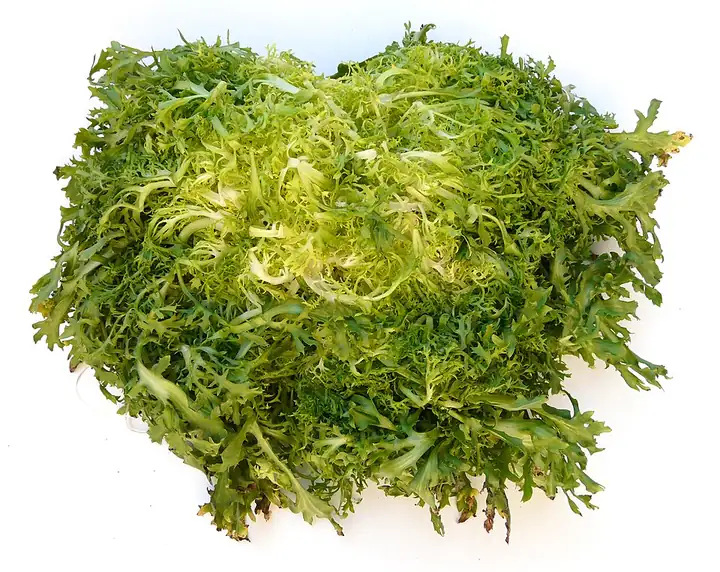
Endive and escarole
Cichorium endivia · Aster family (Asteraceae)
| Hardiness zones | 2 to 11 |
|---|---|
| Sun | full sun to part shade |
| Water | moderate |
| Life cycle | annual |
| Frost | Hardy: takes frost |
| Soil pH | 5.5–7.0 |
| Spacing | 8 to 12 inches |
| Days to harvest | 52 to 90 days |
| Soil temperature to plant | at least 32°F |
About Endive and escarole
Endive is a cool-season salad green in two forms: curly endive (frisee), with narrow, frilly leaves, and escarole, with broad, flatter leaves. Both grow much like lettuce and have a pleasantly bitter bite that mellows when the hearts are blanched. Belgian endive is a different plant (a forced chicory root).
Grown as a cool-season annual in every zone, in spring or fall; in Florida it is a fall-to-spring crop because heat makes it bolt.
When to plant
Timing is counted from your average last spring frost (and first fall frost). Sow & Tell works out the actual dates for your ZIP code.
- Sow seeds outdoors: 2 to 4 weeks before the last frost
Days count from seeding (about 52 to 90 days; leaves for salad mix can be cut about 3 weeks sooner). Plant 2 to 4 weeks before the last spring frost; for fall, New York growers sow in early August for an October-December harvest.
Soil
Medium-rich, well-drained loam kept evenly moist; steady moisture also cuts down on tipburn.
Use well-drained, medium-rich loam with pH about 5.5 to 7.0; work in compost and follow a soil test for fertilizer.
Feeding
Don't tie heads up for blanching while the leaves are wet, or the inner leaves may rot.
Harvest
Blanch first: when the outer leaves are big enough to touch the next plant, tie them up over the heart on a dry day and wait 2 to 3 weeks. Then cut the whole head at ground level. Heat or a hard freeze is a signal to cut early.
Blanched heads are cut once at ground level. If you grow it as baby salad leaves instead, you can cut it young about 3 weeks earlier, and Northeast growers get two cuts of salad mix from a weed-free bed.
Varieties (11)
Extension lists and cultivar descriptions document about 11 curly endive and escarole varieties for U.S. gardens.
| Variety | Type | Days | Notes |
|---|---|---|---|
| Frizz E | Curly endive | 90 days | Listed for Wisconsin home gardens; space plants 8-10 in apart. |
| Green Curled | Curly endive | 90 to 95 days | Dark green, finely cut, frilly leaves with fleshy midribs; the center blanches creamy white. Plants reach 16-18 in across. |
| Green Curled Ruffec | Curly endive | 90 days | Slightly bitter. Finely cut, frilled leaves; on Florida's home garden list. |
| Neos | Curly endive | 90 days | Finely curled, light green leaves; heavy 12-14 in heads with well-blanched centers. |
| Salad King | Curly endive | Large, deep green, toothed leaves with white ribs; slow to bolt and tolerant of heat, frost and tipburn. Adapted to Florida. | |
| Markant | Endive | Named among endive cultivars adapted to Florida. | |
| Broad Leaved Batavian | Escarole | 90 days | Buttery texture. Large, broad, slightly twisted leaves; heads about 16 in across. |
| Coral | Escarole | Listed for Wisconsin salad growers. | |
| Florida Deep Heart | Escarole | 85 to 90 days | Broad-leaf southern type with dark green, crumpled leaves, white midribs and a creamy white heart. |
| Full Heart Batavian | Escarole | 85 days | Upright, broad, smooth dark green leaves around a creamy yellow heart; less prone to basal rot. |
| Natasha | Escarole | Named for Northeast escarole plantings. |
Pests to watch for
Leafhoppers, Whiteflies
Diseases and problems
Tipburn, Bottom rot, Alternaria leaf spot, Downy mildew, Powdery mildew, Gray mold (Botrytis), White mold, Tomato spotted wilt, Lettuce mosaic, Turnip mosaic
In the kitchen
Eaten raw in mixed salads or cooked; escarole is sturdy enough to saute or add to soups.
Keeping it: Wash, drain and keep heads in a plastic bag in the refrigerator; at near-freezing temperatures they keep up to about 2 weeks.
Safety: The milky sap can mildly irritate sensitive skin (NC State Extension). If you take the blood thinner warfarin, keep the amount of leafy greens you eat about the same from day to day, because they are rich in vitamin K (NIH Office of Dietary Supplements).
Pets: Not listed by the ASPCA
Sources
- uaex.uada.edu
- extension.msstate.edu
- plants.ces.ncsu.edu
- gardeningsolutions.ifas.ufl.edu
- ask.ifas.ufl.edu
- hort.extension.wisc.edu
- rvpadmin.cce.cornell.edu
- uidaho.edu
- extensionpubs.unl.edu
- sare.org
- extension.oregonstate.edu
- ods.od.nih.gov
- aspca.org
- aspca.org
Photo: Photo: Frank C. Müller / Wikimedia Commons, CC BY-SA 3.0 (CC BY-SA 3.0). Photo resized for the web.

Planting dates and advice are general guidance; check with your local Cooperative Extension office for your area.