
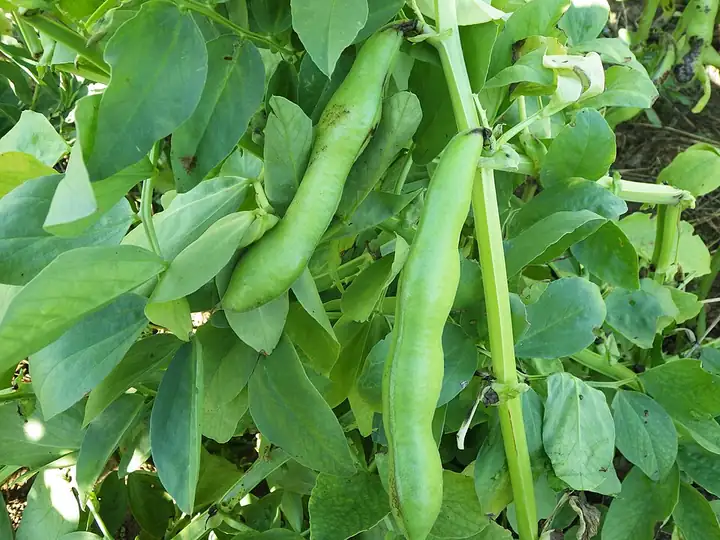
Fava bean
Vicia faba · Pea family (Fabaceae)
| Hardiness zones | 3 to 10 |
|---|---|
| Sun | full sun |
| Water | moderate |
| Life cycle | annual |
| Frost | Hardy: takes frost |
| Soil pH | 6.0–7.0 |
| Spacing | 5 to 10 inches |
| Days to harvest | 90 to 120 days |
About Fava bean
Fava beans (also called broad beans) are a cool-season bean grown for big seeds eaten fresh-shelled or dried, and for tender young pods. The stiff, upright plants need no trellis, fix their own nitrogen, and in mild-winter areas double as a winter cover crop. Heat cuts the crop short, so they are planted early like peas. Some people with an inherited enzyme shortage (G6PD deficiency) get a serious anemia from eating favas: see safety.
Grown as a cool-season annual: sown in early spring in cold-winter areas (UConn grows it down to zone 3), and sown in fall to grow through winter in mild areas such as western Oregon and California's interior and desert valleys. Most varieties die below about 15F, the hardiest below about 10F.
When to plant
Timing is counted from your average last spring frost (and first fall frost). Sow & Tell works out the actual dates for your ZIP code.
Days count from seeding to green (fresh-shell) beans; dry seed takes about 130 to 150 days from a spring sowing. Sow as soon as the soil can be worked in spring (a two-week delay cut yields about 40% in a Massachusetts trial); in mild-winter areas sow in September to November for a spring crop.
Soil
Well-drained loam or silt loam; it tolerates clay and some salt but not long waterlogging.
Use well-drained soil near neutral (pH about 6 to 7); lime only if a soil test shows pH below about 5.6.
Feeding
Don't add much nitrogen, which slows the plant's own nitrogen fixing, and hold off watering for about 2 weeks after sowing unless the soil is dry, since extra water at seeding invites root rot.
Harvest
For fresh beans, pick pods once the seeds inside are full size and bulging but still green; pods that stood upright start to droop as the seeds fill. Tender young pods can be cooked whole. For dry beans, leave pods on the plant until pods and seeds are dry.
Plants start bearing about three months after sowing and keep setting pods until hot weather (or into fall in cool areas). Pick green pods as the seeds fill; leave the last ones to dry for dry beans.
Varieties (8)
Oregon State and a SARE trial document 8 fava varieties for U.S. gardens.
| Variety | Type | Days | Notes |
|---|---|---|---|
| Coles Dwarf Prolific | Dwarf | Short plants for windy sites where taller favas may blow over. | |
| Aprovecho Select | Large-seeded | Large-seeded and cold hardy; in Oregon spring-planting trials. | |
| Aquadulce Claudia | Overwintering | Cold hardy; can be sown in fall in mild Pacific Northwest areas (late September or October) or in early spring. | |
| Sweet Lorane | Small-seeded | Small-seeded; in Oregon spring trials, and in a Massachusetts trial it yielded less than the larger-seeded varieties. | |
| Banner | Small-seeded (field or bell bean) | The most cold-tolerant fava planted in Oregon, reported to survive about 10F; used mainly as a cover crop. | |
| Broad Windsor | Spring-sown | Large-seeded (about 275 seeds per pound); the main fava sold to New England growers and recommended for spring planting in Oregon. | |
| Early White | Much smaller seeds than Windsor but outyielded it in a Massachusetts trial. | ||
| Foul Muddamma | Heat tolerant. |
Pests to watch for
Aphids, Root-knot nematodes
Diseases and problems
Chocolate spot, White mold, Root and crown rot, Broad bean viruses
In the kitchen
Shell the beans, then slip off the pale skin of each bean before or after cooking; use them like limas. Dry beans are cooked like other dried beans in Mediterranean, Middle Eastern, Chinese and Ethiopian dishes.
Keeping it: Keep unshelled pods in a bag in the refrigerator; Oregon State stores them cold (about 40-45F) and humid, because they dry out fast.
Safety: People with G6PD deficiency can get hemolytic anemia (favism) from eating fava beans or breathing the pollen; it affects about 1 in 10 African American men in the U.S. and is common in people with Mediterranean, African, Middle Eastern and Asian roots, and many don't know they have it (NIH MedlinePlus). Always cook favas fully, and check with a doctor before eating them for the first time.
Pets: Not listed by the ASPCA
Sources
- plants.ces.ncsu.edu
- horticulture.oregonstate.edu
- ir.library.oregonstate.edu
- ucanr.edu
- sonomamg.ucanr.edu
- extension.umn.edu
- homegarden.cahnr.uconn.edu
- projects.sare.org
- medlineplus.gov
- aspca.org
- aspca.org
- aspca.org
Photo: Photo: Josef Schlaghecken / Wikimedia Commons, CC BY-SA 4.0 (CC BY-SA 4.0). Photo resized for the web.

Planting dates and advice are general guidance; check with your local Cooperative Extension office for your area.