
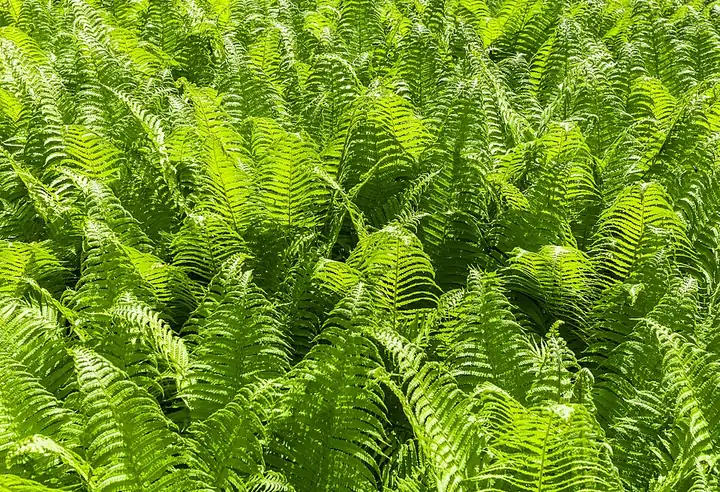
Garden ferns (ostrich, Christmas, lady, Japanese painted)
Matteuccia struthiopteris (ostrich fern), Polystichum acrostichoides (Christmas fern), Athyrium filix-femina (lady fern), Athyrium niponicum (Japanese painted fern) · Several fern families; lady and Japanese painted ferns are in Athyriaceae (NC State)
| Hardiness zones | 3 to 9 |
|---|---|
| Sun | part shade |
| Water | moderate |
| Life cycle | perennial |
| Frost | Hardy: takes frost |
About Garden ferns (ostrich, Christmas, lady, Japanese painted)
Ferns are flowerless shade plants grown for their lacy fronds. Christmas fern is a native evergreen that stays green all winter; ostrich fern makes tall vase-shaped clumps and spreads by runners into big colonies; lady fern is soft and light green; Japanese painted fern has silver, green and maroon fronds (NC State). Deer rarely bother them (Rutgers).
Ostrich fern zones 3-8, Christmas fern 3-9, lady fern 3-7 and Japanese painted fern 4-9 (NC State). Ostrich fern spreads fast by underground runners and can get weedy in a small bed.
When to plant
Timing is counted from your average last spring frost (and first fall frost). Sow & Tell works out the actual dates for your ZIP code.
Plant potted ferns or divisions in spring; divide crowns in spring (NC State). Ostrich fern can take some sun if the soil stays cool and moist, and lady fern takes more sun in moist soil. Japanese painted fern shows its best silver in light shade; too much sun washes out the color.
Soil
Moist, well-drained soil rich in organic matter; Christmas fern takes drier, rocky, acid soil, while ostrich fern likes constant moisture and even heavy, wet soil (NC State).
Mix in organic matter; most ferns want moist, humus-rich soil, though Christmas fern takes drier, rocky soil (NC State).
Feeding
Don't let new plantings dry out the first summer; lady fern and ostrich fern need steady moisture, and Christmas fern can get crown rot in soggy winter soil (NC State). Sources we found give no feeding schedule; ferns need little or none.
Varieties (5)
NC State names only a few fern cultivars; most gardeners grow the species.
| Variety | Type | Days | Notes |
|---|---|---|---|
| Pictum | Japanese painted fern | The classic silver, green and maroon form (also sold as var. pictum). | |
| Silver Falls | Japanese painted fern | Arching silver-gray fronds with dark maroon midribs. | |
| Frizelliae | Lady fern | Dwarf, about 1 ft tall, with beaded, narrow fronds. | |
| Vernoniae Cristatum | Lady fern | Crested frond tips; about 2 ft tall and wide. | |
| Barbara Alexander | Ostrich fern | A named selection of ostrich fern. |
Pests to watch for
Foliar nematodes
Diseases and problems
Crown rot
In the kitchen
Young ostrich fern fiddleheads (smooth stems with a deep U-shaped groove, papery brown scales) are a spring vegetable, picked late April to early June when 1-2 inches tall. Boil them 15 minutes or steam 10-12 minutes before eating (UMaine).
Safety: Only ostrich fern fiddleheads are eaten, and only cooked: raw or undercooked ones have caused food poisoning, and bracken fern fiddleheads cause cancer, so never eat those (UMaine).
Pets: Not listed as toxic by the ASPCA. NC State tags Christmas fern as non-toxic to cats, dogs and horses. Don't confuse these with asparagus 'ferns', which the ASPCA lists as toxic.
Sources
- plants.ces.ncsu.edu
- plants.ces.ncsu.edu
- plants.ces.ncsu.edu
- plants.ces.ncsu.edu
- extension.umaine.edu
- extension.rutgers.edu
- extension.rutgers.edu
- extension.rutgers.edu
- aspca.org
Photo: Photo: Diego Delso / Wikimedia Commons, CC BY-SA 3.0 (CC BY-SA 3.0). Photo resized for the web.

Planting dates and advice are general guidance; check with your local Cooperative Extension office for your area.