
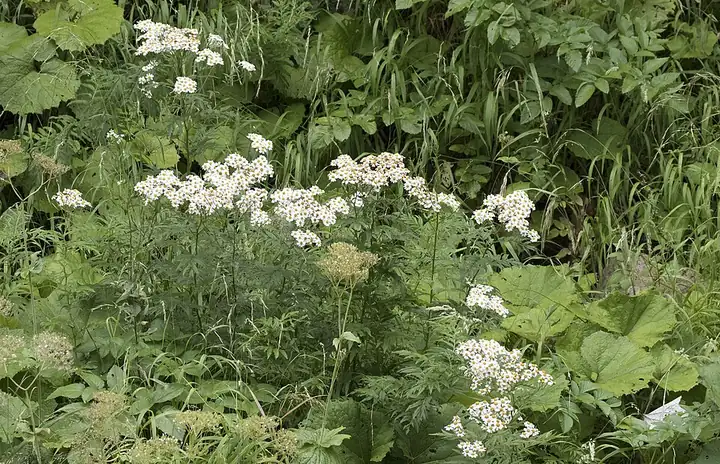
Feverfew
Tanacetum parthenium · Daisy family (Asteraceae)
| Hardiness zones | 5 to 8 |
|---|---|
| Sun | full sun to part shade |
| Water | moderate |
| Life cycle | perennial |
| Frost | Hardy: takes frost |
About Feverfew
Feverfew is a bushy, strong-smelling perennial with lacy leaves and lots of small white daisies with yellow centers. It blooms from June into September, draws bees and butterflies, and deer tend to leave it alone. It reseeds freely and can turn weedy where it is happy.
NC State lists it as hardy in zones 5-8; it struggles in hot, humid Southern summers.
When to plant
Timing is counted from your average last spring frost (and first fall frost). Sow & Tell works out the actual dates for your ZIP code.
Start from seed or by dividing an older clump (NC State). Plants grow 1-3 feet tall and 1-2 feet wide, and NC State's spacing runs from under 1 foot to 3 feet. It drops plenty of seed, so expect volunteers.
Soil
Well-drained loam or sandy soil, ideally rich in organic matter; it adapts to acid, neutral or alkaline soil (NC State).
Plant in well-drained loam or sandy soil, ideally with some organic matter; feverfew accepts acid, neutral or alkaline soil. Follow a soil test before adding fertilizer.
Feeding
Feverfew is a low-care plant that reseeds freely; rich care is not needed, and letting every flower set seed can turn it weedy.
Harvest
Cut flowering stems as the daisies open for bouquets. Snip off spent flowers before they set seed if you don't want seedlings all over the bed.
Varieties (8)
Only 8 named feverfew cultivars are described by sources we can use (NC State Plant Toolbox, Royal Horticultural Society, Berkshire Botanical Garden). Seed companies sell a few more, but we found no neutral source describing them.
| Variety | Type | Days | Notes |
|---|---|---|---|
| Crown White | Button-flowered | Tiny pure-white button flowers on plants about 28 in. tall. | |
| Rowallane | Button-flowered | Pure-white, button-shaped flowers on plants about 14 in. tall. | |
| Flore Pleno | Double-flowered | Sprays of small, double, white pompom flowers on a bushy plant up to about 1.5 ft. Good for cutting. | |
| Golden Ball | Double-flowered | Double, creamy-yellow button flowers with no white rays. About 12-18 in. tall. | |
| Ultra Double White | Double-flowered | Double white flowers on plants about 2 ft tall. A favorite of florists for cutting. | |
| White Bonnet | Double-flowered | Fully double, showy white flowers on plants about 18 in. tall. | |
| Aureum | Golden-leaf feverfew | Bright yellow-green leaves and small white daisies with yellow centers. Low and bushy, about 1 ft tall. | |
| White Star | Single-flowered | Single white daisies on plants about 2-3 ft tall. |
Pests to watch for
Twospotted spider mite, Four-lined plant bug
In the kitchen
NC State notes the leaves can be brewed into tea; read the safety notes first.
Safety: Chewing fresh leaves can cause mouth sores and irritation, and people allergic to ragweed, chrysanthemums, marigolds or other daisy-family plants may react; touching the plant can cause a skin rash (NCCIH, MSKCC, NC State). Don't take feverfew while pregnant, and ask a doctor first if you take blood thinners or other medicines: it may slow blood clotting, should be stopped at least 2 weeks before surgery, and stopping after long use can bring on headaches and stiff, achy muscles (NCCIH, MSKCC).
Pets: Not listed under its own name by the ASPCA; the ASPCA lists its daisy-family relatives chrysanthemum and chamomile as toxic to dogs, cats and horses, and NC State flags feverfew as a problem for cats, dogs and horses.
Sources
Photo: Photo: Zeynel Cebeci / Wikimedia Commons, CC BY-SA 4.0 (CC BY-SA 4.0). Photo resized for the web.

Planting dates and advice are general guidance; check with your local Cooperative Extension office for your area.