
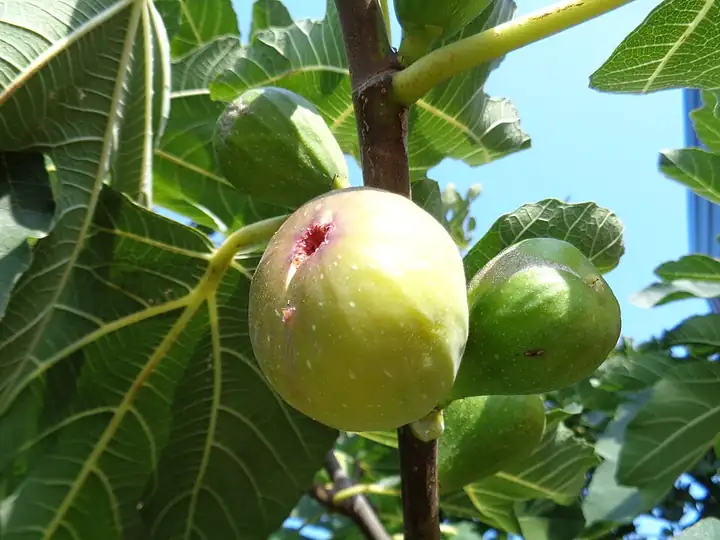
Fig
Ficus carica · Mulberry family (Moraceae)
| Hardiness zones | 7 to 10 |
|---|---|
| Sun | full sun |
| Water | moderate |
| Life cycle | perennial |
| Frost | Half-hardy: takes a light frost |
| Soil pH | 6.0–6.5 |
| Spacing | 120 to 192 inches |
About Fig
The common fig is a fast-growing shrub or small tree that sets fruit with no pollination at all, so a single plant bears. It is a Southern favorite with few serious problems besides root-knot nematodes, and many varieties bear two crops a year.
NC State lists zones 7-10. Fully dormant trees are hardy to about 15-20 F (UF/IFAS); in colder spots, plant on the south side of a building for extra warmth, and winter-killed tops usually regrow from the base (Clemson; Alabama Extension).
When to plant
Timing is counted from your average last spring frost (and first fall frost). Sow & Tell works out the actual dates for your ZIP code.
- Set out plants: up to 6 weeks before the last frost
Plant while trees are dormant, in late winter to early spring (Mississippi State; Clemson); in warm areas fall and winter planting also works. It may take 3 or 4 years to mature a crop (Clemson). Give about 1 inch of water a week (Clemson).
Soil
Well-drained, reasonably fertile soil; figs tolerate pH 5.5-8.0 but do best around 6.0-6.5 (Alabama Extension). Mulch 2-3 inches deep to hold moisture.
Test the soil before planting and bring the pH to about 5.5-6.5 with dolomitic lime if needed; loosen an area about 6 by 6 feet, at least 8 inches deep.
Feeding
- Plants 1-2 years old: once a month from when growth starts through the end of July: balanced fertilizer such as 8-8-8 or 10-10-10. About 1 ounce per plant each time (Georgia suggests about 3 ounces per application for second-year bushes), spread in a circle about 2 feet across.
- Older bushes: early spring, mid-May and mid-July (mature bushes only once, in early spring): balanced fertilizer such as 8-8-8 or 10-10-10. About 1/3 lb per foot of bush height each time for 3-5-year-old bushes; in colder areas (mountains, Piedmont) use half as much or none.
Young, overfed figs grow fast and drop their fruit before it ripens; cut back fertilizer if figs fail to ripen.
Harvest
Wait until the skin is fully colored and the fruit softens but is not mushy; when the fruit necks wilt and the figs hang down, they are ready (Mississippi State). Many varieties bear a light early-summer crop and a main crop in mid to late summer (Clemson).
Most figs bear twice a year: a light early-summer (breba) crop on last year's wood and the main crop in mid to late summer on the current season's growth.
Varieties (25)
| Variety | Type | Days | Notes |
|---|---|---|---|
| Mission | Dark (black) | Excellent quality; light strawberry to pink flesh. Reliable producer of medium to large fruit, but not very cold-hardy. | |
| Sal's Fig | Dark (black) | Good flavor; small to medium fruit. Alabama rates it extremely hardy. | |
| Osborn Prolific | Dark (bronze to brown) | Sweet and rich; amber to light strawberry flesh. Hardy. Long stalks. | |
| Brown Turkey | Dark (brown to violet) | Very sweet but not rich; good fresh and excellent for preserves. Cold-hardy. Heavy producer. After a freeze kills the top, it can still fruit on new growth. | |
| Celeste | Dark (brown to violet) | Small, sweet, excellent-quality fruit with pink to strawberry flesh; very good fresh and excellent for preserves. Very cold-hardy; the fig most often suggested for mountain areas of Georgia. Small, closed eye. Pear-shaped fruit on a long stem. | |
| Hardy Chicago | Dark (brown to violet) | Excellent flavor that Ohio State likens to peach; red to strawberry-pink flesh. Very hardy. Small fruit (about 18 g in Ohio). Less productive than Celeste. | |
| Hunt | Dark (brown) | Small, sweet, rich fruit; good fresh and excellent for preserves. Well suited to the rainy South; long stems help fruit shed rain. | |
| Violette de Bordeaux | Dark (nearly black) | Distinctive, pleasantly tart-sweet flavor; deep red flesh. Excellent fresh or dried. Fairly hardy; large fruit. | |
| LSU Purple | Dark (purple) | Good fresh; strawberry flesh. Quality varies. Alabama says it seems cold-tender. | |
| Black Jack | Dark (purple-brown) | Good; large to very large fruit. Fairly hardy. | |
| Beall | Dark (purplish black) | Very good; amber flesh. Good fresh or dried. Hardy; medium-large fruit. | |
| Nero | Dark (purplish black) | Very good to excellent; large fruit with light pink flesh. Well suited to the South and Southwest. Medium, open eye. | |
| Kathleen's Black | Dark (violet-black) | Rich, sweet fruit with red flesh, a bit larger than Mission. | |
| Green Ischia | Light (bright green) | Good quality with dark strawberry flesh; Georgia and Rutgers note the seeds can be objectionable. Fairly hardy. Small fruit with a fairly closed eye. | |
| Magnolia | Light (bronze with white flecks) | Fair fresh; excellent for preserves. Medium fruit. | |
| Brunswick | Light (bronzy yellow) | Rich flavor; medium-large fruit. Fairly hardy. Open eye, so heavy rain can ruin the fruit. | |
| Alma | Light (golden brown) | Sweet, delicate, very good fresh; amber flesh. Very hardy wood. Highly resistant to fruit rot. | |
| Adriatic | Light (green) | Good quality with strawberry to amber flesh; often dried. Fairly hardy. Small, closed eye. | |
| Marseilles | Light (green) | White flesh with large, noticeable seeds. | |
| Blanche | Light (greenish yellow) | Sweet, delicate, nutty flavor; white flesh. Fairly hardy; medium to large fruit. | |
| Kadota | Light (greenish yellow) | Rich and sweet; fair fresh but excellent canned or preserved. Fairly hardy. | |
| LSU Gold | Light (yellow with red blush) | Outstanding flavor; large fruit with strawberry flesh. Small eye that can leak honeydew. | |
| Excel | Light (yellow) | Superb flavor; amber flesh. Very hardy. | |
| Conadria | Light (yellow-green) | Rich flavor; light strawberry flesh. Hardy and bounces back well after cold. Georgia suggests it for southern areas. | |
| Panache | Striped (green and yellow) | Only fair eating quality; strawberry flesh. Striped fruit makes it an ornamental garden fig. Not hardy. |
Pests to watch for
Root-knot nematodes, Scale insects, Twospotted spider mite, Aphids, Spotted wing drosophila, Birds, Tree squirrels, Rabbits, Granulate ambrosia beetle, Green June beetle (fig-eater), Mealybugs
Diseases and problems
Rust, Frost and freeze injury
In the kitchen
Eaten fresh, dried or made into preserves.
Keeping it: Ripe figs only last a few days, so keep them in the fridge and eat or preserve them fast.
Safety: The milky sap (latex) can irritate skin, and its furanocoumarins can cause a sunlight-triggered rash (phytophotodermatitis), so wear gloves and long sleeves when pruning (NC State; UF/IFAS).
Pets: The ASPCA lists 'fig' (the ornamental weeping fig, Ficus benjamina) as toxic to dogs, cats and horses, with sap enzymes (ficin) and psoralen causing stomach and skin irritation; the edible fig is not listed separately, but its sap contains similar irritants (NC State)
Sources
- plants.ces.ncsu.edu
- content.ces.ncsu.edu
- hgic.clemson.edu
- ask.ifas.ufl.edu
- aces.edu
- extension.msstate.edu
- aspca.org
- extension.unh.edu
- extension.umd.edu
- extension.psu.edu
- njaes.rutgers.edu
- fieldreport.caes.uga.edu
Photo: Photo: Silverije, CC BY-SA 4.0, via Wikimedia Commons (CC BY-SA 4.0). Photo resized for the web.

Planting dates and advice are general guidance; check with your local Cooperative Extension office for your area.