
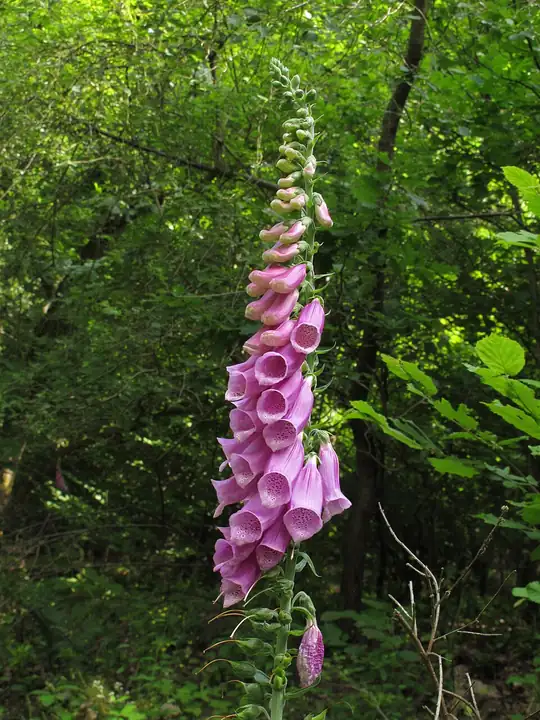
Foxglove
Digitalis purpurea (common foxglove) and its hybrids, including strawberry foxglove (D. x mertonensis) · Plantain family (Plantaginaceae)
| Hardiness zones | 4 to 9 |
|---|---|
| Sun | full sun to part shade |
| Water | moderate |
| Life cycle | biennial |
| Frost | Hardy: takes frost |
| Spacing | 18 inches |
About Foxglove
Common foxglove is a cottage-garden classic. The first year it makes a low rosette of soft, veined leaves; the second year it sends up 2-5 ft spikes of tube-shaped flowers, often spotted inside, that bumblebees and hummingbirds visit (NC State, Wisconsin Extension). Every part is deadly poisonous: it contains the heart compounds behind digitalis medicines, and its first-year leaves have been mistaken for comfrey, borage and even kale (CMAJ, Poison Control). It reseeds heavily, and California's Cal-IPC lists it as an invasive plant.
Hardy in zones 4-9, though some cultivars only to zone 5 (Wisconsin Extension). Invasive: Cal-IPC rates it a 'Limited' invasive in California meadows and roadsides, and Wisconsin Extension notes it's weedy in the Pacific Northwest; a different species, Grecian foxglove (D. lanata), is a prohibited noxious weed in Minnesota.
When to plant
Timing is counted from your average last spring frost (and first fall frost). Sow & Tell works out the actual dates for your ZIP code.
Sow seed outdoors in late summer for flowers next year, or indoors in late spring; don't cover the seed, since it needs light to sprout (Wisconsin Extension). Move seedlings out after the last spring frost, about 18 inches apart. Most plants bloom their second year, but 'Foxy', 'Camelot' and 'Dalmatian' flower the year they're sown. We found no sourced day count to first bloom, so days_to_harvest is empty.
Soil
Moist, well-drained soil high in organic matter, on the acid side (below pH 6.0); it does best with afternoon shade, and dry spells cut flowering (NC State, Wisconsin Extension).
Work compost or other organic matter into the bed so the soil stays moist and humus-rich; foxglove likes slightly acid soil (NC State).
Feeding
- Early spring of the blooming year, just before new growth starts: complete slow-release fertilizer such as 12-6-6. Without a soil test, Clemson suggests 1-2 lb per 100 sq ft; keep it off the leaves and water it in.
Too much fertilizer gives soft growth and fewer flowers (Penn State). Don't let the soil dry out, and wear gloves when handling the leaves.
Harvest
The main show is early summer of the second year; cutting off spent spikes can bring a few more stems later (Wisconsin Extension). Deadhead to limit seedlings, but leave a few spikes to drop seed if you want foxgloves every year. For the vase, cut when about half the flowers on the spike are open (Oklahoma State). Wear gloves: the leaves can irritate sensitive skin.
Varieties (12)
Wisconsin Extension and NC State document these 12 foxgloves; we found no other trustworthy cultivar lists.
| Variety | Type | Days | Notes |
|---|---|---|---|
| Alba | Common foxglove (D. purpurea) | Pure white flowers without spots, 3.5-4 ft tall. | |
| Excelsior Hybrids | Common foxglove (D. purpurea) | Pastel pink, white or yellow flowers that ring the stem and face outward. | |
| Gloxinioides (The Shirley) | Common foxglove (D. purpurea) | Dense spikes in cream, salmon, pink and purple. | |
| Sutton's Apricot | Common foxglove (D. purpurea) | Creamy salmon-pink flowers, 3.5-4 ft tall. | |
| Temple Bells | Common foxglove (D. purpurea) as listed by NC State | Dwarf plants with yellow tubular flowers marked with brown. | |
| Candy Mountain | Common foxglove (D. purpurea), biennial series | Big flowers held sideways to slightly upturned, so you see the spots inside; 3-4 ft. Peach, Rose and a mix. | |
| Camelot series | Common foxglove (D. purpurea), F1 hybrid, first-year bloomer | About 4 ft tall; Lavender, Rose, White and a mix. | |
| Dalmatian series | Common foxglove (D. purpurea), F1 hybrid, first-year bloomer | Compact, 16-20 in; Cream, Peach, Rose, Purple, White and a mix. | |
| DiBella series | Common foxglove (D. purpurea), first-year bloomer | Tall, many-stemmed plants with large flowers in creamy white, peach, purple and white. | |
| Foxy | Common foxglove (D. purpurea), first-year bloomer | Compact, 2-3 ft, in white, cream and rose; blooms the year it's sown. | |
| HANABEE series | Common foxglove (D. purpurea), first-year bloomer | Compact, 16-24 in, several stems per plant; pink, rose and white. | |
| Strawberry foxglove (D. x mertonensis) | Hybrid of common and yellow foxglove | Large coppery-pink flowers; comes true from seed and blooms for several years. |
Pests to watch for
Aphids, Japanese beetle, Mealybugs
Diseases and problems
Powdery mildew, Fungal leaf diseases
In the kitchen
Safety: Deadly poisonous. Every part contains cardiac glycosides (digitalis) that can cause vomiting, severe headache, blurred or colored vision, a slow or irregular heartbeat and death (NC State, MedlinePlus). The first-year leaf rosette has been mistaken for comfrey and borage leaves, and in one Canadian case for kale, causing serious poisonings (CMAJ, Poison Control). Never make tea or food from it; if any is swallowed, call Poison Help at 1-800-222-1222.
Pets: Toxic to dogs, cats and horses (ASPCA). Its heart-affecting glycosides are in every part (NC State), and Poison Control advises not planting it where pets play.
Sources
- plants.ces.ncsu.edu
- hort.extension.wisc.edu
- poison.org
- medlineplus.gov
- cmaj.ca
- cal-ipc.org
- mda.state.mn.us
- extension.okstate.edu
- aspca.org
- aspca.org
- aspca.org
- extension.rutgers.edu
- hgic.clemson.edu
- extension.psu.edu
Photo: Photo: Robert Flogaus-Faust / Wikimedia Commons, CC BY 4.0 (CC BY 4.0). Photo resized for the web.

Planting dates and advice are general guidance; check with your local Cooperative Extension office for your area.