
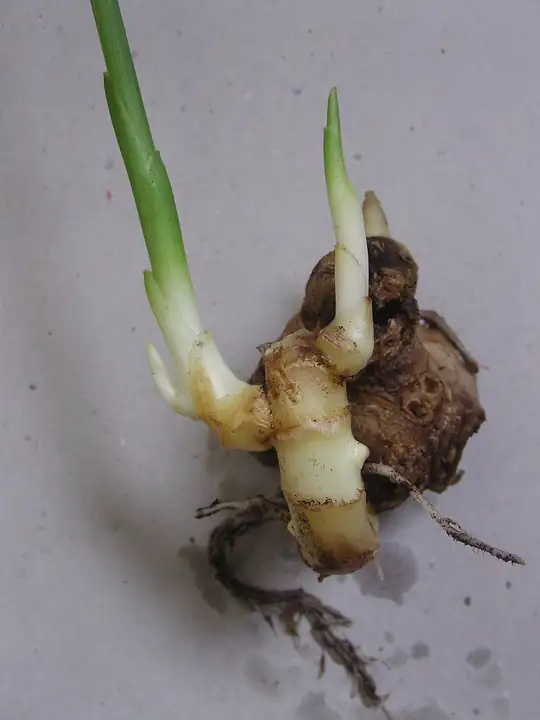
Ginger
Zingiber officinale · Ginger family (Zingiberaceae)
| Hardiness zones | 7 to 12 |
|---|---|
| Sun | part shade |
| Water | moderate |
| Life cycle | tender perennial (grown as an annual) |
| Frost | Tender: killed by frost |
| Spacing | 6 to 15 inches |
| Soil temperature to plant | at least 55°F |
About Ginger
Ginger is a tropical plant grown for its knobby, spicy underground stems (rhizomes), sometimes called 'hands'. It is planted from pieces of rhizome, not seed, and needs a long warm season: full-size ginger takes about 8 to 10 months, while mild, thin-skinned 'baby ginger' is dug in fall before frost. It likes some shade and does well in big pots.
A perennial outdoors only in zones 9-12 (NC State; Clemson), and it grows throughout Florida in soil with plenty of organic matter (UF/IFAS). In zone 7 and warmer it can be grown as a one-season crop for baby ginger (NC State Extension), and Kentucky growers raise it in high tunnels; in colder areas grow it in a pot and bring it indoors for winter.
When to plant
Timing is counted from your average last spring frost (and first fall frost). Sow & Tell works out the actual dates for your ZIP code.
- Start seeds indoors: 4 to 8 weeks before the last frost
Plant rhizome pieces 1 to 1.5 inches long with a few buds, about 1 inch deep; let cut pieces dry a day or two first so they don't rot (UF/IFAS; NC State). To get a head start, pre-sprout them in moist potting mix at about 70-85 F for 4 to 8 weeks, then plant out after the danger of frost has passed, once soil is near 55 F (NC State Extension; Kentucky). Baby ginger is ready about 6 to 10 months after planting and mature ginger in about 8 to 12 months (Kentucky; UF/IFAS). Spacing: about 15 inches apart in a garden bed (UF/IFAS); commercial rows use 5-6 inches in the row with 42 inches between rows (Kentucky).
Soil
Loose, well-drained soil rich in organic matter, kept evenly moist but never soggy; on rocky ground UF/IFAS suggests a raised bed at least 8 inches deep.
Work plenty of compost or other organic matter into loose, well-drained soil (UF/IFAS suggests a 1:1 mix of sand and cow manure) and follow a soil test for fertilizer.
Feeding
- first hilling, when the base of the stems turns from white to bright pink: nitrogen fertilizer such as 21-0-0. Scatter a light side-dressing near the base of the plants, then pull soil up over the rhizomes and water it in; follow a soil test, as no home-garden rate is published.
- second hilling, 4 to 6 weeks after the first: nitrogen fertilizer such as 21-0-0. Repeat the light side-dressing at the base of the plants, hill again, and water in.
Don't keep the soil soggy before shoots appear or plant in full sun (rot and brown leaf tips), and don't plant where tomatoes, peppers or eggplant grew, since they share bacterial wilt.
Harvest
Dig the whole clump in fall when the tops die back, or before the first frost for baby ginger, which needs no peeling (UF/IFAS; NC State Extension). You can also break off a piece from the edge of the clump during the season and let the plant keep growing (UVM Extension).
Most gardeners dig the whole clump once, in fall before frost (baby ginger) or when the tops die back. You can snap off a piece at the edge of the clump during the season, and leaving part of the clump in the ground in frost-free areas gives new shoots next spring.
Varieties (4)
University trials and extension sources name only 4 ginger cultivars; much ginger is sold simply as seed ginger or by origin.
| Variety | Type | Days | Notes |
|---|---|---|---|
| Bubba Blue | Popular with growers; the flesh takes on a blue tint as it ages. It gave its best yield with no shade in a 2019 high-tunnel trial. | ||
| Chinese White | Yielded the most of three cultivars (about 625 g per plant) in an NC A&T greenhouse trial; also tested in high tunnels under shade cloth. | ||
| Hawaii Yellow | The only one of three cultivars in an NC A&T trial with a strong aroma. Lower yield (about 417 g per plant) than Chinese White or Kali Ma in a greenhouse trial; it drew caterpillars there. | ||
| Kali Ma | Yielded nearly as much as Chinese White (about 613 g per plant) in an NC A&T greenhouse trial. |
Pests to watch for
Root-knot nematodes
Diseases and problems
Bacterial wilt, Root and crown rot, Soft rot, Fusarium yellows
In the kitchen
Grate or slice fresh ginger into stir-fries, marinades, stews, pickles and tea, candy it, or dry and grind it for baking; the young shoots are edible too, with a milder flavor (Clemson; NC State).
Keeping it: Let freshly dug ginger dry in the shade until the skin firms up, then keep it in the refrigerator or freeze it and thaw pieces as needed. Baby ginger is perishable: refrigerate it right away.
Safety: Ginger in food is generally fine, but larger amounts can cause heartburn, stomach upset or mouth irritation (NCCIH). Ginger supplements may raise bleeding risk with warfarin and other blood thinners or with NSAIDs, so MSKCC advises stopping them two weeks before surgery and avoiding them with bleeding disorders or gallstones; ask a health care provider before using ginger supplements in pregnancy or while breastfeeding (NCCIH; MSKCC).
Pets: Not listed by the ASPCA
Sources
- gardeningsolutions.ifas.ufl.edu
- plants.ces.ncsu.edu
- hgic.clemson.edu
- extensiongardener.ces.ncsu.edu
- uvm.edu
- ccd.uky.edu
- www3.ctahr.hawaii.edu
- blogs.ifas.ufl.edu
- nccih.nih.gov
- mskcc.org
- aspca.org
Photo: Photo: Olli Salmela / Wikimedia Commons, CC BY-SA 3.0 (CC BY-SA 3.0). Photo resized for the web.

Planting dates and advice are general guidance; check with your local Cooperative Extension office for your area.