
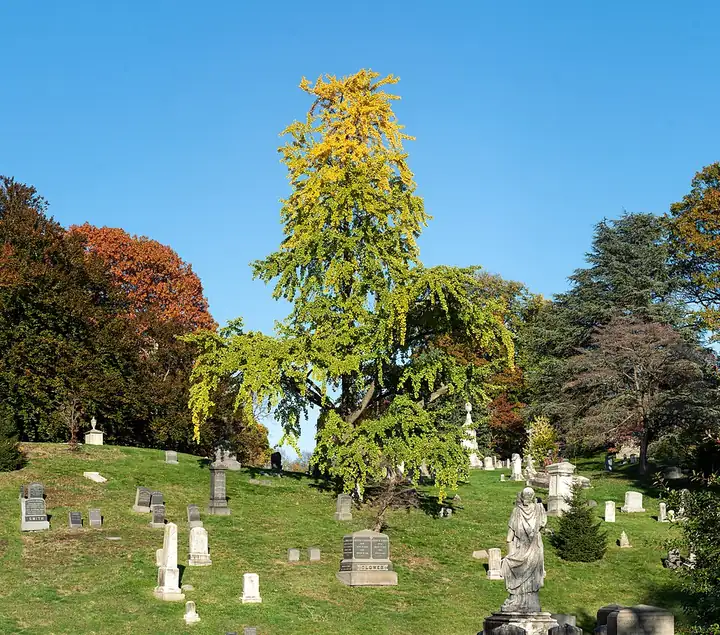
Ginkgo
Ginkgo biloba · Ginkgo family (Ginkgoaceae)
| Hardiness zones | 3 to 9 |
|---|---|
| Sun | full sun |
| Water | low |
| Life cycle | perennial |
| Frost | Hardy: takes frost |
About Ginkgo
Ginkgo, or maidenhair tree, is an ancient 'living fossil' tree from China with fan-shaped leaves that turn bright golden yellow in fall and often drop all at once. It shrugs off heat, drought, pollution and city conditions and has few pests. Female trees drop smelly, messy seeds, so plant grafted male cultivars.
Zones 3-9 (NC State).
When to plant
Timing is counted from your average last spring frost (and first fall frost). Sow & Tell works out the actual dates for your ZIP code.
Plant container or balled-and-burlapped trees. Container trees can go in any time the ground can be worked, but fall is the best season in the South because roots keep growing through mild weather (Clemson). Dig the hole no deeper than the root ball and at least twice as wide, keep the top roots level with the soil, and mulch 2-4 inches without touching the trunk. Choose a named male cultivar to avoid the foul-smelling seeds (NC State).
Soil
Any well-drained soil, clay to sand and acidic to alkaline; avoid wet sites (NC State).
Test the soil first. Loosen a wide planting area and mix 10-20 percent compost into the native soil you dig out; don't use uncomposted bark, and don't dig deeper than the root ball (Clemson).
Feeding
- Spring to early summer, after the tree is established, and only if a soil test or pale leaves and weak twig growth show a need: slow-release nitrogen fertilizer with a ratio near 3-1-1 or 3-1-2 (3-0-1 or 3-0-2 if the soil test shows enough phosphorus). Spread it evenly from just outside the trunk flare to the dripline and water it in. Clemson cites 2-4 lb of slow-release nitrogen per 1,000 sq ft per year, split into a spring and a late-summer feeding; follow your soil test.
First-year watering matters far more than fertilizer: water daily for the first 1-2 weeks, every 2-3 days until week 12, then weekly, using about 1-1.5 gallons per inch of trunk diameter, until the tree is established, roughly 1.5 years per inch of trunk (UMN). Don't count on rain unless it was over an inch. Avoid wet, poorly drained sites (NC State); once established it needs little care. Too much fertilizer can burn roots and push soft growth that pests and cold injure (Clemson).
Varieties (10)
NC State documents these male (seedless) cultivars.
| Variety | Type | Days | Notes |
|---|---|---|---|
| Chi Chi | Dwarf | About 6 ft tall and 5 ft wide. | |
| Mariken | Dwarf | Up to about 3 ft, somewhat weeping. | |
| Saratoga | Male | About 45 ft tall, 30 ft wide. | |
| Jade Butterfly | Male, compact | About 14 ft tall and 8 ft wide; leaves shaped like butterfly wings. | |
| Sky Tower | Male, compact | Compact and upright, about 18 ft tall and 8 ft wide. | |
| Princeton Sentry | Male, narrow | About 45 ft tall, 25 ft wide. | |
| Golden Globe | Male, rounded | Rounded, shady crown with good fall color. | |
| Autumn Gold | Male, upright | About 45 ft tall, 25 ft wide. | |
| Bryson City | Male, vase-shaped | Narrow vase shape with golden fall color. | |
| Weeping Wonder | Weeping | About 10 ft tall and 5 ft wide. |
Diseases and problems
Girdling roots
In the kitchen
Once the smelly outer pulp is removed and the seed washed, the kernel can be boiled or roasted and eaten (NC State).
Safety: Seed pulp can cause a skin rash (contact dermatitis) and irritates the mouth and stomach if eaten (NC State). The kernels contain ginkgotoxin, which cooking only partly removes: eating more than a few at a time can cause vomiting and seizures, and children are most at risk, so treat cooked ginkgo nuts as an occasional small snack, never a bowlful.
Pets: Not on the ASPCA's toxic plant list for dogs.
Sources
Photo: Photo: Rhododendrites / Wikimedia Commons, CC BY-SA 4.0 (CC BY-SA 4.0). Photo resized for the web.

Planting dates and advice are general guidance; check with your local Cooperative Extension office for your area.