
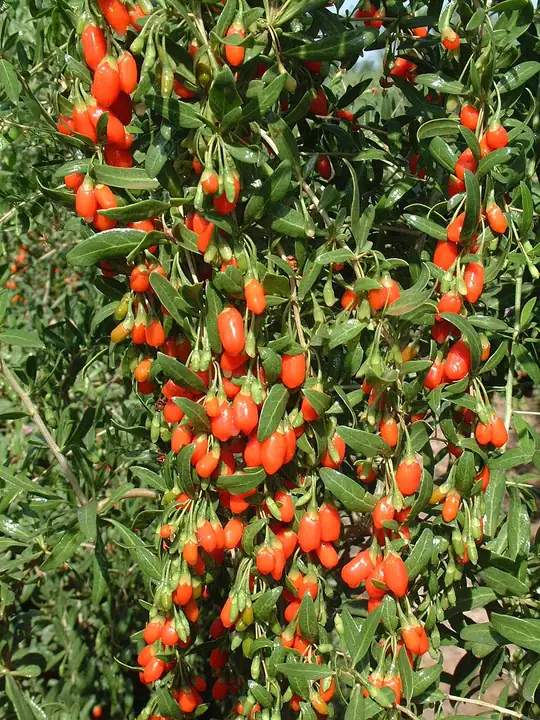
Goji (wolfberry)
Lycium barbarum (also L. chinense) · Nightshade family (Solanaceae)
| Hardiness zones | 4 to 7 |
|---|---|
| Sun | full sun |
| Water | moderate |
| Life cycle | perennial |
| Frost | Hardy: takes frost |
| Soil pH | 7.0–8.0 |
| Spacing | 48 to 60 inches |
About Goji (wolfberry)
Goji, also called wolfberry or matrimony vine, is a loose, arching shrub in the tomato family with small, bright red berries that are often dried. It is self-fruitful and bears quickly, often within a year or two. Heads-up: it suckers and spreads by seed and is considered a weed in parts of North America (Utah State; NC State), and the National Park Service Mid-Atlantic Exotic Plant Management Team lists matrimony vine as invasive, although USDA PLANTS shows no noxious listing.
Utah State recommends it for zones 4-7; the National Park Service Mid-Atlantic Exotic Plant Management Team lists matrimony vine (L. barbarum) as invasive (via EDDMapS), and no state noxious listing was found.
When to plant
Timing is counted from your average last spring frost (and first fall frost). Sow & Tell works out the actual dates for your ZIP code.
Plant in spring in a hole twice as wide as the roots (Utah State). Plants begin bearing 1 to 2 years after planting and reach full production in 3 to 5 years; after about 3 years they start to send up suckers from the roots. Do not prune the first year; later, pinch shoot tips in early summer and thin weak wood in the dormant season. Utah State's main pest is the goji gall mite, which raises small bead-like galls on the leaves.
Soil
Light, well-drained loam that is slightly alkaline; it tolerates clay but not waterlogged soil (Utah State). Give about 1 inch of water a week, more often for new plants in sandy soil.
Plant in light, well-drained loam with a slightly alkaline pH of about 7-8; avoid spots that stay waterlogged (Utah State).
Feeding
- At bud break each spring: balanced fertilizer such as 16-16-16. Utah State suggests 4-5 Tbsp per 10 square feet per year in total, split into three feedings; use less in fertile soil and water it in.
- At flowering: balanced fertilizer such as 16-16-16. The second third of the yearly amount, spread evenly and watered in.
- As the first fruits ripen: balanced fertilizer such as 16-16-16. The last third of the yearly amount, spread evenly and watered in.
Uneven watering can cause blossom end rot on the berries (Utah State); give about 1 inch of water a week.
Harvest
Pick when berries reach full color, about 35 days after full bloom; plants keep fruiting from midsummer to late fall. Pull each berry slightly to the side rather than straight up (Utah State). Fresh berries keep about 2 weeks in the refrigerator.
Goji keeps making new flowers, so berries ripen from midsummer to late fall; pick each when fully colored, about 35 days after bloom. Fruit forms on the current year's growth, so shorten side branches in the dormant season and pinch shoot tips in early summer to keep new fruiting wood coming.
Varieties (3)
Only 3 named goji cultivars are documented by a neutral source (Utah State University), which says US cultivar choices are still limited and gives almost no detail for each. Utah State recommends goji for zones 4-7 but does not rate single cultivars. Goji (matrimony vine) is listed as invasive by the National Park Service Mid-Atlantic Exotic Plant Management Team.
| Variety | Type | Days | Notes |
|---|---|---|---|
| Crimson Star | Goji (Lycium barbarum) | Starts bearing 1-2 years after planting and reaches full crops in 3-5 years. | |
| Phoenix Tears | Goji (Lycium barbarum) | Starts bearing 1-2 years after planting and reaches full crops in 3-5 years. | |
| Wolfberry Agrodevco | Goji (Lycium barbarum) |
Pests to watch for
Aphids, Thrips, Twospotted spider mite, Potato leafhopper
Diseases and problems
Powdery mildew, Blossom end rot
In the kitchen
Berries are eaten fresh, dried, frozen, juiced or brewed as tea (Utah State).
Keeping it: Fresh berries keep about two weeks in the fridge.
Safety: The leaves contain atropine-like alkaloids and can cause headache, stomach upset, vomiting and dilated pupils if eaten in large amounts (NC State). Goji may strengthen the effect of warfarin (cases of raised INR) and can change how the liver breaks down other drugs; people with food or pollen allergies, especially to lipid transfer proteins, have had allergic reactions (MSKCC). We found no research-based guidance on pregnancy.
Pets: Not listed as toxic by the ASPCA
Sources
- extension.usu.edu
- plants.ces.ncsu.edu
- mskcc.org
- eddmaps.org
- plantsservices.sc.egov.usda.gov
- plantsservices.sc.egov.usda.gov
- aspca.org
- aspca.org
Photo: Photo: Paul Gross and Richard Zhang / Wikimedia Commons, Public domain. Photo resized for the web.

Planting dates and advice are general guidance; check with your local Cooperative Extension office for your area.