
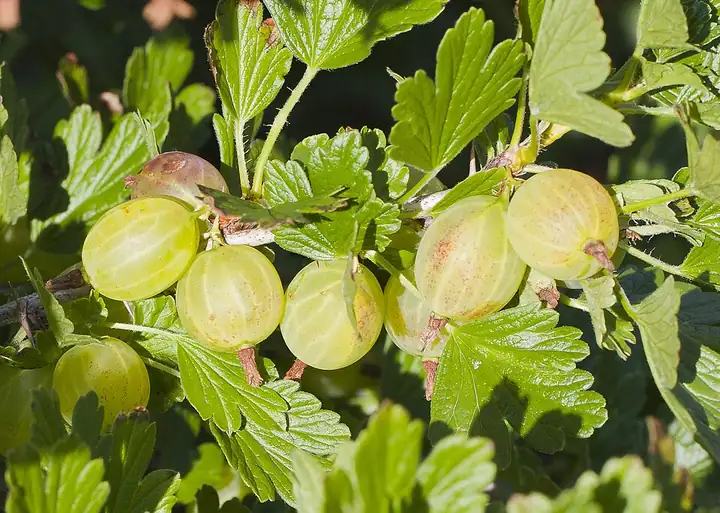
Gooseberry
Ribes hirtellum (American gooseberry), Ribes uva-crispa (European gooseberry) and hybrids · Currant family (Grossulariaceae)
| Hardiness zones | 3 to 8 |
|---|---|
| Sun | full sun to part shade |
| Water | moderate |
| Life cycle | perennial |
| Frost | Hardy: takes frost |
| Soil pH | 6.0–7.0 |
| Spacing | 36 to 60 inches |
About Gooseberry
Gooseberries are thorny, very cold-hardy shrubs with tart berries that can be picked green for cooking or ripe for eating fresh. Like currants, they can host white pine blister rust, so check your state's rules first.
Hardy to zone 3; most varieties survive midwinter lows of -40 F (Utah State). They like some afternoon shade where summers are hot, and they need winter chill, so they are rarely grown south of about zone 8.
When to plant
Timing is counted from your average last spring frost (and first fall frost). Sow & Tell works out the actual dates for your ZIP code.
- Set out plants: 2 to 6 weeks before the last frost
Plant bare-root stock in fall or very early spring before growth starts, and prune it back to 2-4 buds (Utah State). Currants and gooseberries usually fruit 1 to 3 years after planting (University of Minnesota).
Soil
Well-drained soil; a spot with shade during the hottest part of the day helps.
Aim for a pH of 6.0-7.0; test the soil and work organic matter into silt or clay soils to improve drainage.
Feeding
- Once a year after plants are established: balanced fertilizer such as 10-10-10 or 16-16-16. About 1/2 cup per plant (plus about 2 Tbsp of potassium fertilizer if a soil test shows it is needed), spread around the plant; or a few shovels of composted manure in late fall.
Too much nitrogen encourages disease, especially mildew; don't dig deeply near the shallow roots.
Harvest
Pick berries green and firm for pies and jam, or wait until they are fully ripe to eat fresh (Utah State).
Gooseberries give one crop a year in June-July and hold on the bush, so one or two pickings are usually enough. Fruit is best on 2- and 3-year-old canes; each dormant season remove the oldest canes so younger ones replace them.
Varieties (16)
| Variety | Type | Days | Notes |
|---|---|---|---|
| Amish Red | American gooseberry | Medium, deep red berries. Vigorous with some mildew resistance. | |
| Jahn's Prairie | American gooseberry | Red-pink berries with excellent eating quality. Resists botrytis and mildew. | |
| Oregon Champion | American gooseberry | Smaller fruit. Healthier and more mildew-resistant than European types. | |
| Pixwell | American gooseberry | Only fair fruit quality. Very productive and hardy; resists mildew. The most commonly sold gooseberry. | |
| Poorman | American gooseberry | Large, red, flavorful berries. Resists powdery mildew. Vigorous, with fewer and smaller thorns than most. | |
| Welcome | American gooseberry | Reddish, somewhat tart berries. Moderately mildew-resistant. Upright and nearly spine-free once established. Released in 1957. | |
| Black Velvet | American-European hybrid gooseberry | Dark red berries with a blueberry-like flavor. Vigorous with good disease resistance. | |
| Captivator | American-European hybrid gooseberry | Large, sweet, pinkish-red berries. Resists powdery mildew. Tall plant with few thorns. | |
| Careless | European gooseberry | Large, well-flavored fruit. UMass lists it with European types prone to mildew and leaf spot. | |
| Colossal | European gooseberry | Very large berries that turn deep red when ripe. Vigorous and hardy. Tolerates powdery mildew and blister rust. | |
| Early Sulphur | European gooseberry | Large, well-flavored fruit. UMass lists it with European types prone to mildew and leaf spot. | |
| Hinnonmaki Red | European gooseberry | Tart skin over sweet, aromatic flesh. Moderate vigor. May fruit the year it is planted. Minnesota rates it mildew-resistant; Penn State says partly resistant; UMass groups it with mildew-prone European types. | |
| Hinnonmaki Yellow | European gooseberry | Large, well-flavored fruit. UMass groups it with European types that are prone to mildew and leaf spot. | |
| Invicta | European gooseberry | Large, pale green berries with mild flavor. Very high yields on very spiny plants. Minnesota and Penn State rate it mildew-resistant, with moderate blister rust resistance. | |
| Leveller | European gooseberry | Large, well-flavored fruit. UMass lists it with European types prone to mildew and leaf spot. | |
| Tixia | European gooseberry | Large, bright red, teardrop-shaped berries with mild flavor. Nearly thornless (fewer, softer spines). Vigorous. Minnesota and Penn State rate it mildew-resistant. |
Pests to watch for
Imported currantworm, Aphids
Diseases and problems
Powdery mildew, Anthracnose, Rust
In the kitchen
Used green in pies, jams and sauces, or eaten fresh when ripe.
Keeping it: Cool berries quickly; in a covered container in the fridge they keep up to several weeks.
Safety: Currants and gooseberries are alternate hosts of white pine blister rust, a disease that can kill white pines, so some states restrict them: North Carolina bans all Ribes statewide (NC Department of Agriculture), Maine bans European black currant statewide and all Ribes in many counties (Maine Forest Service), and Ohio bans European black currant except approved rust-resistant varieties (Ohio State). Many states lifted their rules decades ago (Oregon State), so check with your state department of agriculture before you buy. University of Minnesota notes most gooseberry varieties it lists are rust-resistant.
Pets: Not listed as toxic by the ASPCA
Sources
- extension.usu.edu
- extension.umn.edu
- s3.wp.wsu.edu
- extension.oregonstate.edu
- content.ces.ncsu.edu
- ncagr.gov
- maine.gov
- ohioline.osu.edu
- aspca.org
Photo: Photo: Diego Delso, delso.photo, License CC BY-SA 3.0, via Wikimedia Commons (CC BY-SA 3.0). Photo resized for the web.

Planting dates and advice are general guidance; check with your local Cooperative Extension office for your area.