
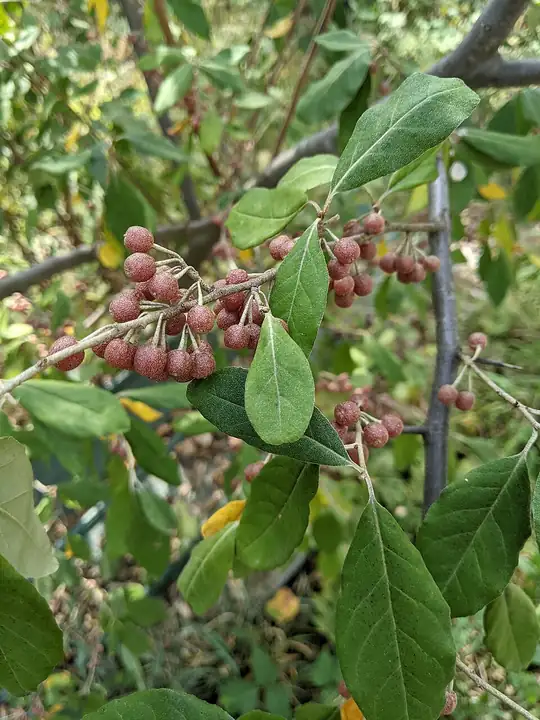
Goumi
Elaeagnus multiflora · Oleaster family (Elaeagnaceae)
| Hardiness zones | 5 to 9 |
|---|---|
| Sun | full sun |
| Water | moderate |
| Life cycle | perennial |
| Frost | Hardy: takes frost |
About Goumi
Goumi is a rounded, somewhat thorny shrub about 8 feet tall with silvery leaves and bright red berries the size of a small cherry. It blooms very early, needs little care, and its fruit shakes off easily when ripe. It is a cousin of the invasive autumn olive: USDA PLANTS shows no noxious or invasive listing for goumi and UW-Madison saw no invasive tendencies, but it does appear in the WeedUS database of plants invading natural areas (via EDDMapS), so keep an eye out for seedlings.
Rated for zones 5-9 and marginal in zone 4, where cold can kill stems back (UW-Madison CIAS); no state noxious or invasive listing was found, though it is in the WeedUS natural-areas database.
When to plant
Timing is counted from your average last spring frost (and first fall frost). Sow & Tell works out the actual dates for your ZIP code.
Expect the first berries 2 to 3 years after planting (UW-Madison CIAS). Flowers open very early, in late March or sooner in a warm spring. If winter cold kills stems back, renewal pruning brings the shrub back.
Soil
Tolerates a wide range of soils as long as drainage is moderate to good (UW-Madison CIAS).
Choose a sunny spot with moderate to good drainage; goumi tolerates a wide range of soils (UW-Madison CIAS).
Feeding
Protect young stems from mice and rabbits, which can girdle them (UW-Madison CIAS).
Harvest
The red berries ripen evenly and shake off easily when they are ripe (UW-Madison CIAS).
Varieties (1)
Only one named goumi cultivar, Sweet Scarlet, is described by a neutral source (University of Wisconsin). Other goumis are sold as seedlings or under nursery names we could not confirm from a university or government source.
| Variety | Type | Days | Notes |
|---|---|---|---|
| Sweet Scarlet | Goumi | Bright red berries about the size of a small cherry, pleasantly tart with slight astringency even when fully ripe. Shrub to about 8 ft. In Wisconsin trials it died back a lot at -20 F but regrew quickly. |
Pests to watch for
Rabbits
In the kitchen
Eaten fresh or made into sauces, pies, jellies and juice (UW-Madison CIAS).
Safety: The sources we checked list no toxic parts, and we found no research-based guidance on use in pregnancy, drug interactions or allergies.
Pets: Not listed as toxic by the ASPCA
Sources
Photo: Photo: Wesxdz / Wikimedia Commons, CC BY-SA 4.0 (CC BY-SA 4.0). Photo resized for the web.

Planting dates and advice are general guidance; check with your local Cooperative Extension office for your area.