
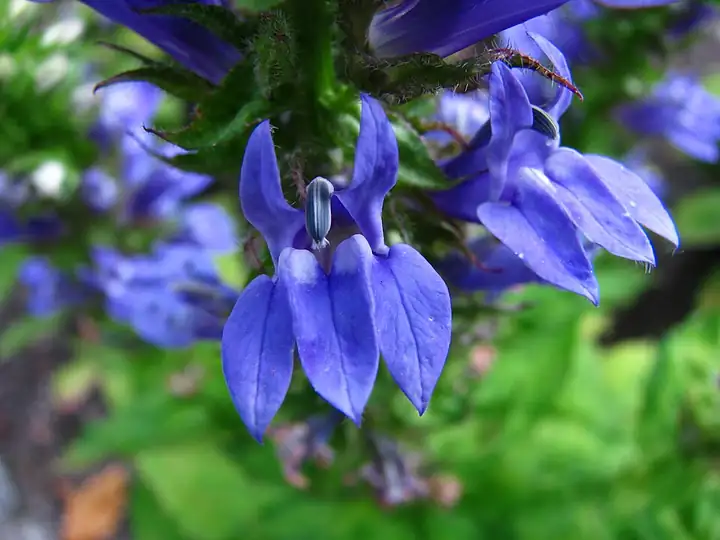
Great blue lobelia
Lobelia siphilitica · Bellflower family (Campanulaceae)
| Hardiness zones | 4 to 9 |
|---|---|
| Sun | full sun to part shade |
| Water | high |
| Life cycle | perennial |
| Frost | Hardy: takes frost |
| Spacing | 8 to 12 inches |
About Great blue lobelia
Great blue lobelia is the blue cousin of cardinal flower: a native wildflower of wet ground with tall spikes of striped, two-lipped blue flowers from midsummer into fall (NC State, USDA Forest Service). It grows wild from Maine to Manitoba and Colorado, south to North Carolina and Texas, in swamps, ditches, floodplains and wet prairies (USDA NRCS). Bumblebees are its main pollinators, and hummingbirds and butterflies visit too; like other lobelias, every part is poisonous if eaten (NC State).
Hardy in zones 4-9 (NC State). Native across the eastern and central U.S. Its relatives cardinal flower and edging lobelia are separate records.
When to plant
Timing is counted from your average last spring frost (and first fall frost). Sow & Tell works out the actual dates for your ZIP code.
Set plants 8-12 inches apart in full sun or light shade where the soil never dries, and mulch (USDA NRCS). Seed needs light but no cold treatment: sow it on the surface of damp mix indoors, move seedlings to pots at 4-6 weeks, and plants usually bloom their first year (USDA NRCS). Divide clumps by their basal offshoots in spring or fall.
Soil
Fertile, loamy soil high in organic matter that stays moist to wet; it takes full sun only if the soil never dries out (NC State, USDA NRCS).
Work in peat or compost so the soil stays moist; it wants fertile, loamy soil high in organic matter (USDA NRCS, NC State).
Feeding
- Spring, as growth starts: compost or a granular garden fertilizer. USDA NRCS calls lobelias heavy feeders and suggests compost or granular fertilizer at the start of growth; follow a soil test and the label rate.
Dry soil is the main killer; in full sun it needs constant moisture (NC State). Protect it from deer and watch for slugs.
Harvest
Flowers open up the spike from midsummer into early fall, about July to October (NC State). Leave some spikes to drop seed so new plants keep the patch going; it self-sows (NC State, USDA NRCS).
Varieties (1)
Mostly the wild species is grown; NC State lists 1 cultivar and USDA NRCS recommends local seed sources.
| Variety | Type | Days | Notes |
|---|---|---|---|
| Blue Selection | Cultivar | Blue-flowered selection of the species. |
Pests to watch for
Slugs, Brown garden snail, Deer
In the kitchen
Safety: Poisonous: every part contains lobeline and related alkaloids. NC State rates it low severity, but eating it can cause nausea, vomiting, diarrhea, drooling, weakness and dilated pupils, and in serious cases convulsions and coma. It doesn't irritate skin. Don't eat any part, and never use it as a home remedy.
Pets: Not listed by the ASPCA. Its close cousin cardinal flower (Lobelia cardinalis) is listed as toxic to dogs, cats and horses (lobeline: vomiting, diarrhea, drooling, belly pain, depression and heart rhythm problems), and NC State rates all parts of great blue lobelia poisonous, so keep pets from chewing it.
Sources
Photo: Photo: Agnieszka Kwiecień, Nova / Wikimedia Commons, CC BY-SA 3.0 (CC BY-SA 3.0). Photo resized for the web.

Planting dates and advice are general guidance; check with your local Cooperative Extension office for your area.