
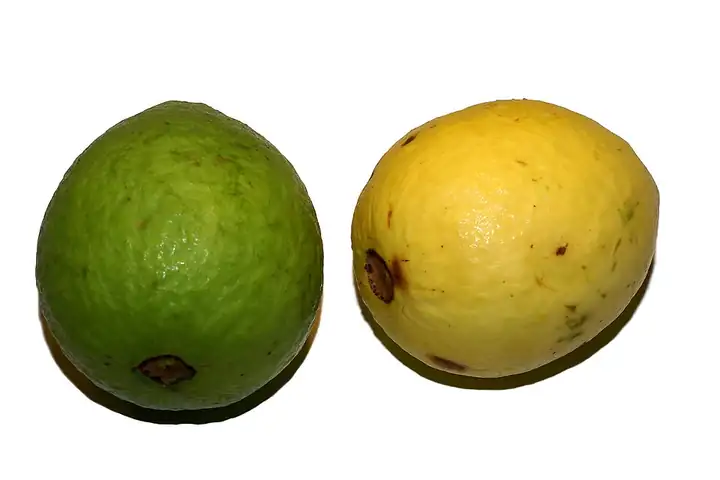
Guava
Psidium guajava · Myrtle family (Myrtaceae)
| Hardiness zones | 9 to 11 |
|---|---|
| Sun | full sun |
| Water | moderate |
| Life cycle | perennial |
| Frost | Tender: killed by frost |
| Soil pH | 4.5–7.0 |
| Spacing | 180 to 300 inches |
About Guava
Guava is a tropical evergreen tree with fragrant fruit that is pink, red, white or yellow inside and very high in vitamin C. It grows fast and fruits within a few years, but it can't take frost, so most gardeners outside the tropics grow it in a pot. Heads-up: common guava is a Category I invasive plant in Florida and a weed in low areas of Hawaii, and its cousin strawberry guava (Psidium cattleyanum) is invasive in both states, so we don't include it.
Guava is frost-tender: young trees die below about 28 F and mature trees are damaged near 25 F (UF/IFAS), so in-ground trees are practical only in zones 9-11, and really only the warmest spots of zone 9; elsewhere grow it in a pot that comes indoors. The Florida Invasive Species Council lists it as Category I invasive, UF/IFAS says not to plant it in south Florida, and Hawaii extension calls it a weed at low elevations; USDA PLANTS lists no federal noxious status.
When to plant
Timing is counted from your average last spring frost (and first fall frost). Sow & Tell works out the actual dates for your ZIP code.
In the ground, plant in full sun 15-25 ft from buildings and other trees (UF/IFAS). Potted trees go back outside once frost danger has passed (no source gives a set number of weeks, so the window is left blank). Grafted, layered or cutting-grown trees bear in about 3-4 years; seedlings don't come true (UF/IFAS; Texas A&M).
Soil
Grows in sand, loam, rocky soil or muck as long as it drains; it tolerates short flooding but not constantly wet soil (UF/IFAS; Texas A&M).
Guava grows in many soils at about pH 4.5-7; in alkaline soil it needs chelated iron (UF/IFAS).
Feeding
- First-year in-ground trees, 4-6 times through the year: balanced fertilizer with magnesium such as 6-6-6-2 or 8-3-9-3. UF/IFAS uses 1/4 to 1/2 lb per feeding the first year, raising the amount each year; Texas A&M instead uses 1/2 cup of 21-0-0 monthly the first year.
- Bearing trees, about 4 times a year: balanced fertilizer higher in potash, such as 8-3-9-3. UF/IFAS uses 1.5-4 lb per feeding for trees four years and older, plus micronutrient sprays and chelated iron as needed.
- Potted trees, from the start of new growth in spring through summer: complete liquid fertilizer with micronutrients, or a timed-release fertilizer. Feed liquid fertilizer at least monthly, or timed-release about every 12 weeks, because nutrients wash out of pots quickly (UF/IFAS St. Lucie County; NC State). Stop in winter and start again when new growth appears (Maryland Extension).
Don't let trees go dry from bloom through fruit growth (UF/IFAS), and avoid severe pruning in winter when frost can hurt new growth.
Harvest
The main crop comes in summer, with a smaller spring crop (UF/IFAS). Pick pink types when the skin turns light green to yellow and let them soften indoors; eat white types while still green to light green and crunchy (UF/IFAS).
In Florida guava can give two crops a year: the main one in summer and a smaller one in early spring. Growers can force an off-season crop by withholding water for 2-3 weeks and then pruning to push new flowering growth.
Varieties (13)
Extension sources document only 13 guava varieties, so this list stops at 13. UF/IFAS recommends Homestead, Patillo, Hong Kong Pink, Crystal, Lotus and Asian White for Florida. Strawberry guava (Psidium cattleyanum) is left out because it is invasive in Florida and Hawaii.
| Variety | Type | Days | Notes |
|---|---|---|---|
| Barbi Pink | Pink-fleshed | ||
| Blitch | Pink-fleshed | Tart but pleasant; light pink flesh. | |
| Homestead | Pink-fleshed | Sweet; pink flesh. A cross of 'Ruby' and 'Supreme'. | |
| Hong Kong Pink | Pink-fleshed | Sweet; pink flesh. | |
| Patillo | Pink-fleshed | Mild and only slightly tart; pink flesh. | |
| Beaumont | Pink-fleshed (processing) | Delicate flavor and low acidity. High-yielding, pink pulp with good puree yield and a pleasant aroma. | |
| Ka Hua Kula | Pink-fleshed (processing) | Delicate flavor and low acidity. Higher yields than 'Beaumont', a lower tree, pink flesh and more solids. | |
| Ruby | Red-fleshed | Mild and sweet; red flesh. | |
| Supreme | White-fleshed | Mild and slightly tart; white flesh. | |
| Asian White | White-fleshed (eaten green) | Mildly sweet and crunchy; eaten while green. | |
| Crystal | White-fleshed (eaten green) | Mildly sweet and crunchy; eaten while green. | |
| Lotus | White-fleshed (eaten green) | Mildly sweet and crunchy; eaten while green. | |
| Webber | Yellow-fleshed | Sweet; yellow flesh. |
Pests to watch for
Thrips, Whiteflies, Scale insects, Mealybugs, Root-knot nematodes
Diseases and problems
Anthracnose, Algal leaf spot (red alga), Leaf spot
In the kitchen
Eaten fresh or made into juice, puree, paste, jelly, ice cream, pies and pastries (UF/IFAS).
Keeping it: Ripe or unripe guavas keep about 5 to 7 days in the fridge; let pink types soften on the counter first.
Safety: The fruit is a common food; the sources we checked list no toxic parts, and we found no research-based guidance on pregnancy, drug interactions or allergies for the fruit.
Pets: Not listed as toxic by the ASPCA
Sources
- ask.ifas.ufl.edu
- gardeningsolutions.ifas.ufl.edu
- plant-directory.ifas.ufl.edu
- floridainvasives.org
- aggie-hort.tamu.edu
- ucanr.edu
- extento.hawaii.edu
- plantpono.org
- plantsservices.sc.egov.usda.gov
- blogs.ifas.ufl.edu
- extension.umd.edu
- yardandgarden.extension.iastate.edu
- aspca.org
- aspca.org
- aspca.org
- content.ces.ncsu.edu
Photo: Photo: Hans Hillewaert, CC BY-SA 3.0, via Wikimedia Commons (CC BY-SA 3.0). Photo resized for the web.

Planting dates and advice are general guidance; check with your local Cooperative Extension office for your area.