
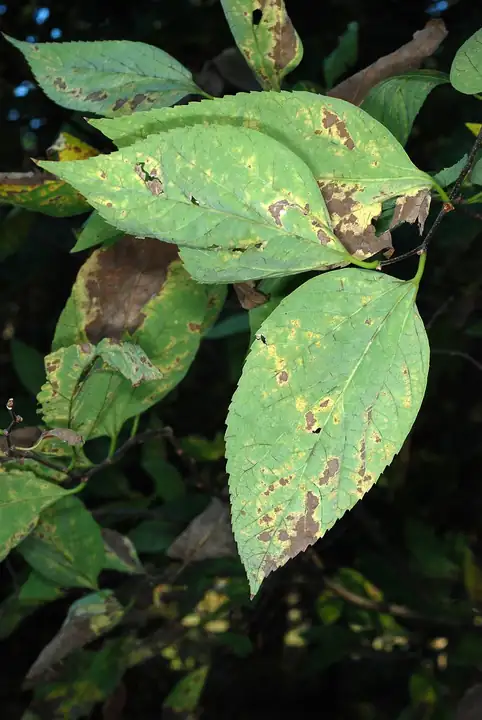
Hackberry
Celtis occidentalis (common hackberry) and C. laevigata (sugarberry or southern hackberry) · Hemp family (Cannabaceae; formerly the elm family, Ulmaceae)
| Hardiness zones | 2 to 10 |
|---|---|
| Sun | full sun to part shade |
| Water | low |
| Life cycle | perennial |
| Frost | Hardy: takes frost |
About Hackberry
Hackberry is a tough, fast-growing native shade tree with warty, corky gray bark and small sweet berries that many birds eat. Common hackberry is native from New Hampshire to Wyoming and south to Georgia, Arkansas and Texas; sugarberry grows from Maryland through the Southeast to Illinois, Kansas and Texas (wildflower.org). It handles wind, poor soil, city conditions and road salt, and it feeds the caterpillars of hackberry emperor, tawny emperor, question mark, American snout and mourning cloak butterflies (NC State, Morton Arboretum). Small bumps under the leaves are hackberry nipple galls made by a tiny psyllid; they don't harm the tree, though the adults can slip through window screens in fall (Purdue).
Common hackberry is hardy in zones 2-9 (Morton Arboretum; NC State says 3-9) and sugarberry in 5-10 (NC State).
When to plant
Timing is counted from your average last spring frost (and first fall frost). Sow & Tell works out the actual dates for your ZIP code.
Hackberry transplants easily (NC State, Morton Arboretum). Plant container or balled-and-burlapped trees and prune in the dormant season (Morton Arboretum). The wood is weak and breaks in ice storms, and falling fruit can be messy over patios and sidewalks (Morton Arboretum, NC State).
Soil
Almost any soil, clay to sand or rocky, acid to alkaline; best in moist, well-drained ground. Once established it rides out both flooding and drought, but it doesn't like soil above pH 8 or salt spray (USDA NRCS, NC State, wildflower.org).
Test the soil first. Hackberry grows in almost any soil, acid to alkaline; loosen a wide area and mix 10-20 percent compost into the native soil (Clemson, NC State).
Feeding
- Spring, after the tree is established, and only if a soil test or pale leaves and weak twig growth show a need; mature trees in good soil often need none (Clemson): slow-release nitrogen fertilizer with a ratio near 3-1-1 or 3-1-2 (3-0-1 or 3-0-2 if the soil test shows enough phosphorus). Spread it from just outside the trunk to the dripline and water it in. Clemson cites 2-4 lb of slow-release nitrogen per 1,000 sq ft per year, split into smaller feedings between budbreak and late summer; follow your soil test and skip it in a summer drought.
Water daily for the first 1-2 weeks, every 2-3 days until week 12, then weekly, giving about 1-1.5 gallons per inch of trunk width, until established (roughly 1.5 years per inch of trunk); only skip after more than an inch of rain (UMN). Too much fertilizer pushes soft growth that pests and cold injure (Clemson).
Harvest
Small greenish flowers in spring (April-May) aren't showy. The fruit ripens red to dark purple from late summer into fall and often hangs on into winter (NC State).
Varieties (6)
Morton Arboretum and USDA NRCS document these common hackberry selections; sources list no sugarberry cultivars.
| Variety | Type | Days | Notes |
|---|---|---|---|
| Chicagoland | Common hackberry | Neat, upright oval with a strong central trunk, about 50 ft tall and 40 ft wide. | |
| Magnifica | Common hackberry | Broadly oval to vase-shaped, about 50 ft tall and 40 ft wide. | |
| Oahe | Common hackberry | Released by the USDA NRCS Plant Materials Program for city plantings in the northern Plains (North Dakota, Montana, South Dakota, Minnesota). | |
| Prairie Pride | Common hackberry | Compact oval crown, about 50 ft tall and 40 ft wide, with thick, leathery leaves; resistant to witches' broom. | |
| Prairie Sentinel | Common hackberry | Tightly columnar, about 45 ft tall and only 12 ft wide. | |
| Ultra | Common hackberry | Rounded habit with blue-green leaves. |
Pests to watch for
Aphids, Lace bugs (azalea and chrysanthemum lace bugs), Scale insects
Diseases and problems
Witches' broom, Powdery mildew, Leaf spot, Armillaria root rot
In the kitchen
NC State lists the small, sweet fruit as edible, eaten raw or cooked into jelly or preserves; each berry holds one seed. Native Americans pounded the whole fruit, seeds and all, into cakes and used it as a flavoring (NC State, wildflower.org, USDA NRCS).
Safety: No poison listing in the sources we used. Eat only fruit from a tree you're sure is hackberry.
Pets: Not listed by the ASPCA.
Sources
- plants.ces.ncsu.edu
- plants.ces.ncsu.edu
- wildflower.org
- wildflower.org
- plants.sc.egov.usda.gov
- mortonarb.org
- extension.entm.purdue.edu
- aspca.org
- hgic.clemson.edu
- hgic.clemson.edu
- extension.umn.edu
Photo: Photo: DouglasGoldman / Wikimedia Commons, CC BY-SA 4.0 (CC BY-SA 4.0). Photo resized for the web.

Planting dates and advice are general guidance; check with your local Cooperative Extension office for your area.