
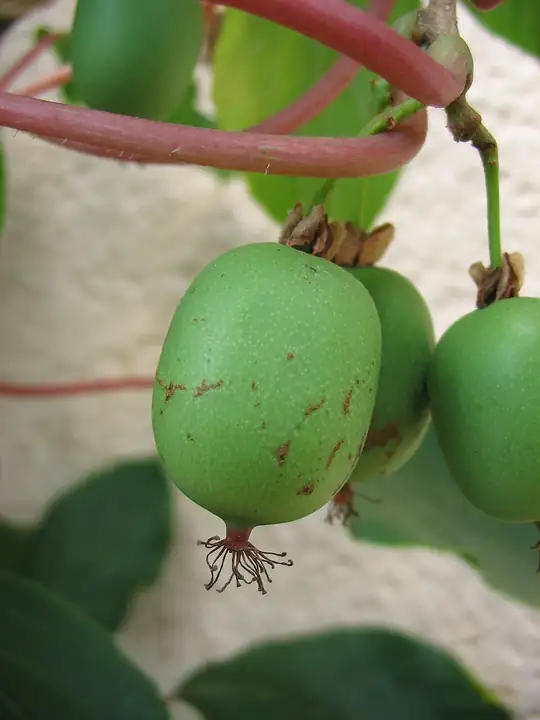
Hardy kiwi (kiwiberry)
Actinidia arguta and Actinidia kolomikta · Kiwifruit family (Actinidiaceae)
| Hardiness zones | 3 to 8 |
|---|---|
| Sun | full sun to part shade |
| Water | moderate |
| Life cycle | perennial |
| Frost | Hardy: takes frost |
| Soil pH | 5.5–7.5 |
| Spacing | 120 to 360 inches |
About Hardy kiwi (kiwiberry)
Hardy kiwis are vigorous vines that bear grape-sized, smooth-skinned fruit you can eat whole. Most need both a male and a female vine, a sturdy trellis, and patience before the first crop.
A. arguta is listed for zones 3-8 (NC State) and A. kolomikta is hardy to zone 3 (University of Minnesota). Vines survive about -30 F, but new spring shoots are very easily killed by frost (Penn State).
When to plant
Timing is counted from your average last spring frost (and first fall frost). Sow & Tell works out the actual dates for your ZIP code.
- Set out plants: from 4 weeks before to 2 weeks after the last frost
Plant dormant rooted cuttings as soon as the soil can be worked, and potted plants after frost (Penn State). Expect fruit 3 to 5 years after planting (University of Minnesota), though Penn State says vines may not bear until 5 to 9 years old. Build a strong pergola or T-bar trellis first.
Soil
Well-drained, airy soil that holds moisture and is rich in organic matter; root rots are common in poorly drained soil (University of Minnesota).
Aim for a slightly acid to neutral pH (about 5.5-7.5) in well-drained soil with added organic matter, then mulch with about 4 inches of wood chips or leaves.
Feeding
- Spring of the second year and each spring after, once frost danger has passed: balanced fertilizer such as 10-10-10, or compost. Penn State suggests 2 oz of 10-10-10 per plant in year two, adding 2 oz each year up to 8 oz; spread it carefully, as kiwi roots burn easily.
Do not fertilize after July, which pushes late growth, and do not overfeed; test the soil every couple of years.
Harvest
Fruit ripens from mid-August to mid-October depending on species (University of Minnesota). Vine-ripened fruit reaches 18-25 percent sugar, or you can pick it firmer (about 8-9 percent) and ripen it in storage; it keeps up to 2 months cold (Penn State).
Hardy kiwi gives one crop a year. You can let fruit ripen fully on the vine and pick it all at once, or pick it firmer and ripen it in storage, where it keeps up to about 2 months cold.
Varieties (19)
| Variety | Type | Days | Notes |
|---|---|---|---|
| Arctic Beauty | Arctic kiwi (Actinidia kolomikta) | Vigorous male vine with showy variegated leaves. | |
| Arnold A | Arctic kiwi (Actinidia kolomikta) | Male vine with heart-shaped leaves splashed pink and white. | |
| Krupnoplodnaya | Arctic kiwi (Actinidia kolomikta) | Larger fruit than the species. Purple stems in winter. | |
| Red Beauty | Arctic kiwi (Actinidia kolomikta) | ||
| Anna (Ananasnaya) | Hardy kiwi (Actinidia arguta) | Popular fruiting variety that is easy to find. | |
| Audrey | Hardy kiwi (Actinidia arguta) | Cold-hardy male vine. | |
| Bingo | Hardy kiwi (Actinidia arguta) | Pineapple-flavored fruit. | |
| Chang Bai Giant | Hardy kiwi (Actinidia arguta) | ||
| Dumbarton Oaks | Hardy kiwi (Actinidia arguta) | Winter-hardy. Found in an old public garden in Washington, D.C. | |
| Geneva 3 | Hardy kiwi (Actinidia arguta) | Green flesh with a tropical flavor. | |
| Hardy Red | Hardy kiwi (Actinidia arguta) | Red flesh. Popular and easy to find. | |
| Issai | Hardy kiwi (Actinidia arguta) | Lower-growing vine. | |
| Jumbo | Hardy kiwi (Actinidia arguta) | Larger fruit. Starts bearing in the 3rd or 4th year. | |
| Ken's Red | Hardy kiwi (Actinidia arguta) | Male vine. | |
| Meader | Hardy kiwi (Actinidia arguta) | Male vine. | |
| Michigan State | Hardy kiwi (Actinidia arguta) | Found growing on a fence at Michigan State University. | |
| Natasha | Hardy kiwi (Actinidia arguta) | More cold-hardy than most. | |
| Scarlet September | Hardy kiwi (Actinidia arguta) | Sweet, red, oval fruit. | |
| Tatyana | Hardy kiwi (Actinidia arguta) | More cold-hardy than most. |
Pests to watch for
Twospotted spider mite, Thrips, Japanese beetle, Root-knot nematodes, Spotted wing drosophila
Diseases and problems
Root and crown rot, Gray mold (Botrytis), White mold, Frost and freeze injury
In the kitchen
Eaten fresh, skin and all.
Keeping it: Firm-picked fruit ripens in storage and keeps up to two months cold; soft, ripe fruit keeps a week or two in the fridge.
Pets: Not listed as toxic by the ASPCA; cats are drawn to its catnip-like scent and can damage young vines by digging (NC State)
Sources
Photo: Photo: Björn Appel, CC BY-SA 3.0, via Wikimedia Commons (CC BY-SA 3.0). Photo resized for the web.

Planting dates and advice are general guidance; check with your local Cooperative Extension office for your area.