
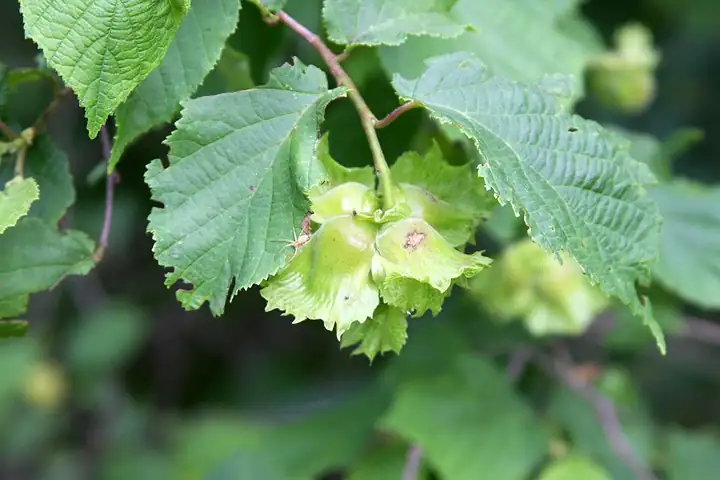
Hazelnut (filbert)
Corylus americana (American hazelnut), Corylus avellana (European hazelnut) and their hybrids · Birch family (Betulaceae)
| Hardiness zones | 3 to 9 |
|---|---|
| Sun | full sun to part shade |
| Water | moderate |
| Life cycle | perennial |
| Frost | Hardy: takes frost |
| Spacing | 180 to 240 inches |
About Hazelnut (filbert)
Hazelnuts are large shrubs or small trees, about 10 to 15 feet tall, that bear small, sweet nuts in leafy husks. The native American hazelnut is very cold-hardy and seems immune to eastern filbert blight, while the European hazelnut has bigger nuts but blooms earlier and is hit hard by the blight, so in the East pick blight-resistant varieties or hybrids.
American hazelnut grows in zones 3-9 (Utah State; NC State); hybrids such as 'Grand Traverse' and 'The Beast' are hardy to zone 5 (Nebraska Extension). European hazelnuts bloom early, so late frosts can cost the crop; pick a frost-protected spot.
When to plant
Timing is counted from your average last spring frost (and first fall frost). Sow & Tell works out the actual dates for your ZIP code.
Plant nursery plants as soon as you get them; keep bare roots moist and between freezing and 40 F until then (Utah State). Space them 15 to 20 feet apart, keep turf at least 2 to 3 feet back, and plant two or three for pollination. Plants start bearing in about 3 to 5 years (Utah State; Nebraska Extension).
Soil
Well-drained, moist, loamy soil is best, but it grows in many soils if water drains away (Utah State); it tolerates a wide pH range and poor soil (Nebraska Extension).
Control weeds first, test the soil, and mix about 1 part compost into 3 parts soil when backfilling.
Feeding
- Spring, as growth begins, and only if a soil test or weak growth calls for it: fertilizer as your soil test recommends. Skip it when plants look healthy and crop well; never fertilize later in the season.
Don't plant in lawn grass, which can cut growth by up to half, and don't overwater: soggy soil invites root rot.
Harvest
Nuts ripen from late September through October and usually drop from the husk; pick them up several times a week, or hand-pick seedling plants once the husks turn brown (Utah State). Start drying within a day of picking (Nebraska Extension).
Nuts ripen once a year, late September through October, and fall over a few weeks, so gather several times a week. Plants often bear heavily in alternate years.
Varieties (20)
| Variety | Type | Days | Notes |
|---|---|---|---|
| Barcelona | European (C. avellana) | Round nut with flavor suited to both shelled and in-shell use. Heavy producer, long the main Pacific Northwest variety, but crops heavily only every other year and has many blanks. | |
| Butler | European (C. avellana) | Very large, rounded nuts; slow-growing. | |
| Casina | European (C. avellana) | Small, thin-shelled nuts; heavy producer. | |
| Dorris | European (C. avellana) | Small to medium round nuts. | |
| Ennis | European (C. avellana) | Large nuts and large crops. | |
| Eta | European (C. avellana) | Medium nuts; bred by OSU as a pollinizer. | |
| Gamma | European (C. avellana) | Medium to small nuts; very productive. | |
| Hall's Giant | European (C. avellana) | Large nuts but light crops; less cold tolerant. | |
| Jefferson | European (C. avellana) | High-quality nuts. Smaller tree than Barcelona but more productive; small to medium round nuts. | |
| McDonald | European (C. avellana) | OSU release. | |
| Raritan | European (C. avellana) | Vigorous and upright; can grow in zone 5 if sheltered from north and west winds. | |
| Red Dragon | European (C. avellana) | Ornamental with twisted branches and dark red leaves; smaller nuts. | |
| Sacajawea | European (C. avellana) | OSU release. | |
| Santiam | European (C. avellana) | Medium to large nuts; very productive. | |
| Theta | European (C. avellana) | May bear more reliably because it blooms late. | |
| Wepster | European (C. avellana) | Small to medium round nuts. | |
| Yamhill | European (C. avellana) | Very tasty nut. Small tree; small to medium round nuts. | |
| York | European (C. avellana) | Pollinizer variety. | |
| Grand Traverse | Hybrid (75% American, 25% Turkish) | Averages about 11 lb of nuts per mature plant; hardy to zone 5. | |
| The Beast | Hybrid (75% European, 25% American) | About 20 ft tall and 15 ft wide after 10 years; hardy to zone 5. Developed at Oregon State. |
Pests to watch for
Aphids, Twospotted spider mite, Scale insects, Japanese beetle, Leafhoppers, Tree squirrels, Deer
Diseases and problems
Eastern filbert blight, Root and crown rot, Powdery mildew, Crown gall
In the kitchen
Roasted and eaten as a snack, or used in baking, salads, cooked dishes, pesto, hummus and nut butter; hazelnut oil is good for cooking (Nebraska Extension).
Keeping it: Dry nuts soon after picking, then keep them in airtight containers in the refrigerator or freezer (Nebraska Extension).
Safety: Hazelnuts (filberts) are tree nuts, one of the major food allergens named by the FDA; anyone with a tree-nut allergy should avoid them.
Pets: No ASPCA plant entry for hazelnut was found. The ASPCA warns that nuts in general are high in fats that can cause vomiting, diarrhea and possibly pancreatitis in pets, so don't share the nuts.
Sources
- plants.ces.ncsu.edu
- extension.usu.edu
- lancaster.unl.edu
- bpp.oregonstate.edu
- extension.oregonstate.edu
- fda.gov
- aspca.org
Photo: Photo: Steven Katovich, USDA Forest Service, Bugwood.org / Wikimedia Commons, CC BY-SA 3.0 (CC BY-SA 3.0). Photo resized for the web.

Planting dates and advice are general guidance; check with your local Cooperative Extension office for your area.