
Hens and chicks
Sempervivum tectorum (common houseleek) and its many hybrids · Stonecrop family (Crassulaceae)
| Hardiness zones | 3 to 8 |
|---|---|
| Sun | full sun to part shade |
| Water | low |
| Life cycle | perennial |
| Frost | Hardy: takes frost |
| Soil pH | 6.0–8.0 |
About Hens and chicks
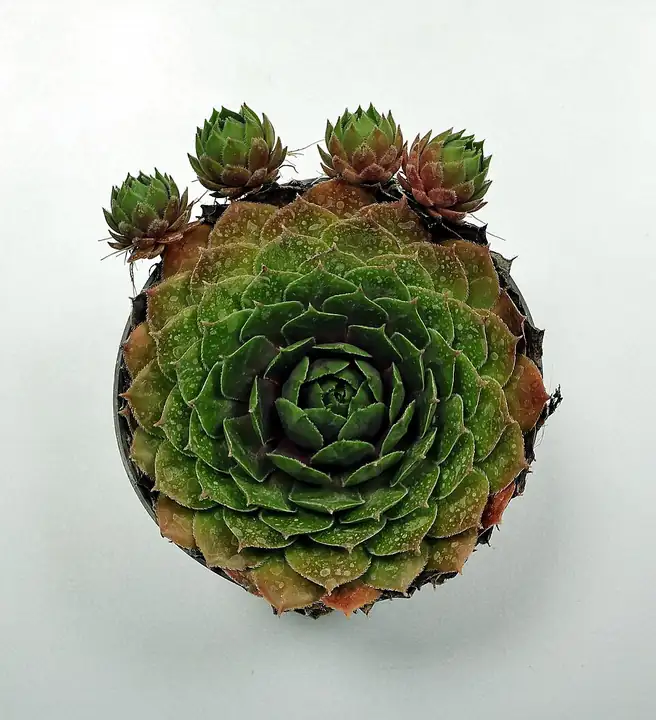
Hens and chicks are tiny, tough, winter-hardy succulents: tight rosettes of thick, pointed leaves, often tipped red or purple, where each big 'hen' ringed by small 'chick' offsets slowly makes a mat (NC State, Oklahoma State). They come from the mountains of southern Europe, not the U.S., and the name Sempervivum means 'live forever' (NC State). Each rosette blooms only once on a thick stalk and then dies, but its chicks carry on. They cross easily, so there are many hybrids to collect (Oklahoma State).
Hardy in zones 3-8 (NC State); give it afternoon shade in very hot, sunny spots.
When to plant
Timing is counted from your average last spring frost (and first fall frost). Sow & Tell works out the actual dates for your ZIP code.
Plant in groups or as a mass in rock gardens, wall crevices, bed edges, containers and green roofs (NC State). Let the soil dry between waterings. Pull off chicks and replant them to make more; seed works too (NC State).
Soil
Sandy or gravelly soil with sharp drainage; it does fine in poor soil, and moist soil brings crown and root rot (NC State, Oklahoma State).
Plant in sandy or gravelly, sharply drained soil; poor soil is fine (NC State).
Feeding
Overwatering is the main killer: it causes crown rot (NC State), and moist soil leads to root rot (Oklahoma State).
Harvest
Rosettes bloom in summer on thick 8-12 in stalks of starry flowers. A rosette dies after it flowers; pull it out then and let the chicks fill the gap (NC State).
Varieties (2)
NC State documents 2 named forms; Oklahoma State notes the plant hybridizes readily, so hundreds are sold, but we found no other extension source naming them.
| Variety | Type | Days | Notes |
|---|---|---|---|
| Emerald Empress | Hybrid | Green to blue-green rosettes edged red to purple; purple flowers. | |
| Andorra | S. tectorum form (f. Andorra) | Medium green rosettes tipped and centered red, tinged pink to lavender in winter. |
Diseases and problems
Crown rot, Root rot
In the kitchen
Safety: No toxicity is listed in the extension sources we used; it isn't a food plant.
Pets: Not listed by the ASPCA under Sempervivum or houseleek. The ASPCA's 'hens and chickens' entry is a different succulent, Echeveria elegans, which it rates non-toxic to dogs, cats and horses.
Sources
Photo: Photo: Terragio67, CC BY-SA 4.0, via Wikimedia Commons (CC BY-SA 4.0). Photo resized for the web.

Planting dates and advice are general guidance; check with your local Cooperative Extension office for your area.