
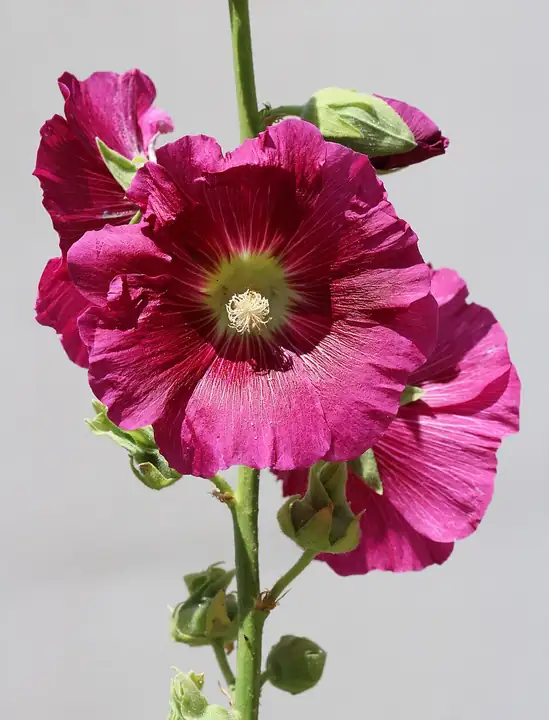
Hollyhock
Alcea rosea · Mallow family (Malvaceae)
| Hardiness zones | 2 to 10 |
|---|---|
| Sun | full sun |
| Water | moderate |
| Life cycle | biennial |
| Frost | Hardy: takes frost |
| Spacing | 24 to 36 inches |
About Hollyhock
Hollyhocks are old-fashioned cottage flowers with 5- to 8-foot spires of big cup-shaped blooms in pink, red, purple, yellow, white and near-black. Most are biennials that bloom their second summer, but they reseed so readily that a patch comes back year after year. Bees, butterflies and hummingbirds visit the flowers.
Iowa State lists zones 2-10 (NC State lists 5-9); plants are short-lived, and new ones come from seed each year.
When to plant
Timing is counted from your average last spring frost (and first fall frost). Sow & Tell works out the actual dates for your ZIP code.
Most varieties take two years from seed to flower, though some bloom the first year (UC Master Gardeners). Press seed into the soil and barely cover it; California Master Gardeners sow or set out plants in August-September, and groups of plants go 2-3 feet apart. Tall types may need staking, and pinching the main stem early makes shorter, bushier plants (Illinois Extension).
Soil
Moist, well-drained soil rich in organic matter; hollyhocks hate soggy winter soil (NC State, Iowa State).
Mix plenty of compost into well-drained soil in full sun before planting; hollyhocks like moist soil rich in organic matter but hate soggy winter ground.
Feeding
Hollyhocks do not need heavy fertilizing. Water at the base, not over the leaves, and don't crowd plants, to keep rust and mildew down.
Harvest
Flowers open from June to August. Pick fresh blooms to use as a garnish; leave a few spikes to drop seed if you want new plants.
Varieties (7)
Extension and award sources describe only 7 hollyhock cultivars or seed series, most in just a few words. Many more are sold, but we found no neutral source describing them.
| Variety | Type | Days | Notes |
|---|---|---|---|
| Chater's Double | Double series | Double flowers in several colors on tall spikes. | |
| Summer Carnival | Mixed colors | Mixed colors from seed. | |
| Queeny Purple | Semi-double (Queeny series) | Short plant, about 20-30 in. tall, with frilly 3-4 in. powder-puff purple flowers. Blooms the first year from a late-winter sowing. | |
| Celebrity | Short series | A shorter hollyhock, easier to fit in small beds. | |
| Majorette | Short series | A shorter hollyhock, easier to fit in small beds. | |
| Nigra | Deep maroon flowers so dark they look almost black, on tall spikes about 5-8 ft. | ||
| Silver Puff | Listed by UC Master Gardeners as rust resistant. Rust is a common problem on hollyhocks. |
Pests to watch for
Japanese beetle, Twospotted spider mite, Slugs, Thrips, Sawflies (garden sawflies)
Diseases and problems
Hollyhock rust, Leaf spot, Anthracnose
In the kitchen
The flowers make a showy edible garnish or a cup for dip, and petals can be added to salads (NC State, UC Master Gardeners).
Safety: NC State and the ASPCA list no toxic parts. As with any edible flower, eat only blooms grown without pesticides, and try a little first, since some people react to new foods (UMN).
Pets: Non-toxic to dogs, cats and horses (ASPCA)
Sources
- plants.ces.ncsu.edu
- yardandgarden.extension.iastate.edu
- web.extension.illinois.edu
- ucanr.edu
- extension.umaine.edu
- aspca.org
- extension.arizona.edu
- extension.umn.edu
- plantsservices.sc.egov.usda.gov
Photo: Photo: George Chernilevsky / Wikimedia Commons, CC BY 4.0 (CC BY 4.0). Photo resized for the web.

Planting dates and advice are general guidance; check with your local Cooperative Extension office for your area.