
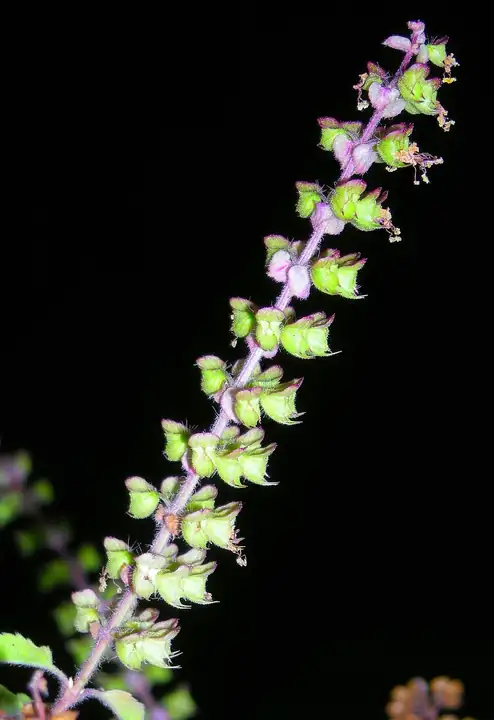
Holy basil (tulsi)
Ocimum tenuiflorum (syn. O. sanctum) · Mint family (Lamiaceae)
| Hardiness zones | 2 to 11 |
|---|---|
| Sun | full sun |
| Water | moderate |
| Life cycle | tender perennial (grown as an annual) |
| Frost | Tender: killed by frost |
About Holy basil (tulsi)
Holy basil, or tulsi, is a warm-weather basil from tropical and subtropical southern Asia with a spicy clove-mint-basil flavor. It grows about 3 feet tall with small white, pale pink or lavender flowers, and it is an important plant in Hindu tradition and Ayurvedic medicine.
Grown as a summer annual in every zone; NC State describes it as an annual or short-lived perennial from the tropics, so frost ends its season.
When to plant
Timing is counted from your average last spring frost (and first fall frost). Sow & Tell works out the actual dates for your ZIP code.
- Start seeds indoors: 6 to 8 weeks before the last frost
Grow it from seed (NC State). Extension guides for sweet basil say to start seed indoors 6-8 weeks ahead and plant out after frost danger has passed; the same timing suits this tropical basil.
Soil
Well-drained soil rich in organic matter; it does poorly in waterlogged ground (NC State).
Plant in sun in well-drained soil with organic matter; herbs grow best at a pH of about 6.0-7.5. Follow a soil test.
Feeding
- once or twice during the growing season: complete fertilizer such as 5-10-5. UMN's basil guide suggests about 3 oz per 10 feet of row beside the plants, watered in. Basil in outdoor pots can get half-strength liquid fertilizer every 3-4 weeks.
Avoid waterlogged soil; holy basil does poorly in soggy ground.
Harvest
Snip young leaves and stem tips as needed, cutting just above a pair of leaves (UMN guidance for basil).
Handle it like basil: snip leaves or cut stems just above a pair of leaves and new growth follows at the cut. Pinch flowers to keep leaf production up.
Pests to watch for
Japanese beetle
In the kitchen
Used like sweet basil, especially in Asian cooking, with a spicy clove-mint-basil bite (NC State).
Keeping it: Snip leaves as you need them; frozen basil keeps about a year.
Safety: MSKCC lists nausea, headache and agitation as reported side effects of holy basil supplements; ask a doctor before using it as medicine.
Pets: Not listed under its own name by the ASPCA; sweet basil (Ocimum basilicum) is listed as non-toxic to dogs and cats.
Sources
- plants.ces.ncsu.edu
- mskcc.org
- extension.umn.edu
- aspca.org
- plantsservices.sc.egov.usda.gov
- extension.umn.edu
Photo: Photo: Muhammad Mahdi Karim / Wikimedia Commons, CC BY-SA 2.5 (CC BY-SA 2.5). Photo resized for the web.

Planting dates and advice are general guidance; check with your local Cooperative Extension office for your area.