
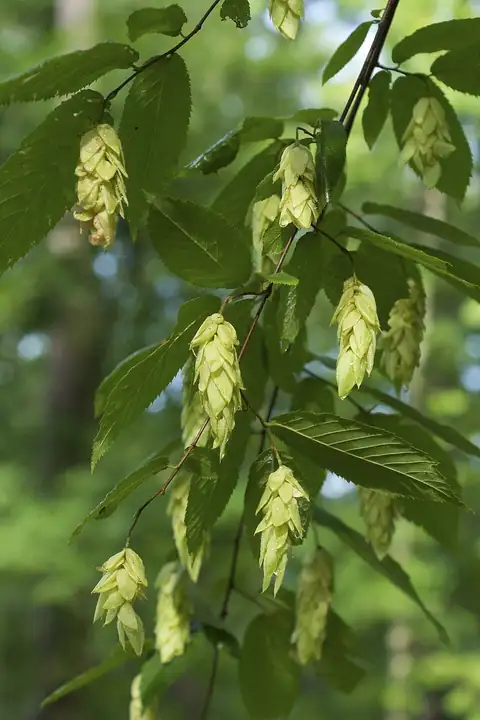
Hop-hornbeam (ironwood)
Ostrya virginiana (eastern or American hop-hornbeam) · Birch family (Betulaceae)
| Hardiness zones | 3 to 9 |
|---|---|
| Sun | full sun to part shade |
| Water | low |
| Life cycle | perennial |
| Frost | Hardy: takes frost |
About Hop-hornbeam (ironwood)
Hop-hornbeam is a slow-growing native understory tree with a rounded crown, drooping branches, shaggy bark that peels in narrow strips, and papery fruit clusters that look like hops (NC State, UKY). Its wood is among the hardest and toughest of any native tree, which is why it is called ironwood or leverwood (wildflower.org, NRCS). It grows wild from Nova Scotia and Manitoba south to the Florida Panhandle and east Texas, with an outlier in Wyoming, in dry, rocky woods and on slopes (wildflower.org, NC State). It is not the same tree as the guide's hornbeam (Carpinus, also called ironwood or musclewood): hornbeam has smooth, rippled gray bark and leafy three-lobed seed bracts, while hop-hornbeam has scaly, shaggy bark and inflated, hop-like seed sacs (NC State, UKY). Shade and drought tolerant once settled, it makes a tough small shade tree for lawns, woodland edges and streets without road salt.
Hardy in zones 3-9 (NC State, Utah State, UF/IFAS 3A-9A); the NRCS plant guide gives 5-9. It is very sensitive to road and sea salt, so keep it away from salted roads and the seashore (UKY, NC State).
When to plant
Timing is counted from your average last spring frost (and first fall frost). Sow & Tell works out the actual dates for your ZIP code.
Plant a young balled-and-burlapped or container tree in early spring; it is slow to re-establish after moving, so choose small trees, ideally nursery-grown in containers or root-control bags that give a fibrous root system (UKY, NRCS). Mulch and water until it is established (UKY). It grows only about 10-15 ft in 15 years (NC State, UKY), and nurseries sell it single- or multi-trunked (UF/IFAS).
Soil
Clay, loam or sand, acid to alkaline, as long as it drains well; best in moist, well-drained, slightly acid soil of average fertility. It handles dry, rocky sites and drought but not wet or flooded soil, compaction or salt (NC State, UKY, UF/IFAS, NRCS; NRCS gives a pH range of about 4.2-7.6).
No special amendments are needed in well-drained soil; it adapts to clay, loam or sand and to acid or alkaline soil. Test the soil and correct pH first if the test calls for it (NC State, UF/IFAS, Clemson).
Feeding
- Spring as growth begins through early summer, only if a soil test or poor growth shows a need: slow-release nitrogen fertilizer, or what the soil test calls for. Spread it evenly from outside the trunk flare to the drip line and water it in; Clemson gives about 2-4 lb of actual nitrogen per 1,000 sq ft per year from slow-release sources, split into smaller doses. Follow a soil test.
Water matters more than food at first: water daily for 2 weeks, every 2-3 days through week 12, then weekly until established, about 1-1.5 gallons per inch of trunk diameter each time (UMN). Keep it out of wet spots, compacted soil and road-salt spray, which it does not tolerate, and keep stressed trees watered in drought to discourage borers (UKY, UF/IFAS, NC State).
Harvest
Male catkins form in late summer and hang on the bare twigs all winter, then open in April and May along with small green female catkins (NC State, wildflower.org). By late summer to fall the female catkins become drooping, hop-like clusters of papery sacs that turn brown and hang on into winter. Little pruning is needed; branches resist breaking in storms (UF/IFAS, NC State).
Pests to watch for
Spongy moth (formerly gypsy moth), Scale insects
Diseases and problems
Canker, Leaf blister, Leaf spot, Powdery mildew
In the kitchen
Safety: The sources we used give no poison warning for hop-hornbeam; it is grown for shade, wildlife and its wood, not food. Wear gloves when handling the ripe seed clusters, because the bristly sacs can make fingers itch (wildflower.org).
Pets: Not listed by the ASPCA (no hop-hornbeam, hornbeam or ironwood entry on its plant lists).
Sources
- plants.ces.ncsu.edu
- ask.ifas.ufl.edu
- extension.usu.edu
- horticulture.mgcafe.uky.edu
- wildflower.org
- plants.sc.egov.usda.gov
- fs.usda.gov
- aspca.org
- aspca.org
- hgic.clemson.edu
- extension.umn.edu
Photo: Photo: Eric Hunt, CC BY-SA 3.0, via Wikimedia Commons (CC BY-SA 3.0). Photo resized for the web.

Planting dates and advice are general guidance; check with your local Cooperative Extension office for your area.