
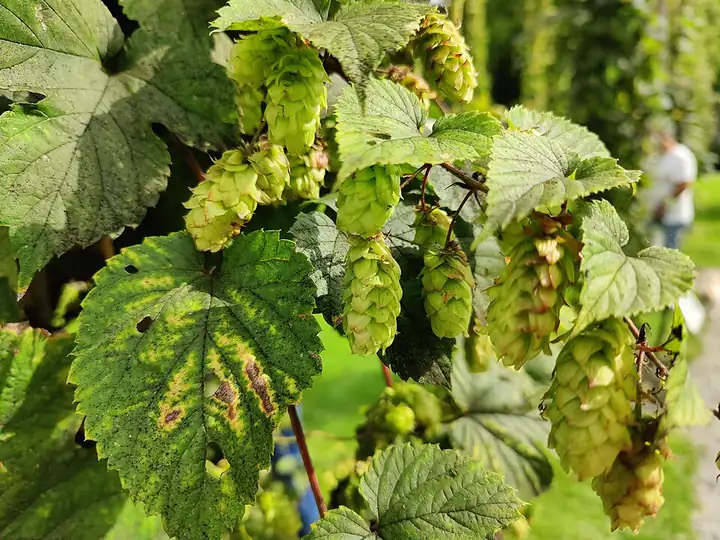
Hops
Humulus lupulus · Hemp family (Cannabaceae)
| Hardiness zones | 4 to 8 |
|---|---|
| Sun | full sun |
| Water | high |
| Life cycle | perennial |
| Frost | Hardy: takes frost |
| Soil pH | 6.0–7.5 |
| Spacing | 24 to 60 inches |
About Hops
Hops are a hardy perennial bine that dies to the ground each winter and shoots up 18 to 25 feet each summer, grown for the papery green cones used to flavor beer. Plants are either male or female; only females make cones, so gardeners plant female rhizomes. Common hops are native to North America and Europe and are not considered invasive, unlike Japanese hops (Humulus japonicus), a weedy annual with 5- to 7-lobed leaves. Hops are toxic to dogs (ASPCA).
Generally grown in zones 4-8 and best at 35-52 degrees north latitude, where long summer days give big yields; UF/IFAS research grows them as far south as zone 9B with smaller crops, since short days make Florida plants flower early.
When to plant
Timing is counted from your average last spring frost (and first fall frost). Sow & Tell works out the actual dates for your ZIP code.
- Set out plants: up to 2 weeks after the last frost
Plant rhizomes in spring once the soil can be worked and frost danger has passed, 1 to 4 inches deep with buds up, 3 to 5 feet apart (2-3 ft in Rutgers' rows). Expect few cones the first year while roots establish. From year two, keep 2 to 4 strong bines per string, wind them clockwise up twine or a 14- to 20-foot support, and strip the lowest 2 to 3 feet of leaves for airflow.
Soil
Deep, well-drained loam to sandy loam; roots don't tolerate standing water.
Test the soil and work recommended fertilizer into the top 6 inches, with no more than about 1 inch of compost per 100 square feet.
Feeding
- Early spring, as new shoots appear (every year): compost, plus nitrogen fertilizer such as 21-0-0 or a balanced 16-16-16. Spread compost around the crown each spring; UC Master Gardeners also feed at first sprout.
- About 3 weeks after the first spring feeding: nitrogen fertilizer such as 21-0-0, or a balanced 16-16-16. Scatter around the plant and water in.
- June to midsummer: nitrogen fertilizer such as 21-0-0. Utah State side-dresses 1/2 to 1 tablespoon per plant in June; water it in.
Don't prune in the first year, and don't let unthinned bines crowd together or wet the leaves when watering: both invite mildew.
Harvest
Pick in late August and September when cones feel dry and papery, spring back when squeezed, smell strongly and show golden, sticky lupulin inside; green, soft, grassy-smelling cones need more time. Pick in several rounds, or cut the bine 2 to 3 feet above the ground and pick cones off it. Dry cones at no more than 140F until the center stem snaps.
New bines grow from the crown every spring and cones are picked from late August into September, in several rounds as they ripen. Expect only a few cones the first year; a mature plant gives about 1 to 2 pounds of dried cones.
Varieties (16)
| Variety | Type | Days | Notes |
|---|---|---|---|
| Cascade | Aroma | Floral and spicy aroma. Alpha acids about 5-7%; resists powdery mildew and did well against nematodes in Florida trials. | |
| Centennial | Aroma | An aroma hop grown in Pennsylvania gardens and tested in southern Nevada. | |
| Crystal | Aroma | Recommended for keeping powdery mildew down. | |
| Fuggle | Aroma | Handles foggy, windy sites. | |
| Mt. Hood | Aroma | Medium vigor with improved yields; alpha acids about 3-4.5%. | |
| Tettnanger | Aroma | Alpha acids about 4-5.5%. | |
| Willamette | Aroma | An aroma hop grown in Pennsylvania; it flowered poorly in southern Nevada trials. | |
| Chinook | Bittering | A high-alpha bittering hop grown in Pennsylvania gardens; grew well for four years in southern Nevada. | |
| Columbus | Bittering | A high-alpha bittering hop. | |
| Galena | Bittering | Alpha acids about 11-13%; Utah State calls it the most popular bittering hop. | |
| Nugget | Bittering | Alpha acids about 11-13%; stores well and handles fog and wind. | |
| Sorachi Ace | Bittering | A bittering variety of common hops that handles fog and wind. | |
| Neomexicanus | Native Southwest hop | The wild hop of the American Southwest (H. lupulus var. neomexicanus); grows well in Arizona and New Mexico and is wanted by brewers. | |
| Comet | Grown in Pennsylvania home gardens. | ||
| Magnum | Grew well for four years with good yields in southern Nevada trials. | ||
| Zeus | Grew well for four years with good yields in southern Nevada trials. |
Pests to watch for
Twospotted spider mite, Aphids, Japanese beetle, Leafhoppers, Cutworms, European corn borer, Spotted lanternfly, Root-knot nematodes
Diseases and problems
Downy mildew, Powdery mildew, Verticillium wilt
In the kitchen
Dried or fresh cones flavor and bitter homemade beer, and hops turn up in some herbal teas and soft drinks; extra spring shoots trimmed in early spring can be cooked as a vegetable.
Keeping it: Use fresh cones within a day for wet-hop beer, or dry them and keep them in sealed, air-free bags in the freezer, labeled and dated.
Safety: Wear gloves and long sleeves: the hooked hairs on bines can irritate skin, and breathing hop dust during harvest has been linked to breathing problems. Hops contain plant estrogens, so people with hormone-sensitive cancers should ask their doctor before using hop products (MSKCC).
Pets: Toxic to dogs (ASPCA): eating hops can cause panting, a dangerously high body temperature, seizures and death. Keep cones and brewing leftovers away from dogs.
Sources
- njaes.rutgers.edu
- extension.usu.edu
- gardeningsolutions.ifas.ufl.edu
- ucanr.edu
- extension.unr.edu
- extension.psu.edu
- extension.umn.edu
- mskcc.org
- aspca.org
- aspca.org
Photo: Photo: Adjoka / Wikimedia Commons, Public domain. Photo resized for the web.

Planting dates and advice are general guidance; check with your local Cooperative Extension office for your area.