
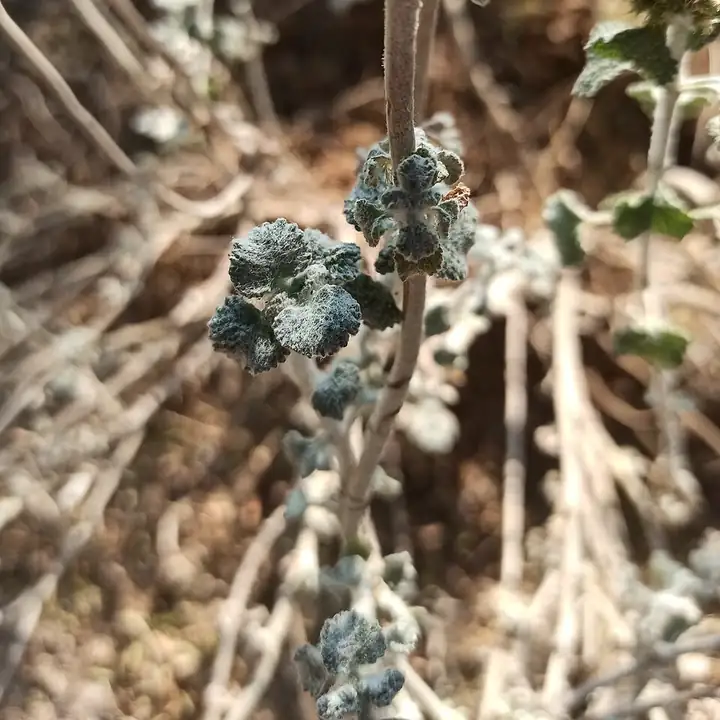
Horehound
Marrubium vulgare · Mint family (Lamiaceae)
| Hardiness zones | 3 to 9 |
|---|---|
| Sun | full sun |
| Water | low |
| Life cycle | perennial |
| Frost | Hardy: takes frost |
| Spacing | 12 inches |
About Horehound
Horehound is a tough, woolly, gray-green mint-family perennial, 1 to 3 feet tall, with crinkled leaves and whorls of small white flowers that bees love (NC State, NMSU). It is best known as the bitter flavor in old-fashioned horehound candy and cough drops. It spreads by seed and can turn weedy: Cal-IPC lists it as invasive in California, where it fills disturbed ground, and it forms dense stands in Arizona and New Mexico, so cut it back before seeds ripen.
NC State lists zones 3-9. Listed as an invasive or troublesome weed (advisory, not a ban) in California, Arizona and New Mexico; don't let it go to seed near wild land.
When to plant
Timing is counted from your average last spring frost (and first fall frost). Sow & Tell works out the actual dates for your ZIP code.
Sow seed in early spring, or start new plants from divisions or cuttings (Missouri, UGA). Plants reach full size in 2 to 5 years (NC State).
Soil
Dry, sandy, well-drained soil; it tolerates poor and alkaline soil (NC State, Missouri, NMSU).
Plant in dry, sandy, well-drained soil; no fertilizer is needed, since it thrives in poor ground.
Feeding
Don't let it drop seed: cut it back after flowering, which also brings a second flush of leaves, so it doesn't turn weedy.
Harvest
Cut leaves and small stems just before or as the plant starts to flower, and use them fresh or dried; cutting back after bloom usually brings a second flush of leaves (Missouri, NC State).
Cut leaves and stems as it starts to bloom; cutting it back after flowering usually brings a second flush of leaves and keeps it from seeding.
Good neighbors
NC State calls horehound a good companion near tomatoes but gives no reason or study, so treat it as garden lore.
In the kitchen
Very bitter; used mostly to flavor hard candy and lozenges, and also in teas and homemade ale (NC State, Missouri, NMSU).
Keeping it: Dried leaves keep in airtight containers away from heat and light.
Safety: Europe's medicines agency says horehound medicines aren't recommended for children under 12 or in pregnancy or breastfeeding, since safety hasn't been shown, and shouldn't be used by people allergic to mint-family plants or with liver or bile-duct disease.
Pets: Not listed by the ASPCA.
Sources
- plants.ces.ncsu.edu
- extension.missouri.edu
- pubs.nmsu.edu
- fieldreport.caes.uga.edu
- ema.europa.eu
- ema.europa.eu
- cal-ipc.org
- azinvasiveplants.arizona.edu
- pubs.nmsu.edu
- aspca.org
Photo: Photo: Juan Carlos Fonseca Mata, CC BY-SA 4.0, via Wikimedia Commons (CC BY-SA 4.0). Photo resized for the web.

Planting dates and advice are general guidance; check with your local Cooperative Extension office for your area.