
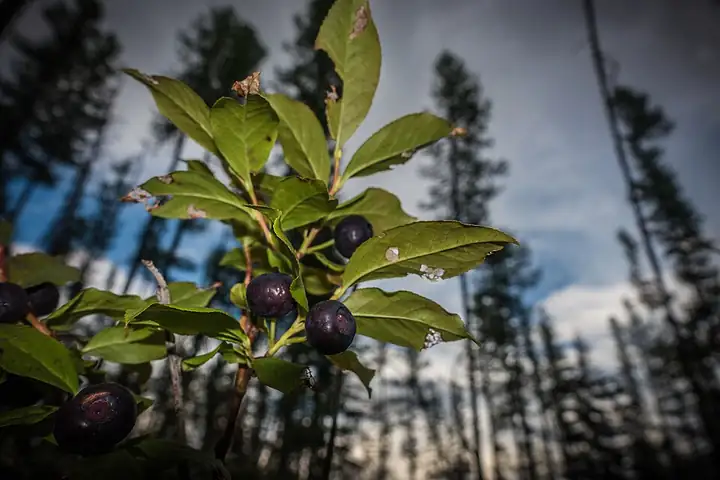
Huckleberry (western mountain huckleberry)
Vaccinium membranaceum (black, thinleaf or mountain huckleberry) and kin such as Cascade huckleberry (V. deliciosum) · Heath family (Ericaceae)
| Hardiness zones | 4 to 8 |
|---|---|
| Sun | full sun to part shade |
| Water | high |
| Life cycle | perennial |
| Frost | Hardy: takes frost |
| Soil pH | 4.0–5.5 |
| Spacing | 36 inches |
About Huckleberry (western mountain huckleberry)
Western huckleberries are native mountain shrubs with sweet, dark purple to black berries prized by people and bears alike. They are fussy and slow in gardens: they need acidic, moist, well-drained soil, and full crops can take 10-15 years.
Rated for zones 4-8; wild plants do best where snow covers them all winter and it stays above about 0 F, and blossoms are hurt below about 28 F (University of Idaho). A native shrub with no noxious or invasive listing in USDA PLANTS.
When to plant
Timing is counted from your average last spring frost (and first fall frost). Sow & Tell works out the actual dates for your ZIP code.
Set out potted plants in spring or fall, about 3 feet apart in rows 8-10 feet apart, and mulch with about 4 inches of sawdust or fine bark (University of Idaho). Expect light picking 1-3 years after planting and full crops only after 10-15 years (University of Idaho).
Soil
Well-drained sandy loam rich in organic matter; plants do not tolerate drought and often die after wilting badly, so keep the soil evenly moist but not waterlogged (University of Idaho).
Plant in well-drained sandy loam with plenty of organic matter at a pH of about 4.0-5.5, and mulch with about 4 inches of sawdust or fine bark.
Feeding
- Second year: start of May, June and July: balanced fertilizer such as 10-10-10, or composted manure. About 6 oz of 10-10-10 (or 7.5 lb composted cow manure) per plant for the year, split into three equal feedings.
- Third year: start of May, June and July: balanced fertilizer such as 10-10-10, or composted manure. About 8 oz of 10-10-10 (or 10 lb composted cow manure) per plant for the year, split into three equal feedings.
- Fourth year on: start of May, June and July: balanced fertilizer such as 10-10-10, or composted manure. About 10 oz of 10-10-10 (or 12.5 lb composted cow manure) per plant for the year, split into three equal feedings.
Don't overfertilize or let plants wilt, since huckleberries don't tolerate drought; skip pruning young plants except to remove dead or damaged branches.
Harvest
Berries ripen in late July or August (USDA NRCS). Pick them when fully ripe but before they shrivel; the skins tear more easily than blueberry skins (University of Idaho).
Huckleberries give one crop a year, usually picked in late July or August.
Pests to watch for
Deer, Birds
Diseases and problems
Mummy berry
In the kitchen
Eaten fresh, baked into pancakes, pies and muffins, or canned, frozen and made into jam and jelly (USDA NRCS).
Keeping it: Skins tear easily, so refrigerate berries right after picking and use or freeze them soon.
Safety: No toxic parts are noted in the USDA NRCS plant guide or the US Forest Service species review.
Pets: Not listed as toxic by the ASPCA
Sources
Photo: Photo: GlacierNPS / Wikimedia Commons, Public domain. Photo resized for the web.

Planting dates and advice are general guidance; check with your local Cooperative Extension office for your area.