
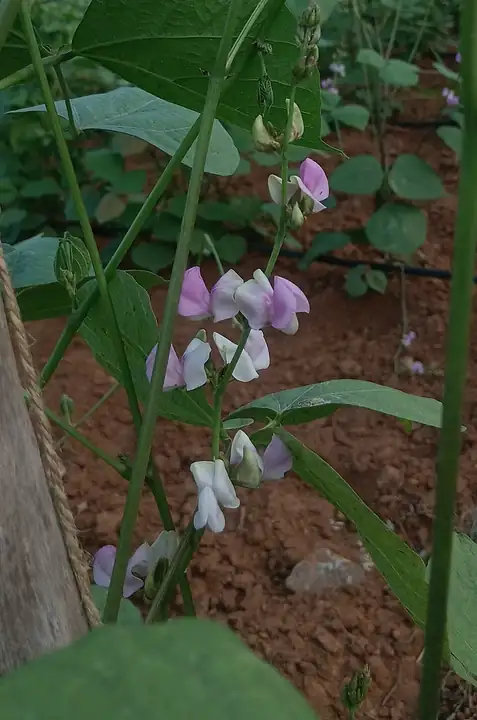
Hyacinth bean
Lablab purpureus (syn. Dolichos lablab) · Pea family (Fabaceae)
| Hardiness zones | 10 to 11 |
|---|---|
| Sun | full sun |
| Water | moderate |
| Life cycle | annual |
| Frost | Tender: killed by frost |
About Hyacinth bean
Hyacinth bean is a vigorous twining bean from tropical Africa grown for spikes of fragrant purple, pink or white pea flowers, purple-tinged leaves and shiny, flat purple pods. It can cover a sturdy trellis or arbor in one summer, handles heat and humidity, and draws hummingbirds and butterflies (NC State, Clemson). Don't eat the beans: the dried seeds are poisonous.
Grown as a warm-season annual everywhere in the US; NC State lists it for zones 10-11. UF/IFAS rates its invasion risk in Florida as low.
When to plant
Timing is counted from your average last spring frost (and first fall frost). Sow & Tell works out the actual dates for your ZIP code.
- Sow seeds outdoors: up to 2 weeks after the last frost
Soak seeds in warm water for a day or two, then sow them about 1/2 inch deep beside a strong support after frost, once the soil has warmed (around early May in Iowa and South Carolina) (Iowa State, Clemson, NC State). Clemson notes May-sown plants start blooming in late June; no sourced day count from sowing.
Soil
Light, moist, well-drained soil (NC State, Iowa State).
Light, moist, well-drained soil in full sun; set up a sturdy trellis before sowing (NC State, Iowa State).
Feeding
Don't skimp on support: the heavy vines need a strong trellis (NC State). We found no extension feeding schedule; as a legume it fixes its own nitrogen (NC State).
Harvest
Blooms from late June or midsummer until frost, followed by glossy purple pods (Clemson, Iowa State). Cut flower spikes for the vase (NC State). Young, tender pods can be picked for cooking.
Varieties (5)
Extension sources document 5 hyacinth bean cultivars.
| Variety | Type | Days | Notes |
|---|---|---|---|
| Alba | Lablab purpureus | Vigorous, white-flowered, and holds up in summer heat. | |
| Giganteus | Lablab purpureus | Robust, with big tropical-looking leaves and purple flowers. | |
| Ruby Moon | Lablab purpureus | Purple leaves with purple flowers and pods. | |
| Rudy Ruby | Lablab purpureus | Dark burgundy leaves. | |
| Silver Moon | Lablab purpureus | White flowers. |
In the kitchen
Young, tender pods are eaten cooked; the purple color fades to green in the pot (Iowa State, UConn). Don't eat the beans: mature dried seeds contain a cyanogenic glycoside (NC State).
Safety: Mature dried seeds contain a cyanogenic glycoside and are poisonous raw (NC State: low severity, mainly in large amounts); symptoms can include weakness, vomiting, trouble breathing and convulsions. Never eat the beans raw, and keep dried pods away from children.
Pets: Not listed by the ASPCA. Because the dried seeds contain a cyanogenic glycoside (NC State), keep pets from chewing pods and seeds.
Sources
- plants.ces.ncsu.edu
- hgic.clemson.edu
- yardandgarden.extension.iastate.edu
- homegarden-cahnr.media.uconn.edu
- planttalk.colostate.edu
- assessment.ifas.ufl.edu
- aspca.org
- aspca.org
- aspca.org
Photo: Photo: சு.பத்மா / Wikimedia Commons, CC BY-SA 4.0 (CC BY-SA 4.0). Photo resized for the web.

Planting dates and advice are general guidance; check with your local Cooperative Extension office for your area.