
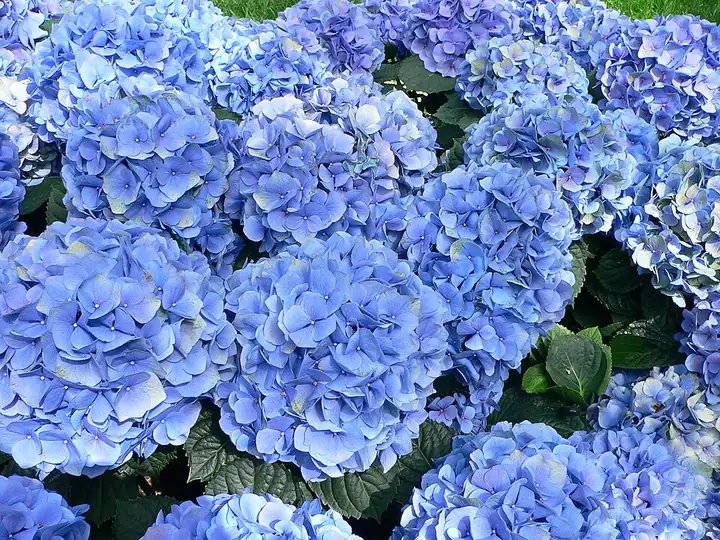
Hydrangea
Hydrangea macrophylla (bigleaf: mophead and lacecap), H. arborescens (smooth), H. quercifolia (oakleaf), H. serrata (mountain) · Hydrangea family (Hydrangeaceae)
| Hardiness zones | 3 to 9 |
|---|---|
| Sun | part shade |
| Water | high |
| Life cycle | perennial |
| Frost | Hardy: takes frost |
| Soil pH | 5.0–6.5 |
About Hydrangea
Hydrangeas are deciduous shrubs grown for big clusters of summer flowers. Bigleaf hydrangeas come as mopheads (round balls) or lacecaps (a flat center of tiny fertile flowers ringed by showy ones), and their flowers turn blue in acid soil and pink in less acid soil. Smooth hydrangea (like 'Annabelle') and oakleaf hydrangea are native to the eastern and southeastern US, and mountain hydrangea is a smaller, hardier cousin of bigleaf. Panicle hydrangeas, often sold as hydrangea trees, have their own entry.
Smooth hydrangea is hardy in zones 3-9 and oakleaf to about zone 5 (NC State); mountain hydrangea suits zones 6-9. Bigleaf plants live in colder areas, but Penn State notes their flower buds or stems often freeze there, so they may not bloom.
When to plant
Timing is counted from your average last spring frost (and first fall frost). Sow & Tell works out the actual dates for your ZIP code.
Plant container shrubs in a hole two to three times as wide as the root ball (Clemson). UGA suggests working compost 8-12 inches deep and mulching 3-5 inches with pine straw, bark or leaves. Color: for blue bigleaf flowers keep the pH about 5.0-5.5; for pink, about 6.0-6.5 or higher; always soil test before adding sulfur or lime (Clemson, UA, Penn State).
Soil
Moist, well-drained soil rich in organic matter; give bigleaf types morning sun and afternoon shade and avoid hot, exposed spots (Clemson HGIC, UGA).
Work in composted organic matter (UGA suggests about 50 lb per 10 sq ft, mixed 8-12 inches deep) and test the soil; for blue bigleaf flowers aim for pH 5.0-5.5, for pink about 6.0 or higher.
Feeding
- March (early spring): balanced fertilizer such as 8-8-8 or 10-10-10. About 1 lb (2 cups) per 100 sq ft spread under the plants, then water it in (Clemson, UGA); follow a soil test.
- May: balanced fertilizer such as 8-8-8 or 10-10-10. Same rate, about 2 cups per 100 sq ft; water in.
- July: balanced fertilizer such as 8-8-8 or 10-10-10. Same rate; this is the last feeding of the year.
- Spring, only if you want to shift bigleaf color (March-May): sulfur or aluminum sulfate for blue; dolomitic or hydrated lime for pink. UGA: about 1/2 cup wettable sulfur or 1 cup dolomitic lime per 10 sq ft, or a drench of 1 Tbsp aluminum sulfate (or hydrated lime) per gallon of water; changes can take a year. Test soil first.
Too much nitrogen gives leaves but few flowers (Clemson, UGA). For blue flowers avoid high-phosphorus fertilizer (Penn State). Don't prune bigleaf, oakleaf or mountain types after August 1 or you cut off next year's buds.
Harvest
Bigleaf hydrangeas bloom in summer, smooth hydrangea from late June into September, and oakleaf from late spring to early summer (Clemson). Pruning depends on type: bigleaf, oakleaf and mountain bloom on old wood, so prune them right after flowering and before August 1; smooth hydrangea blooms on new wood and can be cut back hard in late winter or early spring; rebloomers like Endless Summer flower on old and new wood (UMD, UMN, UGA).
Varieties (25)
| Variety | Type | Days | Notes |
|---|---|---|---|
| Lemon Daddy | Bigleaf hydrangea (H. macrophylla) | Grown for chartreuse leaves. | |
| Pia | Bigleaf hydrangea (H. macrophylla) | Dwarf, about 2-3 ft tall and wide. | |
| Todi | Bigleaf hydrangea (H. macrophylla) | Compact and cold-hardy. | |
| Blue Wave | Bigleaf hydrangea (H. macrophylla), lacecap | Lacecap, 6-7 ft tall. | |
| Fasan (Twilight) | Bigleaf hydrangea (H. macrophylla), lacecap | One of the Swiss-bred Teller lacecaps. | |
| All Summer Beauty | Bigleaf hydrangea (H. macrophylla), mophead | Compact, 3-4 ft; blooms again later in the season. | |
| Hamburg | Bigleaf hydrangea (H. macrophylla), mophead | Good for dried arrangements. | |
| Nikko Blue | Bigleaf hydrangea (H. macrophylla), mophead | Mophead, 4-6 ft tall; blue in acid soil. | |
| Penny Mac | Bigleaf hydrangea (H. macrophylla), mophead | Reblooms on old and new wood. | |
| Endless Summer series | Bigleaf hydrangea (H. macrophylla), reblooming | Flowers on both old and new wood, so it blooms even after a hard winter or a pruning mistake. | |
| Annie's Blue | Mountain hydrangea (H. serrata) | ||
| Blue Billow | Mountain hydrangea (H. serrata), lacecap | About 3 ft tall with blue lacecap flowers. | |
| Alice | Oakleaf hydrangea (H. quercifolia) | ||
| Little Honey | Oakleaf hydrangea (H. quercifolia) | Golden leaves. | |
| Munchkin | Oakleaf hydrangea (H. quercifolia) | Compact, about 3 ft tall and 4.5 ft wide; 6.5-inch clusters turn from white to medium pink. | |
| Pee Wee | Oakleaf hydrangea (H. quercifolia) | Compact oakleaf. | |
| Ruby Slippers | Oakleaf hydrangea (H. quercifolia) | Compact, about 3.5 ft tall and 5 ft wide; upright 9-inch clusters open white and quickly turn pale pink, then rose. | |
| Snow Queen | Oakleaf hydrangea (H. quercifolia) | White flower clusters on a large shrub; bronze fall leaves. | |
| Snowflake | Oakleaf hydrangea (H. quercifolia) | Double-flowered oakleaf. | |
| Annabelle | Smooth hydrangea (H. arborescens) | Huge white snowball heads up to about 12 inches that start green; flowers last 6-8 weeks. Stems can flop. | |
| Bella Anna | Smooth hydrangea (H. arborescens) | Pink-flowered smooth hydrangea. | |
| Hayes Starburst | Smooth hydrangea (H. arborescens) | ||
| Incrediball | Smooth hydrangea (H. arborescens) | ||
| Invincibelle Spirit | Smooth hydrangea (H. arborescens) | The first pink 'Annabelle'-type smooth hydrangea; color holds even in acid soil; as cold-hardy as 'Annabelle'. | |
| Haas' Halo | Smooth hydrangea (H. arborescens), lacecap | Lacecap-style white flowers. |
Pests to watch for
Aphids, Rose chafer, Twospotted spider mite, Scale insects
Diseases and problems
Hydrangea leaf spot, Anthracnose, Powdery mildew, Bacterial wilt, Rust, Bud blight, Black walnut toxicity, Soil pH problems
In the kitchen
Keeping it: Cut hydrangeas wilt fast out of water, so carry a bucket to the garden. Keep the vase cool, change the water every couple of days, and recut stems; fresh blooms last about a week.
Safety: NC State lists hydrangeas as poisonous to people, with low severity; don't eat any part. The leaves contain a cyanogenic glycoside (ASPCA).
Pets: Toxic to dogs, cats and horses (ASPCA): a cyanogenic glycoside causes vomiting, diarrhea and depression; true cyanide poisoning is rare.
Sources
- hgic.clemson.edu
- fieldreport.caes.uga.edu
- uaex.uada.edu
- extension.psu.edu
- extension.umd.edu
- extension.umn.edu
- plants.ces.ncsu.edu
- plants.ces.ncsu.edu
- plants.ces.ncsu.edu
- plants.ces.ncsu.edu
- chicagobotanic.org
- aspca.org
- aspca.org
Photo: Photo: Raul654, CC BY-SA 3.0, via Wikimedia Commons (CC BY-SA 3.0). Photo resized for the web.

Planting dates and advice are general guidance; check with your local Cooperative Extension office for your area.