
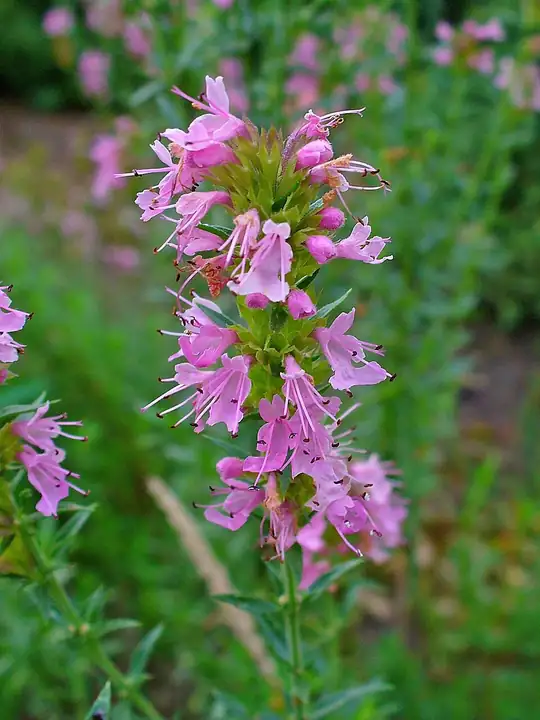
Hyssop
Hyssopus officinalis · Mint family (Lamiaceae)
| Hardiness zones | 4 to 9 |
|---|---|
| Sun | full sun to part shade |
| Water | low |
| Life cycle | perennial |
| Frost | Hardy: takes frost |
| Spacing | 12 to 36 inches |
About Hyssop
Hyssop is a short-lived, shrubby herb from Europe and Asia with narrow, aromatic leaves and spikes of blue-purple flowers (pink and white forms exist). It blooms from summer into fall and is a favorite of bees, butterflies and hummingbirds. It is not the same plant as anise hyssop (Agastache).
NC State lists hyssop as hardy in zones 4-9.
When to plant
Timing is counted from your average last spring frost (and first fall frost). Sow & Tell works out the actual dates for your ZIP code.
Sow seed in spring, or start new plants from divisions or stem cuttings (MU Extension). Plants grow about 1.5-2 feet tall and up to 1.5 feet wide (NC State). Cut plants back in spring to keep them bushy (MU Extension).
Soil
Well-drained loam, sandy or rocky soil that can run dry; it prefers neutral to alkaline soil (NC State).
Choose a sunny, well-drained spot; herbs grow best at a pH of about 6.0-7.5 and in soil that is not overly fertile. Working in about 4 inches of compost improves soil structure. Follow a soil test.
Feeding
- once per growing season, in spring as new growth starts: complete fertilizer such as 5-10-5. Scatter about 3 oz per 10 feet of row beside the plants and water it in; that single feeding is enough for garden herbs.
Avoid heavy clay, soggy soil and overly fertile sites; most herbs do not need rich soil.
Harvest
Pick the youngest leaves and shoot tips as you need them, and pick flowers when they open (MU Extension, NC State).
Pick the youngest leaves as you need them through the season; perennial herbs like this can be cut back by about half their height and will regrow.
Varieties (3)
Hyssop is mostly sold by flower color. NC State and the Royal Horticultural Society describe only 3 named forms: white, pink, and the dwarf rock hyssop.
| Variety | Type | Days | Notes |
|---|---|---|---|
| Rock hyssop (subsp. aristatus) | Dwarf subspecies | Dense, upright, semi-evergreen sub-shrub with narrow aromatic leaves and slender spikes of blue flowers. Very cold hardy; good for rock, gravel and container gardens. | |
| Alba | Flower color form | White flowers on a bushy plant about 1.5-2 ft tall and 1-1.5 ft wide. | |
| Rosea | Flower color form | Pink flowers on a bushy plant about 1.5-2 ft tall and 1-1.5 ft wide. |
In the kitchen
Young leaves and shoot tips are eaten raw in salads or used to flavor soups and stews, and the flowers are edible, with a taste like tonic water (NC State, UMN). Its oil flavors liqueurs, and the FDA lists hyssop as a generally recognized as safe flavoring.
Keeping it: Pick young leaves and shoot tips as you need them; dry extras for later.
Safety: Use the leaves and flowers only in food amounts. Hyssop essential oil is a known seizure trigger in medical reports, so never swallow the oil (Burkhard et al., 1999; Millet et al., 1981).
Pets: Not listed by the ASPCA
Sources
- plants.ces.ncsu.edu
- extension.missouri.edu
- extension.umn.edu
- ecfr.gov
- pubmed.ncbi.nlm.nih.gov
- aspca.org
- aspca.org
- plantsservices.sc.egov.usda.gov
- extension.umn.edu
Photo: Photo: H. Zell / Wikimedia Commons, CC BY-SA 3.0 (CC BY-SA 3.0). Photo resized for the web.

Planting dates and advice are general guidance; check with your local Cooperative Extension office for your area.