
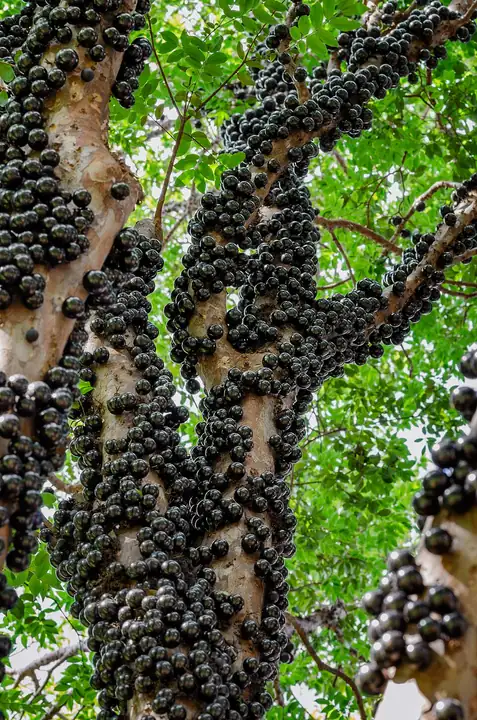
Jaboticaba
Plinia cauliflora (syn. Myrciaria cauliflora) and related Plinia and Myrciaria species · Myrtle family (Myrtaceae)
| Hardiness zones | 9 to 11 |
|---|---|
| Sun | full sun to part shade |
| Water | high |
| Life cycle | perennial |
| Frost | Tender: killed by frost |
| Soil pH | 5.0–6.0 |
| Spacing | 120 inches |
About Jaboticaba
Jaboticaba, the Brazilian grape tree, is a slow-growing evergreen from southeastern Brazil that bears grape-like purple-black fruit right on its trunk and branches. The thick, tart skin hides sweet, juicy white flesh. It is grown by hobbyists in Florida, California and Hawaii, often for years in a big pot.
UF/IFAS lists zones 9a-11 in its grower guide but recommends it for south Florida only (zones 10a-11b) in home landscapes; long spells below about 28 F cause damage, so give it a warm spot such as a south- or east-facing wall. UF/IFAS assessed it as non-invasive in Florida.
When to plant
Timing is counted from your average last spring frost (and first fall frost). Sow & Tell works out the actual dates for your ZIP code.
Seedlings take 8-10 years to fruit, while grafted or air-layered trees fruit within a few years and hybrid seedlings ('Red Hybrid', 'Scarlet') in about 3-5 (UF/IFAS). Trees can be planted at any size; space them about 10 ft apart and keep them away from driveways and walks, since fallen fruit stains (UF/IFAS). No source ties planting to a frost date.
Soil
Acidic, sandy or loamy soil that stays moist but drains well; it has poor drought tolerance and doesn't take salt, and high-pH soils need acidifying or a container (UF/IFAS).
Work in acidic organic matter such as pine bark, peat or oak-leaf compost; on high-pH soil, add elemental sulfur with gypsum or acidic compost twice a year to lower the pH slowly, and mulch (UF/IFAS).
Feeding
- About three times a year, outside the June-September rainy season: Slow-release organic fertilizer such as 4-3-4 with calcium, magnesium and sulfur. Use the label rate; UF/IFAS has no official rate and suggests following mango guidance (UF/IFAS).
- When new leaves turn yellow between green veins: Chelated iron. Apply as a leaf spray or soil drench as needed (UF/IFAS).
Jaboticaba burns easily from nitrogen and salty fertilizers, and too much nitrogen invites aphids, scale and mealybugs; never let it dry out (UF/IFAS).
Harvest
Fruit ripens only 25-45 days after bloom, with the main crop from February through May in Florida and smaller crops at other times. Pick within a few days of turning fully purple-black (or red or yellow, depending on the type); it spoils in 1-2 days at room temperature (UF/IFAS).
Fruit ripens only 25-45 days after bloom, and trees can flower and fruit several times a year, with the main crop February-May in Florida. Steady moisture and pruning that lets light reach the trunk help it bloom.
Varieties (13)
UF/IFAS lists 13 jaboticaba types grown in Florida, several of them separate Plinia or Myrciaria species; flavor is described for only a few.
| Variety | Type | Days | Notes |
|---|---|---|---|
| Red Hybrid | Hybrid (P. cauliflora x P. aureana) | Large, plump red fruit with mild, sweet, juicy, low-acid flesh. Hybrid seedlings may fruit in 3-5 years; fruits well in a container. | |
| Yellow (Cabeluda) | Myrciaria glazioviana | A related yellow-fruited species. | |
| Blue | Myrciaria vexator | A related species. | |
| White | P. aureana | Pale green fruit with a sweet flavor. Listed by UF/IFAS among jaboticaba types grown in Florida. | |
| Paulista | P. cauliflora | Listed by UF/IFAS among jaboticaba types grown in Florida. | |
| Scarlet (Escarlate) | P. cauliflora | Red-fruited selection; hybrid seedlings may fruit in 3-5 years. | |
| Restinga | P. coronata | Listed by UF/IFAS among jaboticaba types grown in Florida. | |
| Cambuca | P. edulis | A related fruit sold with the jaboticabas. | |
| Pingo de Mel (Honey Drop) | P. jaboticaba | Studied for the antioxidants in its peel. | |
| Sabara | P. jaboticaba | Dark, juicy fruit with a grape-and-lychee flavor. Tolerant of root-knot nematodes. | |
| ESALQ | P. phitrantha | Listed by UF/IFAS among jaboticaba types grown in Florida. | |
| Otto Anderson Branco Vinho | P. phitrantha | Listed by UF/IFAS among jaboticaba types grown in Florida. | |
| Grimal | P. spirito-santensis | Listed by UF/IFAS among jaboticaba types grown in Florida. |
Pests to watch for
Birds, Tree squirrels, Aphids, Scale insects, Mealybugs, Whiteflies, Twospotted spider mite, Root-knot nematodes
Diseases and problems
Rust
In the kitchen
Eaten fresh by squeezing the pulp out of the skin, and made into juice, jam, smoothies, desserts, wine and liqueur (UF/IFAS).
Keeping it: Fruit spoils in 1-2 days at room temperature; refrigerate it in a vented container for 3-4 days, or freeze it promptly.
Safety: The fruit is eaten as a food; the thick skin is high in tannins, and many people spit it out. The sources we checked list no toxic parts, and we found no research-based guidance on pregnancy, drug interactions or allergies.
Pets: Not listed by the ASPCA
Sources
Photo: Photo: Bruno.karklis, CC BY-SA 4.0, via Wikimedia Commons (CC BY-SA 4.0). Photo resized for the web.

Planting dates and advice are general guidance; check with your local Cooperative Extension office for your area.