
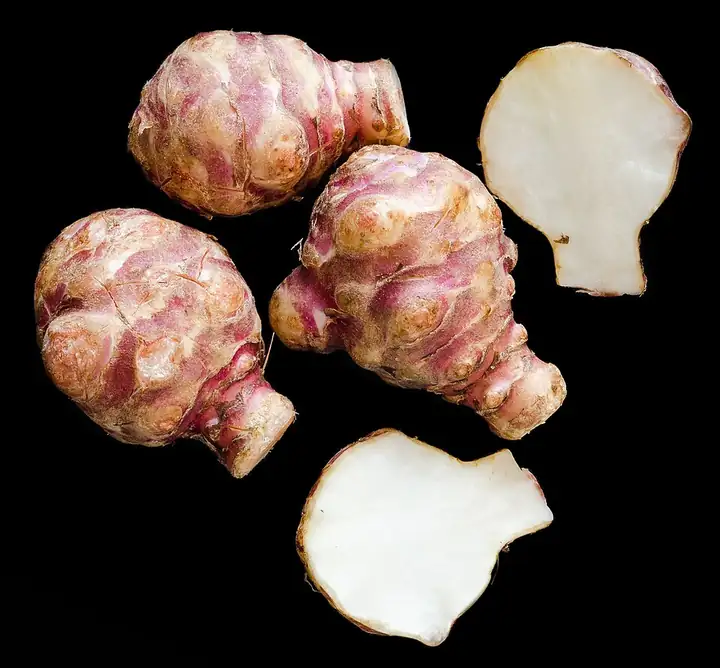
Jerusalem artichoke (sunchoke)
Helianthus tuberosus · Aster family (Asteraceae)
| Hardiness zones | 3 to 9 |
|---|---|
| Sun | full sun to part shade |
| Water | moderate |
| Life cycle | perennial |
| Frost | Hardy: takes frost |
| Soil pH | 6.0–7.5 |
| Spacing | 12 to 24 inches |
| Days to harvest | 120 days |
| Soil temperature to plant | at least 43°F |
About Jerusalem artichoke (sunchoke)
Jerusalem artichoke is a native North American sunflower grown for its knobby, nutty tubers, eaten raw like water chestnuts or cooked like potatoes. It isn't an artichoke and has nothing to do with Jerusalem. Plants grow 6 to 10 feet tall with small yellow flowers in late summer, and they spread hard: any bit of tuber left in the soil sprouts, so plant it where it can't take over, or in a big container. The California Invasive Plant Council has it on its Watch list (advisory); we found no state that bans it.
Hardy perennial in zones 3-9; tops die to the ground each winter and regrow from tubers. It spreads by tubers and rhizomes, and Cal-IPC lists it on its Watch list in California (advisory, not a law).
When to plant
Timing is counted from your average last spring frost (and first fall frost). Sow & Tell works out the actual dates for your ZIP code.
Days count from planting tubers (Oregon State gives about 120 days); tubers fill out late in the season as weather cools. Plant 2-ounce tuber pieces with 2 or more eyes, 3 to 6 inches deep, as soon as the soil can be worked in spring (Ohio: late April to mid-May, soil about 43-45F), or in fall when soil is in the low 40s.
Soil
Loose, fertile, well-drained soil; it grows in almost any soil, but soggy clay lowers yields and rots tubers.
Loosen the soil and work in organic matter; follow a soil test for fertilizer.
Feeding
- Every 2 to 4 weeks through the growing season: balanced fertilizer such as 20-20-20. Ohio State suggests a balanced feed every two weeks to monthly, and extra if leaves yellow or growth stalls; water regularly and mulch with straw.
Don't leave tuber pieces in beds where you don't want them; any piece left behind sprouts next spring.
Harvest
Dig tubers after frost has killed the tops; later digs are sweeter. Where the ground doesn't freeze hard, leave them in the soil and dig as needed through winter. Hunt carefully for every tuber if you don't want plants back next year.
Dig tubers each fall after frost, or as needed through winter where the ground doesn't freeze. Tubers left in the soil come back next year, so leave a few near the stems if you want another crop.
Varieties (11)
Extension sources document 11 sunchoke varieties, several with few details; many are sold only as 'red' or 'white'.
| Variety | Type | Days | Notes |
|---|---|---|---|
| Beaver Valley | Red-skinned | Red tubers; in a 2024 Ohio trial it grew about 6.5 ft and gave 42 tubers (about 1.9 lb) per plant; first bloom in July. | |
| Brazilian Red | Red-skinned | 120 days | Named by Oregon State among varieties taking about 120 days. |
| Jack's Copperclad | Red-skinned | Dark red tubers on shorter plants (about 3.7 ft in Ohio); about 45 tubers (1.1 lb) per plant; blooms in August. | |
| Smooth Garnet | Red-skinned | Red-skinned tubers. | |
| Brazilian White | White-skinned | 120 days | Named by Oregon State among varieties taking about 120 days. |
| Dwarf Sunray | White-skinned | White tubers; despite the name it reached about 8 ft in the Ohio trial, with about 178 tubers (16.3 lb) per plant; blooms June to July. | |
| French Mammoth White | White-skinned | 120 days | The best-known variety in Florida. |
| Supernova | White-skinned | White tubers; about 8 ft tall in Ohio with about 195 tubers (13.6 lb) per plant; blooms June to July. | |
| White Fuseau | White-skinned | Long tubers about 1 in thick; the top yielder in the Ohio trial at about 225 tubers (17.4 lb) per plant on 8-ft plants; blooms August to September. | |
| Golden Nugget | A good slicing type. | ||
| Stampede | 120 days | Named by Oregon State among varieties taking about 120 days. |
Pests to watch for
Slugs
Diseases and problems
Rust, Leaf spot, Powdery mildew
In the kitchen
Scrub (no need to peel) and eat raw in salads, use in stir-fries in place of water chestnuts, or roast, mash, make chips or add to soups.
Keeping it: Refrigerate tubers in a sealed plastic bag; they keep only a couple of weeks, so where the ground doesn't freeze, leave them in the soil and dig as needed.
Safety: The tubers are rich in inulin, a fiber that can cause gas if you eat a lot at once; start with small helpings (Clemson Extension).
Pets: Not listed by the ASPCA
Sources
- plants.ces.ncsu.edu
- horticulture.oregonstate.edu
- ohioline.osu.edu
- ohioline.osu.edu
- hgic.clemson.edu
- site.extension.uga.edu
- extension.missouri.edu
- aggie-horticulture.tamu.edu
- edis.ifas.ufl.edu
- cal-ipc.org
- aspca.org
- aspca.org
- aspca.org
Photo: Photo: BastienM / Wikimedia Commons, CC BY-SA 3.0 (CC BY-SA 3.0). Photo resized for the web.

Planting dates and advice are general guidance; check with your local Cooperative Extension office for your area.