
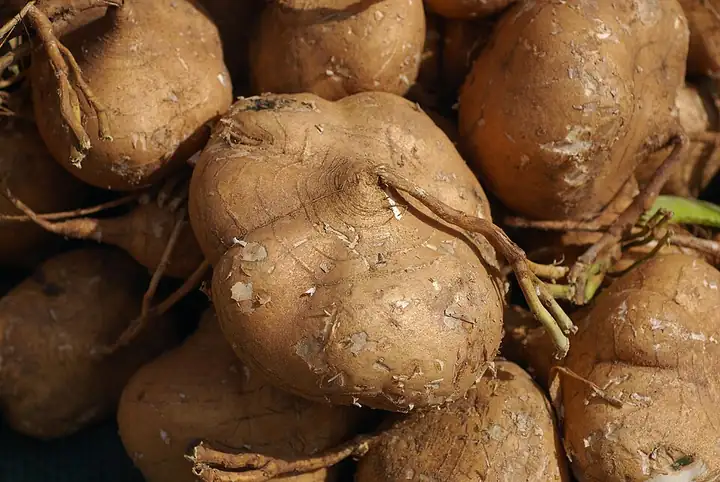
Jicama
Pachyrhizus erosus · Pea family (Fabaceae)
| Hardiness zones | 5 to 11 |
|---|---|
| Sun | full sun |
| Water | moderate |
| Life cycle | tender perennial (grown as an annual) |
| Frost | Tender: killed by frost |
| Soil pH | 6.5–8.0 |
| Spacing | 8 to 12 inches |
| Days to harvest | 90 to 150 days |
| Soil temperature to plant | at least 50°F |
About Jicama
Jicama (yam bean) is a climbing bean-family vine from Mexico grown for its crisp, mildly sweet, white-fleshed root, a favorite snack with lime and chili. ONLY THE ROOT IS EDIBLE: the leaves, stems, flowers, pods and seeds are poisonous, and mature seeds are rich in rotenone, a natural insecticide. Roots form best under short days and a long, warm season, so most U.S. gardens get small roots of 1 to 2 pounds.
Grown as a frost-tender annual. It needs a long, warm season: seed-grown plants take 5 to 9 months in Florida, and UC ANR notes that U.S. plantings outside south Florida often make vines, flowers and pods but only small or fibrous roots; Utah State gets 1-2 lb roots from early transplants.
When to plant
Timing is counted from your average last spring frost (and first fall frost). Sow & Tell works out the actual dates for your ZIP code.
- Start seeds indoors: 4 to 10 weeks before the last frost
- Set out plants: up to 2 weeks after the last frost
Days count from transplanting (Utah State: P. erosus types take 90-150 days, about 4 months for the root). Start seed indoors at about 80F, 4 to 10 weeks before the last frost, and plant out once frost danger is past and soil is above 50F. In Texas and Florida seed is sown outdoors in early spring. Rows 2 to 3 feet apart.
Soil
Well-drained sandy loam; use a raised bed 6 to 8 inches tall where drainage is poor. It tolerates somewhat acidic soil.
Test the soil and work any recommended fertilizer into the top 6 inches; add no more than about 1 inch of compost per 100 square feet.
Feeding
Jicama fixes its own nitrogen, so skip extra nitrogen: over-fertilizing gives big vines and smaller roots. Heavy watering in the last 2-3 weeks splits roots.
Harvest
Dig when the leaves yellow or after the first light frost damages them, but before the soil freezes; roots are edible at any size. Dig carefully with a spading fork so you don't cut or bruise them, and cut back watering 2 weeks before harvest to prevent cracking.
Roots are dug once, when the leaves yellow or after a light frost, before the soil freezes; they are edible at any size.
Varieties (2)
Jicama seed is sold by type rather than named variety; Extension sources describe two P. erosus types.
| Variety | Type | Days | Notes |
|---|---|---|---|
| Jicama de agua | P. erosus type | Top-shaped to flattened round root with clear, watery juice; the type sold in grocery stores and preferred for market. | |
| Jicama de leche | P. erosus type | Longer root with milky juice. |
Pests to watch for
Aphids
Diseases and problems
Bean common mosaic, Root and crown rot
In the kitchen
Peel and eat raw in sticks or slices with lime juice and chili powder, or dice into salads and salsas; it stays crisp when cooked, so it can stand in for water chestnuts in stir-fries.
Keeping it: Cure roots 1-2 weeks at about 80F, then keep them cool and dry at 55-60F for 3-4 months; Utah State warns not to refrigerate whole roots or store them below 50F (chilling injury). Wrap cut pieces and refrigerate them.
Safety: Eat only the root. The leaves, stems, flowers, pods and seeds are poisonous (Utah State, UF/IFAS), and mature seeds hold high levels of rotenone (UC ANR). Keep seeds and pods away from children and pets, and pinch off flowers as they appear, which also helps the root grow.
Pets: Not listed by the ASPCA (but the seeds, pods and vines are poisonous to people, so keep pets away from them too).
Sources
- digitalcommons.usu.edu
- gardeningsolutions.ifas.ufl.edu
- aggie-horticulture.tamu.edu
- sfp.ucanr.edu
- aspca.org
Photo: Photo: Eric in SF, CC BY-SA 3.0, via Wikimedia Commons (CC BY-SA 3.0). Photo resized for the web.

Planting dates and advice are general guidance; check with your local Cooperative Extension office for your area.